MCQ
Choose the correct answer. The equation of a circle with origin as centre and passing through the vertices of an equilateral triangle whose median is of length 3a is:
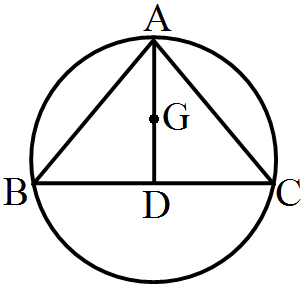
[Hint: Centroid of the triangle coincides with the centre of the circle and the radius of the circle is $\frac{2}{3}$ of the length of the mediam]
  • A
    $x^2+y^2=9 a^2$
  • B
    $x^2+y^2=16 a^2$
  • $x^2+y^2=4 a^2$
  • D
    $x^2+y^2=a^2$

Answer

Correct option: C.
$x^2+y^2=4 a^2$
  1. $x^2+y^2=4 a^2$
Solution:
Let ABC be an equilateral triangle in which mediam AD = 3a
Centre of the circle is same as the centroid of the triangle i.e., $(0, 0)$​​​​​​​

AG : GD = 2 : 1
So, $\text{AG}=\frac{2}{3}\text{AD}=\frac{2}{3}\times3\text{a}=2\text{a}$
$\therefore$ The equation of the circle is,
$(x - 0)^2 + (y - 0)^2= (2a)^2$
$\Rightarrow x^2 + y^2 = 4a^2$​​​​​​​

Need a full question paper?

Generate a complete, print-ready paper with questions like this in minutes — across 16+ boards, with answer keys.

Start Generating Free

Similar questions

The consecutive digits of a three digit number are in GP. If the middle digit be increased by 2, then they form an AP. If 792 is subtracted from this, then we get the number constituting of same three digits but in reverse order. Then, number is divisible by:
The number of values of $a \in N$ such that the variance of $3,7,12 a, 43-a$ is a natural number is  (Mean $=13$)
For the Hyperbola ${x^2}{\sec ^2}\theta - {y^2}cose{c^2}\theta = 1$ which of the following remains constant when $\theta $ varies $= ?$
Consider a rigid square $A B C D$ a s in the figure with $A$ and $B$ on the $X$ and $Y$-axes, respectively.

When $A$ and $B$ slide along their respective axes, the locus of $C$ forms a part of

The centres of a set of circles, each of radius $2$, lie on the circle. ${x^2} + {y^2} = 36$  The locus of any point in the set is -
The value of$^n{C_1}\sum\limits_{r = 0}^1 {^1{C_r}} { + ^n}{C_2}\left( {\sum\limits_{r = 0}^2 {^2{C_r}} } \right){ + ^n}{C_3}\left( {\sum\limits_{r = 0}^3 {^3{C_r}} } \right) + ......{ + ^n}{C_n}\left( {\sum\limits_{r = 0}^n {^n{C_r}} } \right)$ is equal to
The number of ways in which the letters of the word 'CONSTANT' can be arranged without changing the relative positions of the vowels and consonants is.
${11^2} + {12^2} + {13^2} + {.......20^2} = $
If ${}^n{P_5} = 20.\;{}^n{P_3}$, then $n = $
Let $P(n)=5^n-2^n \cdot P(n)$ is divisible by $3 \lambda$ where $\lambda$ and $n$ both are odd positive integers, then the least value of $n$ and $\lambda$ will be: