MCQ 11 Mark
If the equation $\frac{\lambda(\text{x}+1)^2}{3}+\frac{(\text{y}+2)^2}{4}=1$ represents a circle then $\lambda$:
- A
$1$
- ✓
$\frac{3}{4}$
- C
$0$
- D
$-\frac{3}{4}$
AnswerCorrect option: B. $\frac{3}{4}$
- $\frac{3}{4}$
Solution:
$\frac{\lambda(\text{x}+1)^2}{3}+\frac{(\text{y}+2)^2}{4}=1$
for a circle of a $(\text{x}-\alpha)^2+6 (\text{y}-\beta)^2=1$ then (a = 6)
$\frac{\lambda}{3}=\frac{1}{4}$
$\lambda=\frac{3}{4}$ View full question & answer→MCQ 21 Mark
The eccentricity of the ellipse, if the distance between the foci is equal to the length of the latus-rectum, is:
- ✓
$\frac{\sqrt{5}-1}{2}$
- B
$\frac{\sqrt{5}+1}{2}$
- C
$\frac{\sqrt{5}-1}{4}$
- D
$\text{none of these}$
AnswerCorrect option: A. $\frac{\sqrt{5}-1}{2}$
According to the question, the distance between the foci is equal to the length of the latus rectum.
$\frac{2\text{b}^2}{\text{a}}=2\text{ae}$
$\Rightarrow\text{b}^2=\text{a}^2\text{e}$
Now, $\text{e}=\sqrt{1-\frac{\text{b}^2}{\text{a}^2}}$
$\Rightarrow\text{e}=\sqrt{1-\frac{\text{a}^2\text{e}}{\text{a}^2}}$
$\Rightarrow\text{e}=\sqrt{1-\text{e}}$
On squaring both sides, we get:
$\text{e}^2\text{e}-1=0$
$\Rightarrow\text{e}=\frac{-1\pm\sqrt{1+4}}{2}$
$\Rightarrow\text{e}=\frac{\sqrt{5}-1}{2}$ $(\because\text{e}\text{ cannot be negative}\big)$
View full question & answer→MCQ 31 Mark
Find the equation of the circle. Centered at (3, -2) with radius 4:
- A
$x^2+y^2+6 x-4 y=3$
- ✓
$x^2+y^2-6 x+4 y=3$
- C
$x^2+y^2-3 x+2 y=-3$
- D
$x^2+y^2+3 x-2 y=-3$
AnswerCorrect option: B. $x^2+y^2-6 x+4 y=3$
View full question & answer→MCQ 41 Mark
The equation of ellipse whose one focus is at (4, 0) and whose eccentricity is $\frac{4}{5}$ is:
- A
$\frac{\text{x}^2}{5}+\frac{\text{y}^2}{9}=1$
- ✓
$\frac{\text{x}^2}{25}+\frac{\text{y}^2}{9}=1$
- C
$\frac{\text{x}^2}{9}+\frac{\text{y}^2}{5}=1$
- D
$\frac{\text{x}^2}{9}+\frac{\text{y}^2}{25}=1$
AnswerCorrect option: B. $\frac{\text{x}^2}{25}+\frac{\text{y}^2}{9}=1$
- $\frac{\text{x}^2}{25}+\frac{\text{y}^2}{9}=1$
View full question & answer→MCQ 51 Mark
The equation of the incircle formed by the coordinate axes and the line 4x + 3y = 6 is:
AnswerCorrect option: B. $4\left(x^2+y^2-x-y\right)+1=0$
- $4\left(x^2+y^2-x-y\right)+1=0$
Solution:
The line 4x + 3y = 6 cuts the coordinate axes at $\Big(\frac{3}{2},\ 0\Big)$ and (0, 2)
The coordinates of the incentre is $\Big(\frac{\text{ax}_1+\text{bx}_2+\text{cx}_3}{\text{a+b+c}},\ \frac{\text{ay}_1+\text{by}_2+\text{cy}}{\text{a+b+c}}\Big)$
Here, $\text{a}=\frac{5}{2},\ \text{b}=\frac{3}{2},\ \text{c}=2,\ \text{x}_1=0,\ \text{y}_1\\=0,\ \text{x}_2=0,\ \text{y}_2=2,\ \text{x}_3=\frac{3}{2},\ \text{y}_3=0$
Thus, the coordinates of the incentre:
$\Big(\frac{0+0+3}{6},\ \frac{0+3+0}{6}\Big)$
$=\big(\frac{1}{2},\ \frac{1}{2}\Big)$
The equation of the incircle:
$\Big(\text{x}-\frac{1}{2}\Big)^2+\Big(\text{y}-\frac{1}{2}\Big)^2=\text{a}^2$
Also, radius of the incircle $=\frac{\sqrt{\text{s}(\text{s}-\text{a})(\text{s}-\text{b})(\text{s}-\text{c})}}{\text{s}}$
Here, $\text{s}=\frac{\text{a+b+c}}{2}=\frac{\frac{5}{2}+\frac{3}{2}+2}{2}=3$
$\therefore$ Radius of the incircle $=\sqrt{\frac{3(3-\text{a})(3-\text{b}(3-\text{c}))}{3}}$
$=\frac{\sqrt{3\Big(3-\frac{5}{2}\Big)\Big(3-\frac{3}{2}\Big)(3-\text{c})}}{3}$
$=\frac{\sqrt{3\Big(3-\frac{1}{2}\Big)\Big(\frac{3}{2}\Big)}}{3}$
$=\frac{1}{2}$
The equation of circle:
$\Big(\text{x}-\frac{1}{2}\Big)^2+\Big(\text{y}-\frac{1}{2}\Big)^2=\frac{1}{4}$
$\Rightarrow4(\text{x}^2+\text{y}^2)-\text{x}-\text{y}+1=0$ View full question & answer→MCQ 61 Mark
If the centroid of an equilateral triangle is (1, 1) and its one vertex is (-1, 2), then the equation of its circumcircle is:
- ✓
$x^2+y^2-2 x-2 y-3=0$
- B
$x^2+y^2+2 x-2 y-3=0$
- C
$x^2+y^2+2 x+2 y-3=0$
- D
AnswerCorrect option: A. $x^2+y^2-2 x-2 y-3=0$
- $x^2+y^2-2 x-2 y-3=0$
Solution:
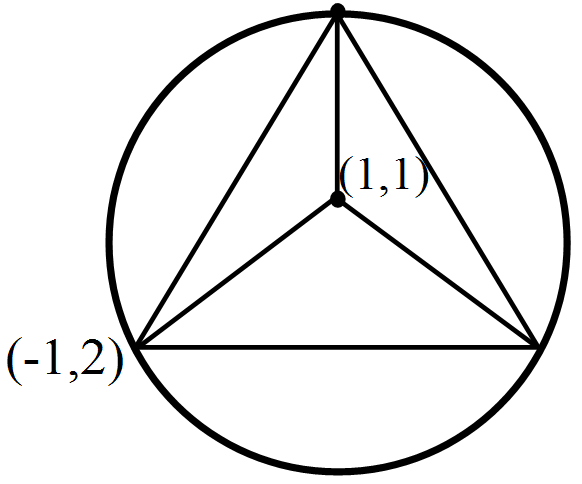
The centre of the circumcircle is (1, 1).
Radius of the circumcircle
$\therefore$ Equation of the circle: $=\sqrt{(1+1)^2+(1-2)^2}=\sqrt{5}$
$(x-1)^2+(y-1)^2=5$
$\Rightarrow x^2+y 2-2 x-2 y-3=0$ View full question & answer→MCQ 71 Mark
The line $2x - y + 4 = 0$ cuts the parabola $y^2 = 8x$ in $P$ and $Q$. The mid-point of $PQ$ is
Answer
- (-1, 2)
Solution:
Let the coordinates of P and Q be $\left(a \mathrm{t}_1{ }^2, 2 \mathrm{a} \mathrm{t}_1\right)$ and $\left(\mathrm{at}_2{ }^2, 2 \mathrm{a} \mathrm{t}_2\right)$, respectively.
Slope of $\mathrm{PQ}=\frac{2 \mathrm{at}_2-2 \mathrm{at}}{\mathrm{at}_2^2-\mathrm{at}_1^2} \ldots$(1)
But, the slope of $P Q$ is equal to the slope of $2 x-y+4=0$.
$\therefore$ Slope of $\mathrm{PQ}=\frac{-2}{-1}=2$
From (1),
$\frac{2 \mathrm{at}_2-2 \mathrm{a} t_1}{\mathrm{at}_2^2-\mathrm{at}_1^2}=2 \ldots$
Putting $4 a=8$,
$a=2$
$\therefore$ Focus of the given parabola $=(a, 0)=(2,0)$
Using equation (2):
$\frac{4\left(t_2-t_1\right)}{2\left(t_2^2-t_1^2\right)}=2$
$\frac{\left(t_2-t_2\right)}{\left(t_2^2-t_1^2\right)}=1$
$\Rightarrow t_1+t_2=1$
As, points $P$ and $Q$ lie on $2 x-y+4=0$
$\Rightarrow P\left(a t_1{ }^2, 2 a t_1\right) \text { or } P\left(2 t_1{ }^2, 4 t_1\right) \text { lie on line } 2 x-y+4=0$
$\Rightarrow 2\left(2 t_1{ }^2\right)-\left(4 t_1\right)+4=0$
$\Rightarrow t_1{ }^2-t_1+1=0 \ldots(3)$
Also, $Q\left(a t_2{ }^2, 2 a t_2\right)$ or $P\left(2 t_2{ }^2, 4 t_2\right)$ lie on line $2 x-y+4=0$
$\Rightarrow 2\left(2 t_2^2\right)-\left(4 t_2\right)+4=0$
$\Rightarrow t_2^2-t_2+1=0 \ldots(4)$
Adding (3) and (4), we get,
$\Rightarrow t_1^2-t_1+1+t_2{ }^2-t_2+1=0$
$\Rightarrow\left(t_1^2+t_2^2\right)-\left(t_1+t_2\right)+2=0$
$\Rightarrow\left(t_1^2+t_2^2\right)-1+2=0\left[t_1+t_2=1, \text { proved above }\right]$
$\Rightarrow\left(t_1^2+t_2{ }^2\right)=-1$
Let $\left(x_1, y_1\right)$ be the mid-point of PQ.
Then, we have:
$\mathrm{y}_1=\frac{2 \mathrm{a} t_2+2 \mathrm{a} t_1}{2}=2\left(\mathrm{t}_1+\mathrm{t}_2\right)=2$
$\text { And, } \mathrm{x}_1=\frac{a \mathrm{t}_1^2+a \mathrm{t}_2^2}{2}=\mathrm{t}_1^2+\mathrm{t}_2^2=-1$
$\Rightarrow\left(\mathrm{x}_1, \mathrm{y}_1\right)=(-1,2)$ View full question & answer→MCQ 81 Mark
The circle $x^2+y^2-3 x-4 y+2=0$ cuts x-axis:
Answer
- (1, 0), (2, 0)
Solution:
$x^2+y^2-3 x-4 y+2=0$
$x \text {-axis will be cut when } y=0$
$\text { put } y=0$
$x^2-3 x+2=0$
$(x-2)(x-1)=0$
$x=1,2$
$\text { points }(1,0),(2,0)$ View full question & answer→MCQ 91 Mark
The equation of the circle passing through (3, 6) and whose centre is (2, -1) is:
- ✓
$x^2+y^2-4 x+2 y=45$
- B
$x^2+y^2-4 x-2 y+45=0$
- C
$x^2+y^2+4 x-2 y=45$
- D
$x^2+y^2-4 x+2 y+45=0$
AnswerCorrect option: A. $x^2+y^2-4 x+2 y=45$
View full question & answer→MCQ 101 Mark
Which of the following equations of a circle has center at $(1,-3)$ and radius of $5$ :
- A
$x^2+y^2=25$
- ✓
$(x-1)^2+(y+3)^2=25$
- C
$(x-1)^2+(y-3)^2=25$
- D
$(x+1)^2+(y-3)^2=25$
AnswerCorrect option: B. $(x-1)^2+(y+3)^2=25$
- $(x-1)^2+(y+3)^2=25$
Solution:
The general equation of a circle with center at $(a, b)$ and radius $r$ is $(x-a)^2+(y-b)^2=r^2$
So substituting the values we get the circle equation as $(x-1)^2+(y+3)^2=25$ View full question & answer→MCQ 111 Mark
The eccentricity of the conic $9\text{x}^2+25\text{y}^2=225$ is:
- A
$\frac{2}{5}$
- ✓
$\frac{4}{5}$
- C
$\frac{1}{3}$
- D
$\frac{1}{5}$
AnswerCorrect option: B. $\frac{4}{5}$
$9\text{x}^2+25\text{y}^2=225$
$\Rightarrow\frac{\text{x}^2}{25}+\frac{\text{y}^2}{9}=1$
Comparing it with $\Rightarrow\frac{\text{x}^2}{\text{a}^2}+\frac{\text{y}^2}{\text{b}^2}=1,$ we get:
$\text{a}=5$ and $\text{b}=3$
Here, a > b, so the major and the minor axes of the ellipse are along the x−axis and y−axis, respectively.
Now, $\text{e}=\sqrt{1-\frac{\text{b}^2}{\text{a}^2}}$
$\Rightarrow\text{e}=\sqrt{1-\frac{9}{25}}$
$\Rightarrow\text{e}=\sqrt{\frac{16}{25}}$
$\Rightarrow\text{e}=\frac{4}{5}$
View full question & answer→MCQ 121 Mark
The equation of the parabola whose vertex is $(a, 0)$ and the directrix has the equation $x+y=3 a$, is
- A
$x^2+y^2+2 x y+6 a x+10 a y+7 a^2=0$
- ✓
$x^2-2 x y+y^2+6 a x+10 a y-7 a^2=0$
- C
$x^2-2 x y+y^2-6 a x+10 a y-7 a^2=0$
- D
AnswerCorrect option: B. $x^2-2 x y+y^2+6 a x+10 a y-7 a^2=0$
- $x^2-2 x y+y^2+6 a x+10 a y-7 a^2=0$
Solution:
Given:
The vertex is at (a, 0) and the directrix is the line x + y = 3a.
The slope of the line perpendicular to x + y = 3a is 1.
The axis of the parabola is perpendicular to the directrix and passes through the vertex.
$\therefore$ Equation of the axis of the parabola = y − 0 = 1(x - a) ...(1)
Intersection point of the directrix and the axis is the intersection point of (1) and x + y = 3a.
Let the intersection point be K.
Therefore, the coordinates of K are (2a, a)
The vertex is the mid-point of the segment joining K and the focus (h, k).
$\therefore\ \text{a}=\frac{2\text{a+h}}{2},\ 0=\frac{\text{a+k}}{2}$
h = 0, k = -a
Let P (x, y) be any point on the parabola whose focus is S (h, k) and the directrix is x + y= 3a.
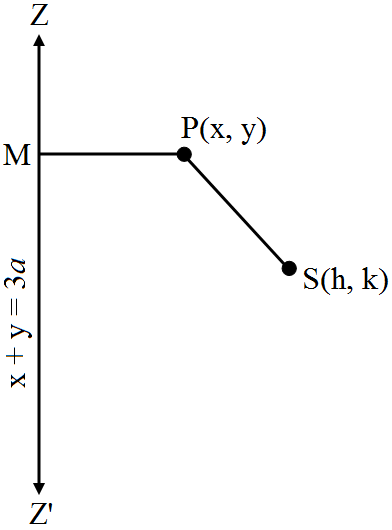
Draw PM perpendicular to x + y = 3a.
Then, we have:
$SP = PM$
$\Rightarrow SP^2 = PM^2$
$\Rightarrow\ (\text{x}-0)^2+(\text{y+a})^2=\Big(\frac{\text{x+y}-3\text{a}}{\sqrt2}\Big)^2$
$\Rightarrow\ \text{x}^2+(\text{y+a})^2=\Big(\frac{\text{x+y}-3\text{a}}{\sqrt2}\Big)^2$
$\Rightarrow\ 2\text{x}^2+2\text{y}^2+2\text{a}^2+4\text{ay}=\text{x}^2+\text{y}^2+9\text{a}^2+2\text{xy}-6\text{ax}-6\text{ay}$
$\Rightarrow\ \text{x}^2+\text{y}^2-7\text{a}^2+10\text{ay}+6\text{ax}=0$ View full question & answer→MCQ 131 Mark
The equation $\sqrt{(\text{x}-2)^{2}+\text{y}^{2}}+\sqrt{(\text{x}+2)^{2}+\text{y}^{2}}=5$ represents:
Answerlet A (2, 0), B (-2, 0) and P (x, y) be three points AB = 4
Given: that, $\sqrt{(\text{x}-2)^{2}+\text{y}^{2}}+\sqrt{(\text{x}+2)^{2}+\text{y}^{2}}=5>\text{AB}$
⇒ PA + PB = constant > AB
$\therefore$ locus of P is an ellipse.
View full question & answer→MCQ 141 Mark
The equation of the circle which touches the axes of coordinates and the line $\frac{\text{x}}{3}+\frac{\text{y}}{4}=1$ and whose centres lie in the first quadrant is $x^2 + y^2 − 2cx − 2cy + c^2 = 0$, where c is equal to:
Answer
- 6
Solution:
The equation of the circle that touches the axes of coordinates is $x^2 + y^2 - 2cx − 2cy + c^2 = 0$.
Also, $x^2 + y^2 − 2cx − 2cy + c^2 = 0$ touches the line $\frac{\text{x}}{3}+\frac{\text{y}}{4}=1$ or 4x +3y -12 = 0.
Since the circle lies in the first quadrant, it centre is is (c, c).
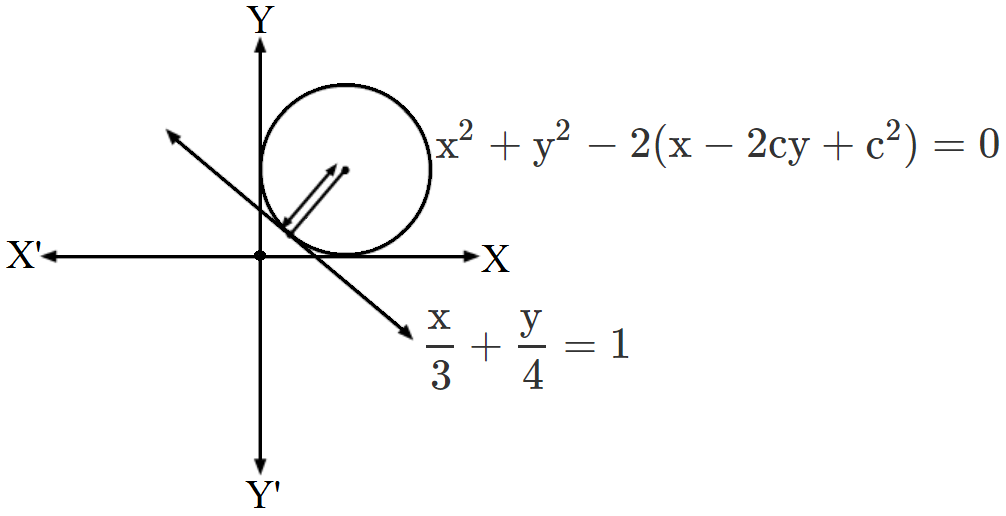
From the figure, we have:
$\Bigg|\frac{4\text{c}+3\text{c}-12}{\sqrt{4^2+3^3}}\Bigg|=\text{c}$
$\Rightarrow\frac{7\text{c}-12}{5}=\text{c}$
$\Rightarrow\text{c}=6$ View full question & answer→MCQ 151 Mark
The intercept on the line $y=x$ by the circle $x^2+y^2-2 x=0$ is $A B$. Equation of the circle with $A B$ as a diameter is:
- A
$x^2+y^2+x+y=0$
- ✓
$x^2+y^2-x-y=0$
- C
$x^2+y^2+x-y=0$
- D
AnswerCorrect option: B. $x^2+y^2-x-y=0$
View full question & answer→MCQ 161 Mark
Choose the correct answer. The eccentricity of the hyperbola whose latus rectum is 8 and conjugate axis is equal to half of the distance between the foci is:
- A
$\frac{4}{3}$
- B
$\frac{4}{\sqrt{3}}$
- ✓
$\frac{2}{\sqrt{3}}$
- D
AnswerCorrect option: C. $\frac{2}{\sqrt{3}}$
Let the equation of the hyperbola be $\frac{\text{x}^2}{\text{a}^2}-\frac{\text{y}^2}{\text{b}^2}=1$
Length of latus rectum = 8
$\therefore\ \frac{2\text{b}^2}{2}=8$
$\Rightarrow\text{b}^2=4\text{a}$
Conjugate axis = half of the distance between the foci
$\therefore\ 2\text{b}=\text{ae}$
Now, $\text{b}^2=\text{a}^2(\text{e}^2-1)$
From eqs. (i) and (iii), we get
$\frac{\text{a}^2\text{e}^2}{4}=\text{a}^2(\text{e}^2-1)$
$\Rightarrow\text{e}^2=4\text{e}^2-4$
$\Rightarrow\text{e}^2=\frac{4}{3}$
$\Rightarrow\text{e}=\frac{2}{\sqrt{3}}$
View full question & answer→MCQ 171 Mark
Find the equation of a circle with center (0, 0) and radius 5:
- A
$x^2+y^2=5$
- B
$x^2-y^2=25$
- ✓
$x^2+y^2=25$
- D
$(x-1)^2+(y+1)^2=25$
AnswerCorrect option: C. $x^2+y^2=25$
- $x^2+y^2=25$
Solution:
Compare the equation with the standard form with center at $(\mathrm{h}, \mathrm{k})$ and radius r is.
$(x-h)^2+(y-k)^2=r^2$
Substitute the value of $(h, k)=(0,0)$ and $r=5$.
Then, the equation becomes $x^2+y^2=25$ View full question & answer→MCQ 181 Mark
If the vertex = (2, 0) and the extremities of the latus rectum are (3, 2) and (3, -2), then the equation of the parabola is:
- A
$y^2=2 x-4$
- B
$x^2=4 y-8$
- ✓
$y^2=4 x-8$
- D
AnswerCorrect option: C. $y^2=4 x-8$
- $y^2=4 x-8$
Solution:
$y^2=4 a x$
$(y-0)^2=4 a(x-2)$
$y^2=4 a(x-2)$
$y^2=4(x-2)$
$y^2=4 x-8$ View full question & answer→MCQ 191 Mark
The equation of the circle passing through the point $(1,1)$ and having two diameters along the pair of lines $x^2-y^2-$ $2 x+4 y-3=0$, is:
- ✓
$x^2+y^2-2 x-4 y+4=0$
- B
$x^2+y^2+2 x+4 y-4=0$
- C
$x^2+y^2-2 x+4 y+4=0$
- D
AnswerCorrect option: A. $x^2+y^2-2 x-4 y+4=0$
- $x^2+y^2-2 x-4 y+4=0$
Solution:
Let the required equation of the circle be $(x-h)^2+(y-k)^2=a^2$.
Comparing the given equation $x^2-y^2-2 x+4 y-3=0$ with $a x^2+b y^2+2 h x y+2 g x+2 f y+c=0$, we get:
$a=1, b=-1, h=0, g=-1, f=2, c=-3$
Intersection point $\left(\frac{\mathrm{hf}-\mathrm{bg}}{\mathrm{ab}-\mathrm{h}^2}, \frac{\mathrm{gh}-\mathrm{af}}{\mathrm{ab}-\mathrm{h}^2}\right)=\left(\frac{-1}{-1}, \frac{-2}{-1}\right)=(1,2)$
Thus, the centre of the circle is $(1,2)$
The equation of the required circle is $(x-1)^2+(y-2)^2=a^2$
Since circle passes through ( 1,1 ), we have:
$1=a^2$
$\therefore$ Equation of the required circle:
$(x-1)^2+(y-2)^2=1$
$\Rightarrow x^2+y^2-2 x-4 y+4=0$ View full question & answer→MCQ 201 Mark
If the point $(2, k)$ lies outside the circles $x^2+y^2+x-2 y-14=0$ and $x^2+y^2=13$ then klies in the interval:
- A
$(-3,\ -2)\cup(3,\ 4)$
- B
$-3,\ 4$
- ✓
$(-\infty,\ -3)\cup(4,\ \infty)$
- D
$(-\infty,\ -2)\cup(3,\ \infty)$
AnswerCorrect option: C. $(-\infty,\ -3)\cup(4,\ \infty)$
- $(-\infty,\ -3)\cup(4,\ \infty)$
Solution:
The given equations of the circles are $x^2+y^2+x-2 y-14=0$ and $x^2+y^2=13$.
Since $(2, k)$ lies outside the given circles, we have:
$4+k^2+2-2 k-14>0 \text { and } 4+k^2>13$
$\Rightarrow k^2-2 k-8>0 \text { and } k^2>9$
$\Rightarrow(k-4)(k+2)>0 \text { and } k^2>9$
$\Rightarrow k>4 \text { or } k<-2 \text { and } k>3 \text { or } k<-3$
$\Rightarrow k>4 \text { and } k<-3$
$\Rightarrow k \in(-\infty,-3) \cup(4, \infty)$ View full question & answer→MCQ 211 Mark
The difference between the lengths of the major axis and the latus-rectum of an ellipse is
AnswerCorrect option: D. $2 a e^2$
- $2 a e^2$
Solution:
Length of the latus rectum $=\frac{2\text{b}^2}{\text{a}}$
and $\text{e}=\sqrt{1-\frac{\text{b}^2}{\text{a}^2}}$
$\text{a}^2\text{e}^2=\text{a}^2-\text{b}^2$
$\Rightarrow\text{b}^2=\text{a}^2-\text{a}^2\text{e}^2$
$\Rightarrow\text{b}^2=\text{a}^2(1-\text{e}^2)$
$\therefore\ $Length of the latus rectum $=\frac{2\text{a}^2(1-\text{e}^2)}{\text{a}}=2\text{a}(1-\text{e}^2)$
Length of the major axis = 2a
Difference between length of latus rectum and length of major axis $=2\text{a}-2\text{a}(1-\text{e}^2)$
$\\=2\text{a}-2\text{a}+2\text{ae}^2\\=2\text{ae}^2$ View full question & answer→MCQ 221 Mark
The circle $x^2+y^2+2 g x+2 f y+c=0$ does not intersect $x$-axis, if:
AnswerCorrect option: A. $\mathrm{g}^2<\mathrm{c}$
- $\mathrm{g}^2<\mathrm{c}$
Solution:
Given:
$x^2+y^2+2 g x+2 f y+c=0$ ......... (1)
The given circle intersects the $x$-axis.
The equation of circle becomes $x^2+2 \mathrm{gx}+\mathrm{c}=0$ ......... (2)
Solving equation (2):
$\therefore \text { Discriminant, } D=\sqrt{4 g^2-4 c} \geq 0$
$\Rightarrow 4 g^2-4 c \geq 0$
$\Rightarrow g^2-c \geq 0$
$\Rightarrow g^2 \geq c$
Hence, if $\mathrm{g}^2<\mathrm{c}$, then the given circle will not intersect the x -axis. View full question & answer→MCQ 231 Mark
The vertex of the parabola $(y+a)^2=8 a(x-a)$ is
Answer
- (a, a)
Solution:
Given:
The equation of the parabola is $(y+a)^2=8 a(x-a)$.
Putting $X=x-a, Y=y+a$
$Y^2=8 a X$
Vertex $=(X=0, Y=0)=(x-a=0, y+a=0)=(x=a, y=-a)$
Hence, the vertex is at $(a, a)$. View full question & answer→MCQ 241 Mark
The equation $x^2 + y^2 + 2x - 4y + 5 = 0$ represents:
- ✓
- B
A pair of straight lines.
- C
A circle of non-zero radius..
- D
Answer
- A point
Solution:
The radius of the given circle $=\sqrt{1^1+(-2)^2-5}=0$
Hence, the radius of the given circle is zero, which represents a point. View full question & answer→MCQ 251 Mark
The equation of parabola with vertex at origin and directrix. x - 2 = 0 is:
- A
$y^2=-4 x$
- B
$y^2=4 x$
- ✓
$y^2=-8 x$
- D
$y^2=8 x$
AnswerCorrect option: C. $y^2=-8 x$
View full question & answer→MCQ 261 Mark
What is the approximate radius of the circle whose equation is $(\text{x}-\sqrt{3})^2+(\text{y}+2)^2=11$:
AnswerThe radius of given circle is $\sqrt{11}=3.32$
View full question & answer→MCQ 271 Mark
Find the value of a if $y^2 = 4ax$ pases through (8, 8):
Answer
- 2
Solution:
Given point (8, 8)
Given equation $y^2= 4ax$
$\Rightarrow8^2=4\text{a}(8)$
$64 = 32\text{a}$
$\text{a}=\frac{64}{32}$
$\text{a} = 2$ View full question & answer→MCQ 281 Mark
If $V$ and $S$ are respectively the vertex and focus of the parabola $y^2+6 y+2 x+5=0$, then $S V=$
AnswerCorrect option: B. $\frac{1}{2}$
- $\frac{1}{2}$
Solution:
Given:
The vertex and the focus of a parabola are V and S, respectively.
The given equation of parabola can be rewritten as follows:
$(y+3)^2-9+5+2 x=0$
$\Rightarrow(y+3)^2+2 x=4$
$\Rightarrow(y+3)^2=4-2 x$
$\Rightarrow(y+3)^2=-2(x-2)$
$\text { Let } Y=y+3, X=x-2$
Then, the equation of parabola becomes $Y^2=-2 X$.
$\text { Vertex }=(X=0, Y=0)=(x-2=0, y+3=0)=(x=2, y=-3)$
Comparing with $y^2=4 a x$ :
$4 \mathrm{a}=2 \Rightarrow \mathrm{a}=\frac{1}{2}$
$\text { Focus }=\left(\mathrm{X}=\frac{-1}{2}, \mathrm{Y}=0\right)=\left(\mathrm{x}-2=\frac{-1}{2}, \mathrm{y}+3=0\right)=\left(\mathrm{x}=\frac{3}{2}, \mathrm{y}=-3\right)$
$\Rightarrow \mathrm{SV}=\sqrt{\left(2-\frac{3}{2}\right)^2+(-3+3)^2}=\frac{1}{2}$ View full question & answer→MCQ 291 Mark
The length of latus rectum of the parabola $y^2+8 x-2 y+17=0$ is:
Answer
- 8
Solution:
The given parabola is, $y^2+8 x-2 y+17=0$
$\Rightarrow\left(y^2-2 y+1\right)=-8 x-17+1=-8 x-16$
$\Rightarrow(y-1)^2=-8(x+2)$
Comparing with standard parabola $Y^2=-4 a X$
$Y=y-1, X=x+2, a=2$
Hence length of latus rectum is $=4 a=4 \times 2=8$ View full question & answer→MCQ 301 Mark
The coordinates of the focus of the parabola $y^2-x-2 y+2=0$ are
- ✓
$\Big(\frac{5}{4}, 1\Big)$
- B
$\Big(\frac{1}{4}, 0\Big)$
- C
$(1, 1)$
- D
AnswerCorrect option: A. $\Big(\frac{5}{4}, 1\Big)$
- $\Big(\frac{5}{4}, 1\Big)$
Solution:
Given:
The equation of the parabola is $y^2-x-2 y+2=0$.
$\Rightarrow(\mathrm{y}-1)-1=(\mathrm{x}-2)$
$(\mathrm{y}-1)=\mathrm{x}-1$
$\text { Let } \mathrm{X}=\mathrm{x}-1, \mathrm{Y}=\mathrm{y}-1$
$\mathrm{Y}=\mathrm{X}$
Comparing with $\mathrm{Y}=4 \mathrm{aX}$ :
$\mathrm{a}=\frac{1}{4}$
Focus =
$(X=a, Y=0)=\left(X=\frac{1}{4}, Y=0\right)=\left(x=\frac{1}{4}+1, y=1\right)=\left(x=\frac{5}{4}, y=1\right)$
Hence, the focus is at $\left(\frac{5}{4}, 1\right)$ View full question & answer→MCQ 311 Mark
If the circle $x^2 + y^2 = 9$ passesthrough (2, c) then c is equal to:
- ✓
$\sqrt{5}$
- B
$\sqrt{6}$
- C
$\sqrt{3}$
- D
$\sqrt{7}$
AnswerCorrect option: A. $\sqrt{5}$
- $\sqrt{5}$
Solution:
The equation of circle $x^2 + y^2 = 9$ The point is (2, c)
$\Rightarrow 2^2 + c^2= 9$
$4 + c^2 = 9$
$c^2 = 9 - 4$
$c^2 = 5$
$\text{c}=\sqrt{5}$ View full question & answer→MCQ 321 Mark
The number of tangents that can be drawn from $(1,2)$ to $x^2+y^2=5$ is:
Answer
- 1
Solution:
Given, point $(1,2)$ and equation of circle is $x^2+y^2=5$
Now, $x^2+y^2-5=0$
Put $(1,2)$ in this equation, we get
$1^2+2^2-5=1+4-5=5-5=0$
So, the point $(1,2)$ lies on the circle.
only one tangent can be drawn. View full question & answer→MCQ 331 Mark
The focus of the parabola $y = 2x^2 + x$ is
- A
$(0, 0)$
- B
$\Big(\frac{1}{2}, \frac{1}{4}\Big)$
- ✓
$\Big(-\frac{1}{4},0\Big)$
- D
$\Big(-\frac{1}{4}, \frac{1}{8}\Big)$
AnswerCorrect option: C. $\Big(-\frac{1}{4},0\Big)$
- $\Big(-\frac{1}{4},0\Big)$
Solution:
Given:
Equation of the parabola = $y = 2x^2 + x$
$\Rightarrow\ \text{x}^2+\frac{\text{x}}{2}=\frac{\text{y}}{2}$
$\Rightarrow\ \Big(\text{x}+\frac{1}{4}\Big)^2=\frac{\text{y}}{2}+\frac{1}{16}$
$\Rightarrow\ \Big(\text{x}+\frac{1}{4}\Big)^2=\frac{8\text{y}+1}{16}$
$\Rightarrow\ \Big(\text{x}+\frac{1}{4}\Big)^2=\frac{1}{2}(\text{y}+\frac{1}{8})$
$\text{Let }\text{X}=\text{x}+\frac{1}{4},\text{Y}=\text{y}+\frac{1}{8}$
$\therefore\ \text{X}^2=\frac{1}{2}\text{Y}$
Comparing with X = 4aY
$\text{a}=\frac{1}{8}$
Focus $=(\text{X}=0,\ \text{Y}=\text{a})=\Big(\text{x}=\frac{-1}{4},\text{y}=0\Big)$
Hence, the focus is at $\Big(-\frac{1}{4},0\Big).$ View full question & answer→MCQ 341 Mark
The equation circle whose center is $(0,0)$ and radius is 4 is:
- A
$x^2+y^2=4$
- ✓
$x^2+y^2=16$
- C
$x^2+y^2=2$
- D
AnswerCorrect option: B. $x^2+y^2=16$
- $x^2+y^2=16$
Solution:
The equation of circle is $x^2+y^2=r^2$
Here, the radius is 4 So the equation is $x^2+y^2=4^2$
$x^2+y^2=16$ View full question & answer→MCQ 351 Mark
Equation of the hyperbola whose vertices are $( \pm 3,0)$ and foci at $( \pm 5,0)$, is
- ✓
$16 x^2-9 y^2=144$
- B
$9 x^2-16 y^2=144$
- C
$25 x^2-9 y^2=225$
- D
$9 x^2-25 y^2=81$
AnswerCorrect option: A. $16 x^2-9 y^2=144$
- $16 x^2-9 y^2=144$
Solution:
The vertices of the hyperbola are $( \pm 3,0)$ and foci are $( \pm 5,0)$.
Thus, the value of a and ae are 3 and 5 , respectively.
Now, using the relation $b^2=a^2\left(e^2-1\right)$, we get:
$b^2=25-9$
$\Rightarrow b^2=16$
Equation of hyperbola is given below:
$\frac{x^2}{9}-\frac{y^2}{16}=1$
$16 x^2-9 y^2=144$ View full question & answer→MCQ 361 Mark
The vertex of the parabola $x^2+8 x+12 y+4=0$ is
Answer
- (-4, 1)
Solution:
Given:
$x^2+8 x+12 y+4=0$
$\Rightarrow(x+4)^2-16+12 y+4=0$
$\Rightarrow(x+4)^2+12 y-12=0$
$\Rightarrow(x+4)^2=-12(y-1)$
Let $\mathrm{X}=\mathrm{x}+4, \mathrm{Y}=\mathrm{y}-1$
$X^2=-12 Y$
Vertex $=(X=0, Y=0)=(x+4=0, y-1=0)=(x=-4, y=1)$
Hence, the vertex is at $(-4,1)$. View full question & answer→MCQ 371 Mark
The equation of the circle $x^2 + y^2 + 2gx + 2fy + c = 0$ will represent a real circle if:
AnswerCorrect option: B. $\text{g}^{2} + \text{f}^{2} – \text{c} \underline{>} 0$
- $\text{g}^{2} + \text{f}^{2} – \text{c} \underline{>} 0$
View full question & answer→MCQ 381 Mark
For what value of $k$, does the equation $9 x^2+y^2=k\left(x^2-y^2-2 x\right)$ represents equation of a circle?
Answer
- 4
Solution:
$9 x^2-k x^2+y^2+k y^2+2 k x=0$
$x^2(9-k)+y^2(1+k)+2 k x=0$
for circle
$9-k=1+k$
So, $k=4$ View full question & answer→MCQ 391 Mark
A circle of radius 2 lies in the first quadrant and touches both the axes of co-ordinates. Then the equation of the circle with centre $(6,5)$ and touching the above circle externally is:
- ✓
$(x-6)^2+(y-5)^2=4$
- B
$(x-6)^2+(y-5)^2=9$
- C
$(x-6)^2+(y-5)^2=36$
- D
AnswerCorrect option: A. $(x-6)^2+(y-5)^2=4$
- $(x-6)^2+(y-5)^2=4$
Solution:
If $(h, k)$ is the center and the radius is $r$ then the equation of the circle is given by
$(x-h)^2+(y-k)^2=r^2$
Given that The center of the circle $(h, k)=(6,5)$ and the radius $\mathrm{r}=2$
$\therefore$ The equation of the circle is $(x-6)^2+(y-5)^2=4$ View full question & answer→MCQ 401 Mark
If the parabola $y^2= 4ax$ passes through the point $(3, 2)$, then the length of its latusrectum is:
- A
$\frac{2}{3}$
- ✓
$\frac{4}{3}$
- C
$\frac{1}{3}$
- D
$4$
AnswerCorrect option: B. $\frac{4}{3}$
- $\frac{4}{3}$
Solution:
Since, the parabola $y^2 = 4ax$ passes through the point $(3, 2)$
$\Rightarrow 2^2 = 4a \times 3$
$\Rightarrow 4 = 12a$
$\Rightarrow\text{a} =\frac{ 4}{12}$
$\Rightarrow\text{a}=\frac{1}{3}$
So, the length of latusrectum $= \text{4a} = 4 \times (\frac{1}{3}) = \frac{4}{3}$ View full question & answer→MCQ 411 Mark
If the circles $x^2 + y^2 = 9$ and $x^2 + y^2 + 8y + c = 0$ touch each other, then c is equal to:
Answer
- 15
Solution:
The centre of the circle $x^2 + y^2 = 9$ is $(0, 0)$.
Let us denote it by $C_1$.
The centre of the circle $x^2 + y^2+ 8y + c = 0$ is $(0, -4)$.
Let us denote it by $C_2$.
The radius of $x^2 + y^2 = 9$ is $3$ units.
$x^2 + y^2+ 8y + c = 0$
$\Rightarrow(\text{x}-0)^2+(\text{y}+4)^2=16-\text{c}=(\sqrt{16-\text{c}})^2$
Therefore, the radius of the above circle is $\sqrt{16-\text{c}}$
Let the circles touch each other at P.
$\therefore\text{C}_1\text{C}_2=\text{PC}_2+\text{PC}_1$
$\Rightarrow\text{PC}_2=4-3=1$
$\Rightarrow\text{PC}_2-1=\sqrt{16-\text{c}}$
$\Rightarrow\text{c}=15$ View full question & answer→MCQ 421 Mark
Equation of the circle through origin which cuts intercepts of length a and b on axes is:
- A
$x^2+y^2+a x+b y=0$
- ✓
$x^2+y^2-a x-b y=0$
- C
$x^2+y^2+b x+a y=0$
- D
AnswerCorrect option: B. $x^2+y^2-a x-b y=0$
- $x^2+y^2-a x-b y=0$
Solution:
Centre of the circle is $\Big(\frac{\text{a}}{2},\ \frac{\text{b}}{2}\Big)$ and its radius is $\sqrt{\Big(\frac{\text{a}}{2}\Big)^2+\Big(\frac{\text{b}}{2}\Big)^2}=\frac{1}{2}\sqrt{\text{a}^2+\text{b}^2}$
Equation of circle:
$\Big(\text{x}-\frac{\text{a}}{2}\Big)^2+\Big(\text{y}-\frac{\text{b}}{2}\Big)^2=\frac{1}{4}(\text{a}^2+\text{b}^2)$
$\Rightarrow(2\text{x}-\text{a}^2)+(2\text{y}-\text{b})^2=(\text{a}^2+\text{b}^2)$
$\Rightarrow4\text{x}^2+\text{a}^2-4\text{ax}+4\text{y}^2+\text{b}^2-4\text{by}=\text{a}^2+\text{b}^2$
$\Rightarrow\text{x}^2-\text{ax}+\text{y}^2-\text{by}=0$ View full question & answer→MCQ 431 Mark
If $e_1$ and $e_2$ are respectively the eccentricities of the ellipse $\frac{\text{x}^2}{18}+\frac{\text{y}^2}{4}=1$ and the hyperbola $\frac{\text{x}^2}{9}-\frac{\text{y}^2}{4}=1,$ then the relation between $e_1$ and $e_2$ is
- A
$3\text{e}_1^2 + \text{e}_2^2 = 2$
- B
$\text{e}_1^2 + 2\text{e}_2^2 = 3$
- ✓
$2\text{e}_1^2 +\text{e}_2^2 = 3$
- D
$\text{e}_1^2 + 3\text{e}_2^2 = 2$
AnswerCorrect option: C. $2\text{e}_1^2 +\text{e}_2^2 = 3$
- $2\text{e}_1^2 +\text{e}_2^2 = 3$
Solution:
The standard from of the ellipse is $\frac{\text{x}^2}{18}+\frac{\text{y}^2}{4}=1,$ where $a^2 = 18$ and $b^2 = 4$.
So, the eccentricity is calculated in the following way:
$\text{b}2 = \text{a}2 (1 - \text{e}_1^2)$
$\Rightarrow4 = 18 (1 - \text{e}_1^2)$
$\Rightarrow\frac{2}{9}=1-\text{e}_1^2$
$\Rightarrow\text{e}_1^2=\frac{7}{9}$
The standard from of the hyperbola is $\frac{\text{x}^2}{9}-\frac{\text{y}^2}{4}=1,$ where $a^2 = 9$ and $b^2 = 4$.
So, the eccentricity is calculated in the following way:
$\text{b}^2 = \text{a}^2(\text{e}_2^2 - 1)$
$\Rightarrow4 = 9(\text{e}_2^2 - 1)$
$\Rightarrow\frac{4}{9}=\text{e}_2^2-1$
$\Rightarrow\text{e}_2^2=\frac{13}{9}$
$\therefore2\text{e}_1^2+\text{e}_2^2=\frac{2\times7}{9}+\frac{13}{9}$
$=\frac{27}{9}$
$=3$ View full question & answer→MCQ 441 Mark
If the focus of a parabola is (-2, 1) and the directrix has the equation x + y = 3, then its vertex is
AnswerCorrect option: C. $(−1, 2)$
Given:
The focus S is at (-2, 1) and the directrix is the line x + y - 3 = 0.
The slope of the line perpendicular to x + y - 3 = 0 is 1.
The axis of the parabola is perpendicular to the directrix and passes through the focus.
$\therefore$ Equation of the axis of the parabola = y - 1 = 1(x + 2) ...(1)
Intersection point of the directrix and the axis is the intersection point of (1) and x + y - 3 = 0.
Let the intersection point be K.
Therefore, the coordinates of K will be (0, 3).
Let (h, k) be the coordinates of the vertex, which is the mid-point of the segment joining K and the focus.
$\therefore\ \text{h}=\frac{0-2}{2},\ \text{k}=\frac{3+1}{2}$
h = -1, k = 2
Hence, the coordinates of the vertex are $(−1, 2).$
View full question & answer→MCQ 451 Mark
The centre of the circle $x^2+ y^2+ 10x - 20y + 100 = 0$ is:
Answer
- (-5, 10)
Solution:
Given the equation of the circle is $x^2+y^2+10 x-20 y+100=0$
or, $x^2+10 x+25+y^2-20 y+100=25$
or, $(x+5)^2+(y-10)^2=52$
From this equation it is clear that the centre is $(-5,10)$ View full question & answer→MCQ 461 Mark
The vertex of the parabola $(y-2)^2=16(x-1)$ is
Answer
- (1, 2)
Solution:
Given:
$(y-2)^2=16(x-1)$
$\text { Let } X=x-1, Y=y-2$
$\therefore Y^2=16 X$
$\text { Vertex }=(X=0, Y=0)=(x-1=0, y-2=0)=(x=1, y=2)$
Hence, the vertex is at $(1,2)$. View full question & answer→MCQ 471 Mark
The number of integral values of $\lambda$ for which the equation $\text{x}^2+\text{y}^2+\lambda+(1-\lambda)\text{y}+5=0$ is the equation of a circle whose radius cannot exceed 5, is:
Answer$\sqrt{\Big(\frac{-\lambda}{2}^2\Big)+\Big(\frac{\lambda-1}{2}\Big)^2-5}\leq5$
$\Rightarrow\Big(\frac{-\lambda}{2}^2\Big)+\Big(\frac{\lambda-1}{2}\Big)\leq30$
$\lambda^2+(\lambda-1)^2\leq120$
$\Rightarrow2\lambda^2-2\lambda-199\leq0$
Using quadratic formula:
$\Rightarrow\lambda=\frac{2\pm\sqrt{2^2-4(2)(-119)}}{2(2)}$
$\Rightarrow\lambda=\frac{2\pm\sqrt{956}}{4}$
$\Rightarrow\lambda=\frac{1\pm\sqrt{239}}{2}$
$\Rightarrow\lambda=-7.23,\ 8.23$
$\Rightarrow-7.23\leq\lambda\leq8.23$
$\Rightarrow\lambda=-7,\ -6,\ -5,\ -4,\ -3,\ -2,\ -1\\0,\ 1,\ 2,\ 3,\ 4,\ 5,\ 6,\ 7,\ 8,\ $ $(\text{if}\ \lambda\in\text{Z})$
Thus, the number of integral values of $\lambda$ is 16.
View full question & answer→MCQ 481 Mark
If the line $\text{2x} - \text{y} + \lambda = 0$ is a diameter of the circle $x^2 + y^2 + 6x - 6y + 5 = 0$ then $\lambda=$
View full question & answer→MCQ 491 Mark
In the parabola $y^2 = 4ax$, the length of the chord passing through the vertex and inclined to the axis at $\frac{\pi}{4}$ is
- ✓
$4\sqrt2\text{a}$
- B
$2\sqrt2\text{a}$
- C
$\sqrt2\text{a}$
- D
AnswerCorrect option: A. $4\sqrt2\text{a}$
- $4\sqrt2\text{a}$
Solution:
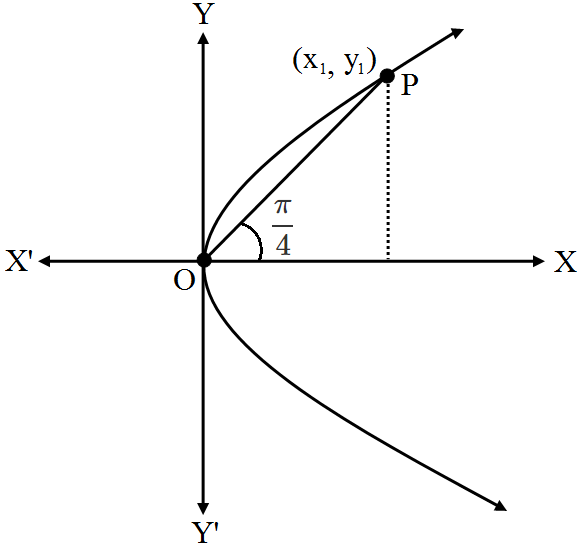
Let $O P$ be the chord.
Let the coordinates of $P$ be $\left(\mathrm{x}_1, \mathrm{y}_1\right)$.
From the figure, we have:
$O P^2=x_1^2+y_1^2 \ldots(1)$
And, $\tan \frac{\pi}{4}=\frac{y_1}{x_1}$
$\Rightarrow x_1=y_1 \ldots(2)$
Also, $\left(x_1, y_1\right)$ lies on the parabola.
$\therefore y_1{ }^2=4 \mathrm{ax}_{1 \ldots(3)}$
Using (2) and (3):
$x_1^2=4 a x_1 \Rightarrow x_1=4 a$
From (4), (1) and (2), we have:
$\mathrm{OP}^2=(4 a)^2+(4 a)^2=32 a^2$
$\Rightarrow \mathrm{OP}=4 \sqrt{2} \mathrm{a}$
Therefore, the length of the chord is $4 \sqrt{2} a$ a units. View full question & answer→MCQ 501 Mark
If the coordinates of the vertex and the focus of a parabola are (-1, 1) and (2, 3) respectively, then the equation of its directrix is
AnswerGiven:
The vertex and the focus of a parabola are (-1, 1) and (2, 3), respectively.
$\therefore$ Slope of the axis of the parabola $=\frac{3-1}{2+1}=\frac{2}{3}$
Slope of the directrix $=\ \frac{-3}{2}$
Let the directrix intersect the axis at K (r, s).
$\therefore\ \frac{\text{r+2}}{2}=-1,\ \frac{\text{s}+3}{2}=1$
$\Rightarrow\ \text{r}=-4,\ \text{s}=-1$
Equation of the directrix:
$(\text{y}+1)=\frac{-3}{2}(\text{x}+4)$
$\Rightarrow\ 3\text{x}+2\text{y}+14=0$
View full question & answer→MCQ 511 Mark
Choose the correct answer. The equation of the ellipse whose focus is (1, -1), the directrix the line x - y - 3 = 0 and eccentricity $\frac{1}{2}$ is:
AnswerCorrect option: A. $7 x^2+2 x y+7 y^2-10 x+10 y+7=0$
- $7 x^2+2 x y+7 y^2-10 x+10 y+7=0$
Solution:
Given that, foums of the ellipse is $S(1,-1)$ and the equation of directrix is $x-y-3=0$
Also, $e=\frac{1}{2}$
From definition of ellipse, for any point $P(x, y)$ on the ellipse, we have $S P=e P M$, where $M$ is foot of the perpendicular from point $P$ to the directrix.
$\therefore \sqrt{(x-1)^2+(y+1)^2}=\frac{1}{2} \frac{|x-y-3|}{\sqrt{2}}$
$\Rightarrow 8 x^2-16 x+16+8 y^2+16 y=x^2+y^2+9-2 x y+6 y-6 x$
$\Rightarrow 7 x^2+2 x y+7 y^2-10 x+10 y+7=0$ View full question & answer→MCQ 521 Mark
The eccentricity of the hyperbola $x^2 - 4y^2 = 1$
- A
$\frac{\sqrt3}{2}$
- ✓
${\frac{\sqrt5}{2}}$
- C
${\frac{2}{\sqrt3}}$
- D
$\frac{2}{\sqrt5}$
AnswerCorrect option: B. ${\frac{\sqrt5}{2}}$
- ${\frac{\sqrt5}{2}}$
Solution:
The equation of the hyperbola is $x^2 - 4y^2 = 1$.
This can be rewritten in the following way:
$\frac{\text{x}^2}{1}-\frac{\text{y}^2}{\frac{1}{4}}=1$
This is the standard form of a hyperbola, where a = 1 and $\text{b}^2=\frac{1}{4}.$
The value of eccentricity is calculated in the following way:
$\text{b}^2=\text{a}^2(\text{e}^2-1)$
$\Rightarrow\frac{1}{4}=(\text{e}^2-1)$
$\Rightarrow\text{e}^2=\frac{5}{4}$
$\Rightarrow\text{e}=\frac{\sqrt5}{4}$ View full question & answer→MCQ 531 Mark
The equations of the tangents to the ellipse $9\text{x}^2+16\text{y}^2=144$ from the point (2, 3) are:
Answer$9\text{x}^2+16\text{y}^2=144$
$\Rightarrow\frac{\text{x}^2}{16}+\frac{\text{y}^2}{9}=1$
Equation of the tangent in case of an ellipse is given by
$\text{y}=\text{mx}+\sqrt{\text{a}^2\text{m}^2+\text{b}^2}$
$\Rightarrow\text{y}=\text{mx}+\sqrt{16\text{m}^2+9}\ \dots(1)$
Substituting x = 2 and y = 3, we get:
$3=2\text{m}\pm\sqrt{16\text{m}^2+9}$
$\Rightarrow3-2\text{m}=\sqrt{16\text{m}^2+9}$
On squaring both sides, we get:
$(3-2\text{m})^2=(16\text{m}^2+9)$
$\Rightarrow9+4\text{m}^2-12\text{m}=(16\text{m}^2+9)$
$\Rightarrow12\text{m}^2+12\text{m}=0$
$\Rightarrow12\text{m}(\text{m+1})=0$
$\Rightarrow\text{m}=0,-1$
Substituting values of m in eq. (1), we get:
For $\text{m}=0,\ \text{y}=3$
For $\text{m}=-1,\ \text{y}=-\text{x}+5$ or $\text{x}+\text{y}=5$
View full question & answer→MCQ 541 Mark
The circle with radius 1 and centre being foot of the perpendicular from (5, 4) on y-axis, is:
- A
$x^2+y^2-8 x-15=0$
- B
$x^2+y^2-10 x+24=0$
- ✓
$x^2+y^2-8 y+15=0$
- D
$x^2+y^2+2 y=0$
AnswerCorrect option: C. $x^2+y^2-8 y+15=0$
- $x^2+y^2-8 y+15=0$
Solution:
Foot of perpendicular of $(5,4)$ on $y$-axis is $(0,4)$
$\therefore$ The equation of circle with
radius 1 cm is $(x-0)^2+(y-4)^2=1$
$\Rightarrow x^2+y^2-8 y+16$
$\Rightarrow x^2+y^2-8 y+15=0$ View full question & answer→MCQ 551 Mark
Choose the correct answer. The area of the circle centred at (1, 2) and passing through (4, 6) is:
AnswerCorrect option: C. $25\pi$
Given that the centre of the circle is (1, 2)
Radius of the circle $=\sqrt{(4-1)^2+(6-2)^2}$
$=\sqrt{9+16}=5$
So, the area of the circle $=\pi\text{r}^2$
$=\pi\times(5)^2=25\pi$
View full question & answer→MCQ 561 Mark
Determine the area enclosed by the curve $x^2 - 10x + 4y + y^2 = 196$:
- A
$15\pi$
- ✓
$225\pi$
- C
$20\pi$
- D
$17\pi$
AnswerCorrect option: B. $225\pi$
View full question & answer→MCQ 571 Mark
Equation of the diameter of the circle $x^2 + y^2 − 2x + 4y = 0$ which passes through the origin is:
Answer
- 2x + y = 0
Solution:
Let the diameter of the circle be y = mx.
Since the diameter of the circle passes through its centre, (1, -2) satisfies the equation of the diameter.
$\therefore$ m = -2
Substituting the value of m in the equation of diameter:
y = -2x
⇒ 2x + y = 0
Hence, the required equation of the diameter is 2x + y = 0. View full question & answer→MCQ 581 Mark
The length of the transverse axis is the distance between the:
AnswerThe length of the transverse axis is the distance between two vertices.
View full question & answer→MCQ 591 Mark
The order of the differential equation of the family of parabolas whose length of latus rectum is fixed and axis is the x-axis:
MCQ 601 Mark
If $2\text{x}^2+\lambda\text{xy}+2\text{y}^2(\lambda-4)\text{x}+6\text{y}-5=0$ is the equation of a circle, then its radius is:
- A
$3\sqrt{2}$
- B
$2\sqrt{3}$
- C
$2\sqrt{2}$
- ✓
AnswerThe given equation is $2\text{x}^2+\lambda\text{xy}+2\text{y}^2+(\lambda-4)\text{x}+6\text{y}-5=0$ which can be rewritten as
$\text{x}^2+\frac{\lambda\text{xy}}{2}+\text{y}^2+\frac{(\lambda-4)}{2}\text{x}+3\text{y}-\frac{5}{2}=0.$
Comparing the given equation $\text{x}^2+\text{y}62+2\text{gx}+2\text{fy}+\text{c}=0$ with we get: $\lambda=0$
$\therefore\text{x}^2+\text{y}^2-2\text{x}+3\text{y}-\frac{5}{2}=0$
$\therefore$ Radius $=\sqrt{(-1)^2+\Big(\frac{3}{2}\Big)^2+\frac{5}{2}}=\sqrt{1+\frac{9}{4}+\frac{5}{2}}=\sqrt{\frac{23}{4}}=\frac{\sqrt{23}}{2}$
View full question & answer→MCQ 611 Mark
If the circle $x^2 + y^2 + 2ax + 8y + 16 = 0$ touches x-axis, then the value of a is:
- A
$\pm16$
- ✓
$\pm4$
- C
$\pm8$
- D
$\pm1$
AnswerCorrect option: B. $\pm4$
- $\pm4$
Solution:
The equation of the circle is $x^2 + y^2 + 2ax + 8y + 16 = 0$.
Its centre is (-a, -4) and its radius is a units.
Since the circle touches the x-axis, we have:
$\sqrt{(-\text{a}+\text{a})^2+(4-0)^2}=\text{a}$
$\Rightarrow\text{a}=\pm4$ View full question & answer→MCQ 621 Mark
The radius of the circle represented by the equation $3\text{x}^2+3\text{y}^2+(\lambda-6)\text{y}+3=0$ is:
- ✓
$\frac{3}{2}$
- B
$\frac{\sqrt{17}}{2}$
- C
$\frac{2}{3}$
- D
AnswerCorrect option: A. $\frac{3}{2}$
The equation of the circle is $3\text{x}^2+3\text{y}^2+(\lambda-6)\text{y}+3=0$
$\therefore$ Coefficient of $\text{xy}=0$
$\Rightarrow\lambda=0$
$\therefore3\text{x}^2+3\text{y}^2+9\text{x}-6\text{y}+3=0$
$\Rightarrow\text{x}^2+\text{y}^2+3\text{x}-2\text{y}+1=0$
Therefore, the radius of the circle is $\sqrt{\Big(\frac{3}{2}\Big)^2+(-1)^2-1}=\frac{3}{2}.$
View full question & answer→MCQ 631 Mark
The equation of a hyperbola with foci on the $x-$axis is:
- A
$\frac{\text{x}^2}{\text{a}^2}+\frac{\text{y}^2}{\text{b}^2} = 1$
- ✓
$\frac{\text{x}^2}{\text{a}^2}-\frac{\text{y}^2}{\text{b}^2} = 1$
- C
$\text{x}^2 + \text{y}^2 = (\text{a}^2 + \text{b}^2)$
- D
$\text{x}^2 - \text{y}^2 = (\text{a}^2 + \text{b}^2)$
AnswerCorrect option: B. $\frac{\text{x}^2}{\text{a}^2}-\frac{\text{y}^2}{\text{b}^2} = 1$
$\frac{\text{x}^2}{\text{a}^2}-\frac{\text{y}^2}{\text{b}^2} = 1$
View full question & answer→MCQ 641 Mark
The equation $x^2+ y^2 - 2x + 4y + 5 = 0$ represents:
- ✓
- B
- C
A circle of non zero radius
- D
Answer
- A point
Solution:
$x^2+y^2-2 x+4 y+5=0$
$(x-1)^2+(y+2)^2-5+5=0$
$\Rightarrow(x-1)^2+(y+2)^2=0$
Since, radius is 0, its a point
Alternative method:
Here, a = b = 1
$\text{r}=\sqrt{1+4-5=0}$
a circle of radius 0. So, its a point. View full question & answer→MCQ 651 Mark
The equation to the circle with centre (2, 1) and touches the line 3x + 4y - 5 is:
- A
$x^2+y^2-4 x-2 y+5=0$
- B
$x^2+y^2-4 x-2 y-5=0$
- ✓
$x^2+y^2-4 x-2 y+4=0$
- D
$x^2+y^2-4 x-2 y-4=0$
AnswerCorrect option: C. $x^2+y^2-4 x-2 y+4=0$
- $x^2+y^2-4 x-2 y+4=0$
Solution:
distance of pt. (2, 1) from line 3x + 4y - 5 is radius(r)
$\Rightarrow\text{r}=\frac{\mid6+4-5\mid}{5}=\frac{5}{5}=1$
⇒ Equation of circle is
⇒ $(x - 2)^2 + (y - 1)^2 = 1$
⇒ $x^2 + y^2 - 4x - 2y + 4 = 0$ View full question & answer→MCQ 661 Mark
The distance between the directrices of the hyperbola $\text{x}=8\sec\theta,\text{y}=8,$ is
- ✓
$8\sqrt2$
- B
$16\sqrt2$
- C
$4\sqrt2$
- D
$6\sqrt2$
AnswerCorrect option: A. $8\sqrt2$
We have:
$\text{x}=8\sec\theta,\text{y}=8\tan\theta$
On squaring and subtracting:
$\text{x}^2-\text{y}^2=8\sec^2\theta-8\tan^2\theta$
$\Rightarrow\text{x}^2-\text{y}^2=8$
$\Rightarrow\frac{\text{x}^2}{8}-\frac{\text{y}^2}{8}=1$
$\therefore\text{a}=\text{b}=\text{c}$
Distance between the directrices of the hyperbola $=\frac{2\text{a}^2}{\sqrt{\text{a}^2+\text{b}^2}}$
Distance between the directrices $=\frac{2\times64}{\sqrt{64+64}}$
$=\frac{128}{8\sqrt2}$
$=\frac{16}{\sqrt2}$
$=8\sqrt2$
View full question & answer→MCQ 671 Mark
The equation of the conic with focus at (1, -1) directrix along x - y + 1 = 0 and eccentricity $\sqrt2$ is
Answer
- 2xy - 4x + 4y + 1 = 0
Solution:
Let P(x, y) be any point on the hyperbola.
Then, the distance of any point from the focus is eccentricity times the distance from the directrix.
$\therefore\sqrt{(\text{x}-1)^2+(\text{y}+1)^2}=\sqrt2\Big|\frac{\text{x}-\text{y}+1}{\sqrt2}\Big|$
Squaring both the sides, we get:
$(x - 1)^2 + (y + 1)^2 = (x - y + 1)^2$
$x^2 - 2x + 1 + y^2 + 1 + 2y = x^2 + y^2 + 1 - 2xy - 2y + 2x$
$2xy - 4x + 4y + 1 = 0$ View full question & answer→MCQ 681 Mark
The equation of a circle with radius $5$ and touching both the coordinate axes is:
- A
$x^2+y^2 \pm 10 x \pm 10 y+5=0$
- B
$x^2+y^2 \pm 10 x \pm 10 y=0$
- ✓
$x^2+y^2 \pm 10 x \pm 10 y+25=0$
- D
$x^2+y^2 \pm 10 x \pm 10 y+51=0$
AnswerCorrect option: C. $x^2+y^2 \pm 10 x \pm 10 y+25=0$
- $x^2+y^2 \pm 10 x \pm 10 y+25=0$
Solution:
Case I: If the circle lies in the first quadrant:
The equation of a circle that touches both the coordinate axes and hasradius a is $x^2+y^2-2 a x-2 a y+a^2=0$.
The given radius of the circle is 5 units, i.e. $a=5$.
Thus, the equation of the circle is $x^2+y^2-10 x-10 y+25=0$.
Case II: If the circle lies in the second quadrant:
The equation of a circle that touches both the coordinate axes and has radius $a$ is $x^2+y^2+2 a x-2 a y+a^2=0$.
The given radius of the circle is 5 units, i.e. $a=5$.
Thus, the equation of the circle is $x^2+y^2+10 x-10 y+25=0$.
Case III: If the circle lies in the third quadrant:
The equation of a circle that touches both the coordinate axes and has radius $a$ is $x^2+y^2+2 a x+2 a y+a^2=0$
The given radius of the circle is 5 units, i.e. $a=5$.
Thus, the equation of the circle is $x^2+y^2+10 x+10 y+25=0$.
Case IV: If the circle lies in the fourth quadrant:
The equation of a circle that touches both the coordinate axes and has radius $a$ is $x^2+y^2-2 a x+2 a y+a^2=0$.
The given radius of the circle is 5 units, i.e. $a=5$.
Thus, the equation of the circle is $x^2+y^2-10 x+10 y+25=0$.
Hence, the required equation of the circle is $x^2+y^2 \pm 10 x \pm 10 y+25=0$. View full question & answer→MCQ 691 Mark
The perpendicular distance from the point (3, -4) to the line 3x - 4y + 10 = 0:
MCQ 701 Mark
If the point $(\lambda,\ \lambda+1)$ lies inside the region bounded by the curve $\text{x}=\sqrt{25-\text{y}^2}$ and y-axis, then $\lambda$ belongs to the interval:
AnswerCorrect option: A. $(-1,\ 3)$
- $(-1,\ 3)$
Solution:
The given equation of the curve is $x^2 + y^2 = 25$
Since $(\lambda,\ \lambda+1)$ lies inside the region bounded by the curve $x^2 + y^2 = 25$ and the y-axis, we have:
$\lambda^2+(\lambda+1)^2<25,$ provided $\lambda+1>0$
$\Rightarrow\lambda^2+\lambda^2+12\lambda<25,\ \lambda>-1$
$\Rightarrow2\lambda^2+2\lambda-24<0,\ \lambda>-1$
$\Rightarrow\lambda^2+\lambda-12<0,\ \lambda>-1$
$\Rightarrow(\lambda-3)(\lambda+4)<0,\ \lambda>-1$
$\Rightarrow-4<\lambda<3,\ \lambda>-1$
$\Rightarrow\lambda\in(-1,\ 3)$ View full question & answer→MCQ 711 Mark
The center of the circle $4 x^2+4 y^2-8 x+12 y-25=0$ is:
View full question & answer→MCQ 721 Mark
The equation of circle center at (0, 0) and Radius 8cm:
- ✓
$x^2+y^2=64 cm$
- B
$x^2+y^2=8$
- C
$x^2+y^2=16$
- D
$x^2+y^2=4$
AnswerCorrect option: A. $x^2+y^2=64 cm$
- $x^2+y^2=64 cm$
Solution:
The equation of circle is $x^2+y^2=r^2$
$x^2+y^2=8^2$
$x^2+y^2=64$ View full question & answer→MCQ 731 Mark
The area of an equilateral triangle inscribed in the circle $x^2 + y^2 - 6x - 8y - 25 = 0$ is:
- ✓
$\frac{225\sqrt{3}}{6}$
- B
$25\pi$
- C
$50\pi-100$
- D
AnswerCorrect option: A. $\frac{225\sqrt{3}}{6}$
- $\frac{225\sqrt{3}}{6}$
Solution:
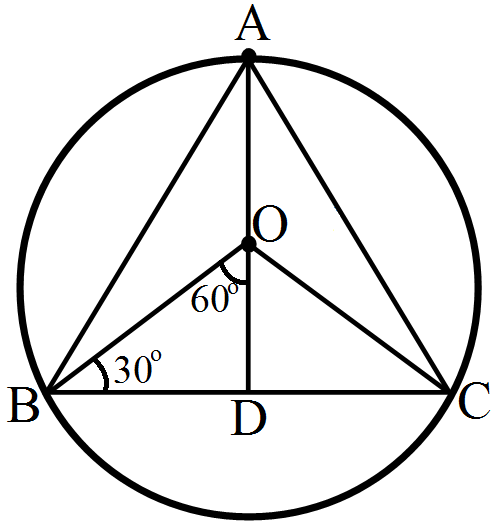
Let ABC be the required equilateral triangle.
The equation of the circle is $x^2 + y^2 - 6x - 8y - 25 = 0$.
Therefore, coordinates of the centre O is (3, 4).
Radius of the circle $=\text{OA}=\text{OB}=\text{OC}=\sqrt{9+16+25}=5\sqrt{2}$
In $\Delta\text{BOD},$ we have:
$\sin60^\circ=\frac{\text{DB}}{\text{BO}}$
$\Rightarrow\text{DB}=\frac{\sqrt{3}}{2}(5\sqrt{2})$
$\Rightarrow\text{BC}=2\text{BD}-\sqrt{3}\big(5\sqrt{2}\big)=5\sqrt{6}$
Now, area of $\triangle\text{ABC}=\frac{\sqrt{3}}{4}\text{BC}^2=\big(5\sqrt{6}\big)^2\\=\frac{\sqrt{3}(150)}{4}=\frac{\sqrt{3}(75)}{2}=\frac{\sqrt{3}(225)}{6}$ square units View full question & answer→MCQ 741 Mark
The distance between the foci of a hyperbola is 16 and its eccentricity is $\sqrt2$ , then equation of the hyperbola is
- A
$x^2+y^2=32$
- B
$x^2-y^2=16$
- C
$x^2+y^2=16$
- ✓
$x^2-y^2=32$
AnswerCorrect option: D. $x^2-y^2=32$
- $x^2-y^2=32$
Solution:
The distance between the foci is 2ae.
$\therefore$ 2ae = 16
⇒ ae = 8
$\text{e}=\sqrt2$
$\therefore\text{a}\sqrt2=8$
$\Rightarrow\text{a}=4\sqrt2$
Also, $b^2 = a^2(e^2 − 1)$
$\Rightarrow b^2 = 32(2 − 1)$
$\Rightarrow b^2 = 32$
Standard form of the hyperbola is given below:
$\frac{\text{x}^2}{32}-\frac{\text{y}^2}{32}=1$
$\text{x}^2-\text{y}^2=32$ View full question & answer→MCQ 751 Mark
Which of the following points lie on the parabola $x^2=4 a y$ ?
- A
$x=a t^2, y=2 a t$
- B
$x=2 a t, y=a t^2$
- C
$x=2 a t^2, y=a t$
- ✓
$x=2 a t, y=a t^2$
AnswerCorrect option: D. $x=2 a t, y=a t^2$
- $x=2 a t, y=a t^2$
Solution:
Substituting $x=2 a t, y=a t^2$ in the given equation:
$(2 a t)^2=4 a\left(a t^2\right)$
$\Rightarrow 4 a^2 t^2=4 a^2 t^2$
Hence, (2at, at ${ }^2$ ) lies on the parabola $x^2=4 a y$. View full question & answer→MCQ 761 Mark
The equation of the circle concentric with $x^2+y^2-3 x+4 y-c=0$ and passing through $(-1,-2)$ is:
- A
$x^2+y^2-3 x+4 y-1=0$
- ✓
$x^2+y^2-3 x+4 y=0$
- C
$x^2+y^2-3 x+4 y+2=0$
- D
AnswerCorrect option: B. $x^2+y^2-3 x+4 y=0$
- $x^2+y^2-3 x+4 y=0$
Solution:
The centre of the circle $x^2 + y^2 - 3x + 4y - c = 0$ is $\Big(\frac{3}{2},\ -2\Big).$
Therefore, the centre of the required circle is $\Big(\frac{3}{2},\ -2\Big).$
The equation of the circle is $\Big(\text{x}-\frac{3}{2}\Big)^2+(\text{y}+2)^2=\text{a}^2. \ ......(1)$
Also, circle (1) passes through (-1, -2).
$\therefore\Big(-1-\frac{3}{2}\Big)^2+\Big(-2+2\Big)^2=\text{a}^2$
$\Rightarrow\text{a}=\frac{5}{2}$
Substituting the value of a in equation (1):
$\Big(\text{x}-\frac{3}{2}\Big)^2+(\text{y}+2)^2=\Big(\frac{5}{2}\Big)^2$
$\Rightarrow\frac{(2\text{x}-3)^2}{4}+(\text{y}+2)^2=\frac{25}{4}$
$\Rightarrow(2\text{x}-3)^2+4(\text{y}+2)^2=25$
$\Rightarrow\text{x}^2+\text{y}^2-3\text{x}+4\text{y}=0$
Hence, the required equation of the circle is $x^2 + y^2 - 3x + 4y = 0$. View full question & answer→MCQ 771 Mark
The equation of the circle passing through (2, 0) and (0, 4) and having the minimum radius is:
- A
$x^2+y^2=20$
- ✓
$x^2+y^2-2 x-4 y=0$
- C
$x^2+y^2=4$
- D
$x^2+y^2=16$
AnswerCorrect option: B. $x^2+y^2-2 x-4 y=0$
- $x^2+y^2-2 x-4 y=0$
Solution:
Given, points are (2, 0) and (0, 4)
$\therefore$ equation of circle is (x - 2) (x - 0) + (y - 0) (y - 4) = 0
By expanding, we get
$x^2 - 2x + y^2 - 4y = 0$ View full question & answer→MCQ 781 Mark
Choose the correct answer. The equation of a circle with origin as centre and passing through the vertices of an equilateral triangle whose median is of length 3a is:
[Hint: Centroid of the triangle coincides with the centre of the circle and the radius of the circle is $\frac{2}{3}$ of the length of the mediam]
- A
$x^2+y^2=9 a^2$
- B
$x^2+y^2=16 a^2$
- ✓
$x^2+y^2=4 a^2$
- D
$x^2+y^2=a^2$
AnswerCorrect option: C. $x^2+y^2=4 a^2$
- $x^2+y^2=4 a^2$
Solution:
Let ABC be an equilateral triangle in which mediam AD = 3a
Centre of the circle is same as the centroid of the triangle i.e., $(0, 0)$
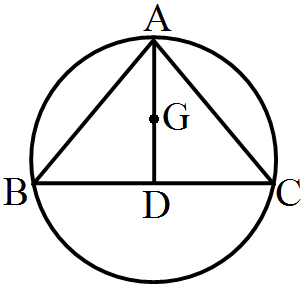
AG : GD = 2 : 1
So, $\text{AG}=\frac{2}{3}\text{AD}=\frac{2}{3}\times3\text{a}=2\text{a}$
$\therefore$ The equation of the circle is,
$(x - 0)^2 + (y - 0)^2= (2a)^2$
$\Rightarrow x^2 + y^2 = 4a^2$ View full question & answer→MCQ 791 Mark
The equation of the circle passing through (3, 6) and whose centre is (2, -1) is:
- ✓
$x^2+y^2-4 x+2 y=45$
- B
$x^2+y^2-4 x-2 y+45=0$
- C
$x^2+y^2+4 x-2 y=45$
- D
$x^2+y^2-4 x+2 y+45=0$
AnswerCorrect option: A. $x^2+y^2-4 x+2 y=45$
- $x^2+y^2-4 x+2 y=45$
Solution:
Equation of circle, $(\text{x} - 2)^2 + (\text{y} -( -1))^2= \Big(\sqrt{{(3-2)^2+(6}-(-1))^2\Big)}^2$
$\text{x}^2 - 4\text{x} + 4 + \text{y}^2 + 2\text{y} + 1=(\sqrt{1+49})^2\therefore\text{x}^2+\text{y}^2-4\text{x}+2\text{y}=45$ Equation of circle. View full question & answer→MCQ 801 Mark
The eccentricity of the ellipse $\frac{\text{x}^2}{\text{b}^2}+\frac{\text{y}^2}{\text{y}^2}=1$ if its latus rectum is equal to one half of its minor axis, is:
- A
$\frac{1}{\sqrt{2}}$
- ✓
$\frac{\sqrt{3}}{2}$
- C
$\frac{1}{2}$
- D
$\text{none of these}$
AnswerCorrect option: B. $\frac{\sqrt{3}}{2}$
According to the question, the latus rectum is half its minor axis.
i.e. $\frac{2\text{b}^2}{\text{a}}=\frac{1}{2}\times2\text{b}$
$\Rightarrow2\text{b}^2=\text{ab}$
$\Rightarrow\text{a}=2\text{b}$
Now, $\text{e}\sqrt{1-\frac{\text{b}^2}{\text{a}^2}}$
$\Rightarrow\text{e}=\sqrt{1-\frac{\text{b}^2}{4\text{b}^2}}$
$\Rightarrow\text{e}=\sqrt{1-\frac{1}{4}}$
$\Rightarrow\text{e}=\frac{\sqrt{3}}{2}$
View full question & answer→MCQ 811 Mark
Assertion: If the equation of a circle is ($x + 1)^2+ (y - 1)^2 = 4$, then its radius is 4. Reason: Equation of a circle with radius r is given by, $(x -a)^2 + (y - b)^2 = r2$.
- A
Both Assertion and Reason are correct and Reason is the correct explanation for Assertion
- B
Both Assertion and Reason are correct but Reason is not the correct explanation for Assertion
- C
Assertion is correct but Reason is incorrect
- ✓
Assertion is incorrect but Reason is correct
AnswerCorrect option: D. Assertion is incorrect but Reason is correct
- Assertion is incorrect but Reason is correct
Solution:
$(x + 1)^2 + (y - 1)^2= 2^2$ Radius = 2 Centre (-1, 1) Assertion is incorrect but reason is correct. View full question & answer→MCQ 821 Mark
The equation of the circle which touches $x$-axis at $(0,0)$ and touches the line $3 x+4 y-5=0$ is:
- A
$x^2+y^2-4 y=0$
- B
$x^2+y^2-10 y=0$
- C
$x^2+y^2+10 x=0$
- ✓
$x^2+y^2+10 y=0$
AnswerCorrect option: D. $x^2+y^2+10 y=0$
- $x^2+y^2+10 y=0$
Solution:
Equation of circle touching $x$-axis at $(0,0)$, means centre of circle lie on $Y$-axis i.e. $(0, k)$.
$(x-0)^2+(y-k)^2=k^2$
$S: x^2+y^2-2 k y=0$.... (1)
Circle S touches $3 x+4 y-5=0$
$\therefore \mathbf{k}=\frac{4 \mathbf{k}-5}{5}$
$5 k=4 k-5$
$k=-5$
$\therefore$ Equation of circle is
$\Rightarrow x^2+y^2+10 y=0$ View full question & answer→MCQ 831 Mark
Choose the correct answer. Equation of a circle which passes through $(3,6)$ and touches the axes is:
- A
$x^2+y^2+6 x+6 y+3=0$
- B
$x^2+y^2-6 x-6 y-9=0$
- ✓
$x^2+y^2-6 x-6 y+9=0$
- D
AnswerCorrect option: C. $x^2+y^2-6 x-6 y+9=0$
- $x^2+y^2-6 x-6 y+9=0$
Solution:
Given that the circle touches both axes.
Therefore, equation of the circle is, $(x - a)^2 + (y - a)^2 = a^2$
Circle passes through the point (3, 6)
$\therefore (3 - a)^2 + (6 - a)^2 = a^2$
$\Rightarrow a^2 - 18a + 45 = 0$
$\Rightarrow (a - 3)(a - 15) = 0$
$\therefore a = 3, a = 15$
For a = 3, the equation of circle is,
$(x - 3)^2 + (y - 3)^2 = 9$
$\Rightarrow x^2 + y^2 - 6x - 6y + 9 = 0$ View full question & answer→MCQ 841 Mark
If $(-3,2)$ lies on the circle $x^2+y^2+2 g x+2 f y+c=0$ which is concentric with the circle $x^2+y^2+6 x+8 y-5=0$, then $\mathrm{c}=$
Answer
- -11
Solution:
The centre of the circle $x^2+y^2+6 x+8 y-5=0$ is $(-3,-4)$.
The circle $x^2+y^2+2 g x+2 f y+c=0$ is concentric with the circle $x^2+y^2+6 x+8 y-5=0$.
Thus, the centre of $x^2+y^2+2 g x+2 f y+c=0$ is $(-3,-4)$.
$\therefore g=3, f=4$
Also, it is given that $(-3,2)$ lies on the circle $x^2+y^2+2 g x+2 f y+c=0$.
$\therefore(-3)^2+2^2+2(3)(-3)+2(4)(2)+c=0$
$\Rightarrow 9+4-18+16+c=0$
$\Rightarrow c=-11$ View full question & answer→MCQ 851 Mark
Choose the correct answer. If the focus of a parabola is (0, -3) and its directrix is y = 3, then its equation is:
- ✓
$x^2=-12 y$
- B
$x^2=12 y$
- C
$y^2=-12 x$
- D
$y^2=12 x$
AnswerCorrect option: A. $x^2=-12 y$
- $x^2=-12 y$
Solution:
According to the definition of parabola,
$\sqrt{(\text{x}-0)^2+(\text{y}+3)^2}=\Bigg|\frac{\text{y}-3}{\sqrt{(0)^2+(1)^2}}\Bigg|$
$\Rightarrow\sqrt{\text{x}^2+\text{y}^2+9+6\text{y}}=|\text{y}-3|$
Squaring both sides, we get
$x^2+y^2+9+6 y=y^2+9-6 y$
$\Rightarrow x^2+9+6 y=9-6 y$
$\Rightarrow x^2=-12 y$ View full question & answer→MCQ 861 Mark
Choose the correct answer. If the vertex of the parabola is the point (-3, 0) and the directrix is the line x + 5 = 0, then its equation is:
- ✓
$y^2=8(x+3)$
- B
$x^2=8(y+3)$
- C
$y^2=-8(x+3)$
- D
$y^2=8(x+5)$
AnswerCorrect option: A. $y^2=8(x+3)$
- $y^2=8(x+3)$
Solution:
Given that vertex $\equiv(-3,0)$ and directrix, x + 5 = 0
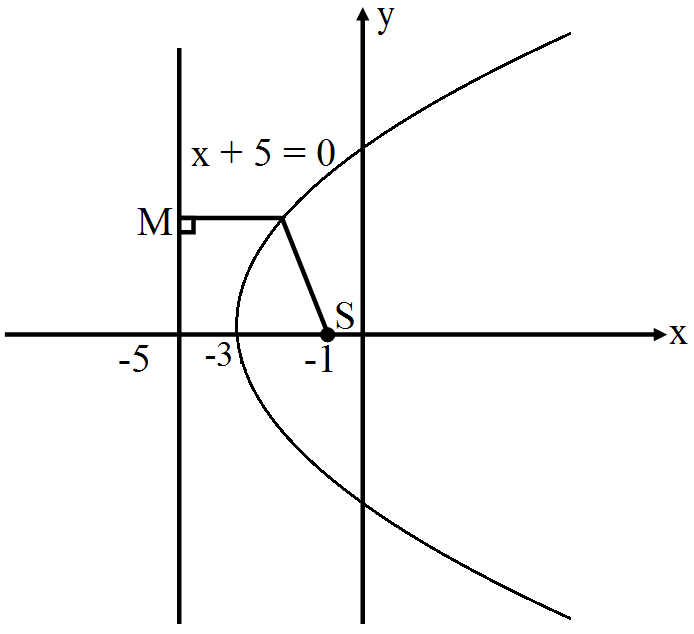
So, focus $\equiv\text{S}(-1,0)$
For any point of parabola P(x, y) we have,
$\text{SP}=\text{PM}$
$\Rightarrow\sqrt{(\text{x}+1)+\text{y}^2}=|\text{x}+5|$
$\Rightarrow\text{x}^2+2\text{x}+1+\text{y}^2=\text{x}^2+10\text{x}+25$
$\Rightarrow\text{y}^2=8\text{x}+24$
$\Rightarrow\text{y}^2=8(\text{x}+3)$ View full question & answer→MCQ 871 Mark
What is the equation of a circle with center $(-3,1)$ and radius 7 :
- A
$(x-3)^2+(y+1)^2=7$
- B
$(x-3)^2+(y+1)^2=49$
- C
$(x+3)^2+(y-1)^2=7$
- ✓
$(x+3)^2+(y-1)^2=49$
AnswerCorrect option: D. $(x+3)^2+(y-1)^2=49$
- $(x+3)^2+(y-1)^2=49$
Solution:
The general equation of a circle with center at $(a, b)$ and radius $r$ is $(x-a)^2+(y-b)^2=r^2$
So substituting the values we get the equation of the circle is $(x+3)^2+(y-1)^2=7^2=49$ View full question & answer→MCQ 881 Mark
The eccentricity of the hyperbola whose latus-rectum is half of its transverse axis, is
- A
$\frac{1}{\sqrt2}$
- B
$\sqrt{\frac{2}{3}}$
- ✓
$\sqrt{\frac{3}{2}}$
- D
AnswerCorrect option: C. $\sqrt{\frac{3}{2}}$
The lengths of the latus rectum and the transverse axis are $\frac{2\text{b}^2}{\text{a}}\text{ and }2\text{a},$ respectively.
According to the given statement, length of the latus rectum is half of its transverse axis.
$\therefore\frac{2\text{b}^2}{\text{a}}=\frac{1}{2}\times2\text{a}$
$\Rightarrow\frac{2\text{b}^2}{\text{a}}=\text{a}$
$\Rightarrow2\text{b}^2=\text{a}$
Eccentricity, $\text{e}=\frac{\sqrt{\text{a}^2+\text{b}^2}}{\text{a}}$
Substituting the value $\text{b}^2=\frac{\text{a}^2}{2},$ we get:
$\text{e}=\frac{\sqrt{\text{a}^+\frac{\text{a}}{2}}}{\text{a}}$
$=\frac{\text{a}\sqrt{\frac{3}{2}}}{\text{a}}$
$=\sqrt{\frac{3}{2}}$
$\therefore$ Eccentricity is $\sqrt{\frac{3}{2}}$
View full question & answer→MCQ 891 Mark
If $e_1$ is the eccentricity of the conic $9 x^2+4 y^2=36$ and $e_2$ is the eccentricity of the conic $9 x^2-4 y^2=36$, then
- A
$\text{e}_1^2-\text{e}_2^2=2$
- ✓
$2<\text{e}_2^2-\text{e}_1^2<3$
- C
$\text{e}_2^2-\text{e}_1^2=2$
- D
$\text{e}_2^2-\text{e}_1^2>3$
AnswerCorrect option: B. $2<\text{e}_2^2-\text{e}_1^2<3$
- $2<\text{e}_2^2-\text{e}_1^2<3$
Solution:
The conic $9x^2 + 4y^2 = 36$ can rewritten in the following way:
$\frac{9\text{x}^2}{36}+\frac{4\text{y}^2}{36}=1$
$\Rightarrow\frac{\text{x}^2}{4}+\frac{\text{y}^2}{9}=1$
This is the standard equation of an ellipse.
$\therefore b^2 = a^2(1−e_1)^2$
$\Rightarrow9=4(1-\text{e}_1)^2$
$\Rightarrow(\text{e}_1)^2=\frac{-5}{4}$
The conic $9x^2 − 4y^2 = 36$ can rewritten in the following way:
$\frac{9\text{x}^2}{36}-\frac{4\text{y}^2}{36}=1$
$\Rightarrow\frac{\text{x}^2}{4}-\frac{\text{y}^2}{9}=1$
This is the standard equation of a hyperbola.
$\therefore b^2 = a^2(e_2^2 − 1)$
$\Rightarrow9=4(\text{e}_2^2-1)$
$\Rightarrow(\text{e}_2)^2=\frac{13}{4}$
$\therefore\text{e}_2^2-\text{e}_1^2=\frac{13}{4}+\frac{5}{4}=2.5$ View full question & answer→MCQ 901 Mark
If the circles $x^2 + y^2 + 2ax + c = 0$ and $x^2 + y^2 + 2by + c = 0$ touch each other, then:
- ✓
$\frac{1}{\text{a}^2}+\frac{1}{\text{b}^2}=\frac{1}{\text{c}}$
- B
$\frac{1}{\text{a}^2}+\frac{1}{\text{b}^2}=\frac{1}{\text{c}}$
- C
$\text{a}+\text{b}=2\text{c}$
- D
$\frac{1}{\text{a}}+\frac{1}{\text{b}}=\frac{2}{\text{c}}$
AnswerCorrect option: A. $\frac{1}{\text{a}^2}+\frac{1}{\text{b}^2}=\frac{1}{\text{c}}$
- $\frac{1}{\text{a}^2}+\frac{1}{\text{b}^2}=\frac{1}{\text{c}}$
Solution:
Given:
$x^2 + y^2 + 2ax + c = 0$ ....... (1)
And, $x^2 + y^2 + 2by + c = 0$ ........ (2)
For circle (1), we have:
Centre = $(-a, 0) = C_1$
For circle (2), we have:
Centre = $(0,-b) = C_2$
Let the circles intersect at point P.
$\therefore$ Coordinates of P = Mid point of $C_1C_2$
$\Rightarrow$ Coordinates of P $=\Big(\frac{-\text{a}+0}{2},\ \frac{0-\text{b}}{2}\Big)=\Big(\frac{-\text{a}}{2},\ \frac{-\text{b}}{2}\Big)$
Now, we have:
$PC_1$ = radius of (1)
$\Rightarrow\sqrt{(-\text{a}+\frac{\text{a}}{2})^2}+\Big(0-\frac{\text{b}}{2}\Big)^2=\sqrt{\text{a}^2-\text{c}}$
$\Rightarrow\frac{\text{a}^2}{4}+\frac{\text{b}}{4}^2=\text{a}^2-\text{c}\ .....(3)$
Also, radius of circle (1) = radius of circle (2)
$\Rightarrow\sqrt{\text{a}^2-\text{c}}=\sqrt{\text{b}^2-\text{c}}$
$\Rightarrow\text{a}^2=\text{b}^2\ .....(4)$
From (3) and (4), we have:
$\frac{\text{a}^2}{2}=\text{a}^2-\text{c}$
$\Rightarrow\frac{\text{a}^2}{2}=\text{c}$
$\Rightarrow\frac{2}{\text{a}^2}=\frac{1}{\text{c}}$
$\Rightarrow\frac{1}{\text{a}^2}+\frac{1}{\text{a}^2}=\frac{1}{\text{c}}$
$\Rightarrow\frac{1}{\text{a}^2}+\frac{1}{\text{b}^2}=\frac{1}{\text{c}}$ View full question & answer→MCQ 911 Mark
For the ellipse $12\text{x}^2+4\text{y}^2+24\text{x}-16\text{y}+25=0$
AnswerDisclaimer : The equation should be $12\text{x}^2+4\text{y}^2+24\text{x}-16\text{y}+24=0$ instead of $12\text{x}^2+4\text{y}^2+24\text{x}-16\text{y}+25=0.$
$12\text{x}^2+4\text{y}^2+24\text{x}-16\text{y}+24=0$
$\Rightarrow12\big(\text{x}^2+2\text{x}\big)+4\big(\text{y}^2-4\text{y}\big)=-24$
$\Rightarrow12\big(\text{x}^2+2\text{x}+1\big)+4\big(\text{y}^2-4\text{y}+4\big)=-24+12+16$
$\Rightarrow12\big(\text{x}+1\big)^2+4\big(\text{y}-2\big)^2=4$
$\Rightarrow\frac{(\text{x}+1)^2}{3}+\frac{(\text{y}-2)^2}{1}=1$
So, the centre is a $(-1,\ 2).$
Here, $\text{a}=\sqrt{3}$ and $\text{b}=1$
The lengths of the axes are $\sqrt{3}$ and 1.
Now, $\text{e}=\sqrt{1-\frac{\text{b}62}{\text{a}^2}}$
$\text{e}=\sqrt{1-\frac{1}{3}}$
$\Rightarrow\text{e}=\sqrt{\frac{2}{3}}$
View full question & answer→MCQ 921 Mark
The parametric equations of a parabola are $x=t^2+1, y=2 t+1$. The cartesian equation of its directrix is
Answer
- x = 0
Solution:
Given:
$x=t^2+1$
$y=2 t+1$
From (1) and (2):
$x=\left(\frac{y-1}{2}\right)^2+1$
On simplifying:
$(y-1)^2=4(x-1)$
Let $\mathrm{Y}=\mathrm{y}-1$ and $\mathrm{X}=\mathrm{x}-1$
$\therefore Y^2=4 X$
Comparing it with $y^2=4 a x:$
$a=1$
Therefore, the equation of the directrix is $X=-a$, i.e. $x-1=-1 \Rightarrow x=0$ View full question & answer→MCQ 931 Mark
Choose the correct answer. If the parabola $y^2 = 4ax$ passes through the point (3, 2), then the length of its latus rectum is:
- A
$\frac{2}{3}$
- ✓
$\frac{4}{3}$
- C
$\frac{1}{3}$
- D
$4$
AnswerCorrect option: B. $\frac{4}{3}$
- $\frac{4}{3}$
Solution:
Given parabola is $y^2 = 4ax$
If the parabola is passing through (3, 2)
Then $(2)^2 = 4a \times 3$
$\Rightarrow 4 = 12a$
$\Rightarrow\text{a}=\frac{1}{3}$
Nowm length of the latus rectum $=4\text{a}=4\times\frac{1}{3}=\frac{4}{3}$ View full question & answer→MCQ 941 Mark
The focus of the parabola $y^2 = 8x$ is:
Answer
- (2, 0)
Solution:
Given parabola equation $y^2 = 8x …(1)$
Here, the coefficient of x is positive and the standard form of parabola is $y^2 = 4ax … (2)$
Comparing (1) and (2), we get
4a = 8
$\text{a} = \frac{8}{4} = 2$
We know that the focus of parabolic equation $y^2 = 4ax$ is $(a, 0)$.
$\therefore$ The focus of the parabola $y^2 = 8x$ is $(2, 0)$. View full question & answer→MCQ 951 Mark
The equation of the directrix of the parabola whose vertex and focus are (1, 4) and (2, 6) respectively is
AnswerGiven:
The vertex and the focus of a parabola are (1, 4) and (2, 6), respectively.
$\therefore$ Slope of the axis of the parabola $= \frac{6-4}{2-1}=2$
Slope of the directrix $=\ \frac{-1}{2}$
Let the directrix intersect the axis at K (r, s).
$\therefore\ \frac{\text{r}+2}{2}=1,\ \frac{\text{s}+6}{2}=4$
$\Rightarrow\ \text{r}=0,\ \text{s}=2$
Equation of the directrix:
$(\text{y}-2)=\frac{-1}{2}(\text{x}-0)$
⇒ x + 2y = 4
View full question & answer→MCQ 961 Mark
Equation of the parabola having focus (3, 2) and Vertex (-1, 2) is:
- A
$(x+1)^2=16(y-2)$
- B
$(x-1)^2=16(y+2)$
- ✓
$(y-2)^2=16(x+1)$
- D
$(y+2)^2=16(x-1)$
AnswerCorrect option: C. $(y-2)^2=16(x+1)$
View full question & answer→MCQ 971 Mark
Latus rectum of a parabola is a $........$ line segment with respect to the axis of the parabola through the focus whose endpoints lie on the parabola:
AnswerConsider the above image which shows that the latus rectum of a parabola is a line segment perpendicular to the axis of the parabola, through the focus and whose end points lie on the parabola.
View full question & answer→MCQ 981 Mark
If the eccentricity of the hyperbola $x^2-y^2 \sec ^2 \alpha=5$ is $\sqrt{3}$ times the eccentricity of the ellipse $x^2 \sec ^2 \alpha+y^2=25$, then $\alpha=$
- A
$\frac{\pi}{6}$
- ✓
$\frac{\pi}{4}$
- C
$\frac{\pi}{3}$
- D
$\frac{\pi}{2}$
AnswerCorrect option: B. $\frac{\pi}{4}$
- $\frac{\pi}{4}$
Solution:
The hyperbola $\text{x}^2 − \text{y}^2 \sec^2\alpha = 5$ can be rewritten in the following way:
$\frac{\text{x}^2}{5}-\frac{\text{y}^2}{5\cos^2\text{a}}=1$
This is the standard form of a hyperbola, where $ \text{a}^2 = 5 \text{ and } \text{b}^2 = 5\cos^2\alpha.$
$\Rightarrow\text{b}^2 = \text{a}^2(\text{e}_1^2 − 1)$
$⇒ 5\cos^2\alpha=5(\text{e}_1^2−1)$
$\Rightarrow\text{e}_1^2=\cos^2\alpha+1...(1)$
The ellipse $\text{x}^2\sec^2\alpha+\text{y}^2=25$ can be rewritten in the following way:
$\frac{\text{x}^2}{25\cos^2\alpha}+\frac{\text{y}^2}{25}=1$
This is the standard form of an ellipse, where $\text{a}^2=25\text{ and }\text{b}^2=25\cos^2\alpha$
$\text{b}^2=\text{a}^2(1-\text{e}_2^2)$
$\Rightarrow\text{e}_2^2=1-\cos^2\alpha$
$\Rightarrow\text{e}_2^2=\sin^2\alpha...(2)$
According to the question,
$\cos^2\alpha+1=3(\sin^2\alpha)$
$\Rightarrow2=4\sin^2\alpha$
$\Rightarrow\sin\alpha=\frac{1}{\sqrt2}$
$\Rightarrow\alpha=\frac{\pi}{4}$ View full question & answer→MCQ 991 Mark
Find the equation to the circle which touches the axis of $y$ at the origin and passes through the point (b, c):
- A
$b x^2+b y^2-\left(b^2+c^2\right) y=0$
- ✓
$b x^2+b y^2-\left(b^2+c^2\right) x=0$
- C
$b x^2+b y^2+\left(b^2+c^2\right) y=-1$
- D
$b x^2+c y^2-\left(b^2+c^2\right) x=1$
AnswerCorrect option: B. $b x^2+b y^2-\left(b^2+c^2\right) x=0$
- $b x^2+b y^2-\left(b^2+c^2\right) x=0$
Solution:
Equation of circle which touches the $y$-axis at origin is $x^2+y^2+2 g x+d=0$
Since the circle passes through origin, $d=0$ Thus the equation becomes, $x^2+y^2+2 g x=0 \ldots .$. (1)
The equation passes through $(b, c)$
so, $b^2+c^2+2 g b=0$
$\therefore \mathrm{g}=\frac{-\mathrm{b}^2-\mathrm{c}^2}{2 \mathrm{~b}}$
So, putting the value of $g$ in (1) we getb $x^2+b y^2-\left(b^2+c^2\right) x=0$ View full question & answer→MCQ 1001 Mark
The equation of parabola with vertex at origin and directrix $x-2=0$ is:
- A
$y^2=-4 x$
- B
$y^2=4 x$
- ✓
$y^2=-8 x$
- D
$y^2=8 x$
AnswerCorrect option: C. $y^2=-8 x$
View full question & answer→MCQ 1011 Mark
The number of tangents that can be drawn from $(1,2)$ to $x^2+y^2=5$ is:
Answer
- 1
Solution:
Given circle equation: $x^2+y^2=5$
$x^2+y^2-5=0 \ldots$
Now, substitute $(1,2)$ in equation (1), we get
Circle Equation: $(1)^2+(2)^2-5=0$
Equation of circle $=1+5-5=0$
This represents that the point lies on the circumference of a circle, and hence only one tangent can be drawn from (1, 2). View full question & answer→MCQ 1021 Mark
On the parabola $y=x^2$, the point least distant from the straight line $y=2 x-4$ is:
Answer
- (1, 1)
Solution:
Given, parabola is $y=x^2 \ldots .$. (i)
and straight line is $\mathrm{y}=2 \mathrm{x}-4 \ldots$... (ii)
From equations (i) and (ii), we get
$x^2-2 x-4=0$
$\Rightarrow 2 x-2=0$
$\Rightarrow x=1$
From equation (i), we have $y=1$
The point least distant from the line is $(1,1)$. View full question & answer→MCQ 1031 Mark
The equation of parabola whose focus is $(3,0)$ and directrix is $3 x+4 y=1$ is:
- A
$16 x^2-9 y^2-24 x y-144 x+8 y+224=0$
- B
$16 x^2+9 y^2-24 x y-144 x+8 y-224=0$
- C
$16 x^2+9 y^2-24 x y-144 x-8 y+224=0$
- ✓
$16 x^2+9 y^2-24 x y-144 x+8 y+224=0$
AnswerCorrect option: D. $16 x^2+9 y^2-24 x y-144 x+8 y+224=0$
- $16 x^2+9 y^2-24 x y-144 x+8 y+224=0$
View full question & answer→MCQ 1041 Mark
If the equation of a circle is $\lambda\text{x}^2+(2\lambda-3)\text{y}^2-4\text{x}+6\text{y}-1=0,$ then the coordinates of centre are:
- A
$\Big(\frac{4}{3},\ -1\Big)$
- ✓
$\Big(\frac{2}{3},\ -1\Big)$
- C
$\Big(\frac{-2}{3},\ 1\Big)$
- D
$\Big(\frac{2}{3},\ 1\Big)$
AnswerCorrect option: B. $\Big(\frac{2}{3},\ -1\Big)$
- $\Big(\frac{2}{3},\ -1\Big)$
Solution:
To find the centre:
Coefficient of $\text{x}^2$ = Coefficient of $\text{y}^2$
$\therefore\lambda=2\lambda-3\Rightarrow\lambda=3$
Therefore, the given equation can be rewritten as $3\text{x}^2+3\text{y}^2-4\text{x}+6\text{y}-1=0.$
$\therefore\text{x}^2+\text{y}^2-\frac{4}{3}\text{x}+2\text{y}-\frac{1}{3}=0$
Thus, the coordinates of the centre is $\Big(\frac{2}{3},\ -1\Big).$ View full question & answer→MCQ 1051 Mark
Choose the correct answer. The distance between the foci of a hyperbola is 16 and its eccentricity is 2. Its equation is:
- ✓
$\text{x}^2-\text{y}^2=32$
- B
$\frac{\text{x}^2}{4}-\frac{\text{y}^2}{9}=1$
- C
$2\text{x}-3\text{y}^2=7$
- D
AnswerCorrect option: A. $\text{x}^2-\text{y}^2=32$
We know that distance between the foci = 2ae
$\therefore\ 2\text{ae}=16$
$\Rightarrow\text{ae}=8$
Given that $\text{e}=\sqrt{2}$
$\therefore\ \sqrt{2}\text{a}=8$
$\Rightarrow\text{a}=4\sqrt{2}$
Now, $\text{b}^2=\text{a}^2(\text{e}^2-1)$
$\Rightarrow\text{b}^2=32(32-1)$
$\Rightarrow\text{b}^2=32$
So, the equation of the hyperbola is,
$\frac{\text{x}^2}{\text{a}^2}-\frac{\text{y}^2}{\text{b}^2}=1$
$\Rightarrow\frac{\text{x}^2}{32}-\frac{\text{y}^2}{32}=1$
$\Rightarrow\text{x}^2-\text{y}^2=32$
View full question & answer→MCQ 1061 Mark
The length of the latus-rectum of the parabola $y^2 + 8x − 2y + 17 = 0$ is
Answer
- 8
Solution:
$y^2+8 x-2 y+17=0$
$\Rightarrow(y-1)^2-1+8 x+17=0$
$\Rightarrow(y-1)^2+8 x+16=0$
$\Rightarrow(y-1)^2=-8(x+2)$
Let $X = x +2, Y = y -1$
$\therefore Y^2=-8 X$
Comparing with $y ^2=4 ax$ :
$a=2$
Length of the latus rectum $=4 a=8$ units View full question & answer→MCQ 1071 Mark
Centre of circle whose normals are $x^2-2 x y-3 x+6 y=0$, is:
- ✓
$\big(3, \frac{3}{2}\big)$
- B
$\big(3, -\frac{3}{2}\big)$
- C
$\big(\frac{3}{2},3\big)$
- D
AnswerCorrect option: A. $\big(3, \frac{3}{2}\big)$
- $\big(3, \frac{3}{2}\big)$
Solution:
$x^2-2 x y-3 x+6 y=0$
$\Rightarrow(x-3)(x-2 y)=0$
$\Rightarrow \mathrm{x}=3$ and $\mathrm{x}=2 \mathrm{y}$ are two normals.
The intersection point of these two normals will be the centre of the circle.
$\therefore \text { for } x=3$
$\Rightarrow y=\frac{x}{2}=\frac{3}{2}$
The intersection point is $\left(3, \frac{3}{2}\right)$ the centre of the given circle is $\left(3, \frac{3}{2}\right)$ View full question & answer→MCQ 1081 Mark
Equation of the directrix of the parabola $x^2=4 a y$ is:
Answer
- y = -a
Solution:
Given, parabola $x^2=4 a y$
Now, its equation of directrix $=y=-a$ View full question & answer→MCQ 1091 Mark
Choose the correct answer. If e is the eccentricity of the ellipse $\frac{\text{x}^2}{\text{a}^2}+\frac{\text{y}^2}{\text{b}^2}=1(\text{a}<\text{b}),$ then:
- A
$b^2=a^2\left(1-e^2\right)$
- ✓
$a^2=b^2\left(1-e^2\right)$
- C
$a^2=b^2\left(e^2-1\right)$
- D
$b^2=a^2\left(e^2-1\right)$
AnswerCorrect option: B. $a^2=b^2\left(1-e^2\right)$
- $a^2=b^2\left(1-e^2\right)$
Solution:
Given equation is $\frac{\text{x}^2}{\text{a}^2}+\frac{\text{y}^2}{\text{b}^2}=1(\text{a}<\text{b})$
$\therefore\text{ Eccentricity e}=\sqrt{1-\frac{\text{a}^2}{\text{b}^2}}$
$\Rightarrow\text{e}^2=1-\frac{\text{a}^2}{\text{b}^2}$
$\Rightarrow\frac{\text{a}^2}{\text{b}^2}=(1-\text{e}^2)$
$\Rightarrow\text{a}^2=\text{b}^2(1-\text{e}^2)$ View full question & answer→MCQ 1101 Mark
The eccentricity of an ellipse is:
AnswerThe eccentricity of an ellipse e $=(1-\frac{\text{a}^2}{\text{b}^2})$ and 0 < e < 1
View full question & answer→MCQ 1111 Mark
If the circles $x^2+y^2=a$ and $x^2+y^2-6 x-8 y+9=0$, touch externally, then $a=$
Answer
- 1
Solution:
$x^2+y^2=a$
And, $x^2+y^2-6 x-8 y+9=0$......(2)
Let circles (1) and (2) touch each other at point $P$.
The centre of the circle $x^2+y^2=a, 0$, is $(0,0)$.
The centre of the circle $x^2+y^2-6 x-8 y+9=0, C_1$, is $(3,4)$.
Also, radius of circle (1) $=\sqrt{\text{a}}=\text{OP}$
Radius of circle (2) $\sqrt{9+16-9}=4=\text{C}_1\text{P}$
From figure, we have:
$\Rightarrow\sqrt{3^2+4^2}=4+\sqrt{\text{a}}$
$\Rightarrow5=4+\sqrt{\text{a}}$
$\Rightarrow\text{a}=1$ View full question & answer→MCQ 1121 Mark
The length of the latus-rectum of the parabola $x^2-4 x-8 y+12=0$ is
Answer
- 8
Solution:
Given:
$x^2-4 x-8 y+12=0$
$(x-2)^2-8 y+8=0$
$(x-2)^2=8 y-8=8(y-1)$
Let $X=x-2, Y=y-1$
$\therefore \mathrm{X}^2=8 \mathrm{Y}$
$\therefore$ Length of the latus rectum $=4 a=8$ units View full question & answer→MCQ 1131 Mark
Equation of the ellipse in its standard form is $\frac{\text{x}^2}{\text{a}^2}-\frac{\text{y}^2}{\text{b}^2}=1$:
AnswerEquation of ellipse in standard form is
$\frac{\text{x}^2}{\text{a}^2}-\frac{\text{y}^2}{\text{b}^2}=1$
View full question & answer→MCQ 1141 Mark
If the parabola $y^2=4$ ax passes through the point $(3,2)$, then the length of its latusrectum is:
- A
$\frac{2}{3}$
- ✓
$\frac{4}{3}$
- C
$\frac{1}{3}$
- D
$4$
AnswerCorrect option: B. $\frac{4}{3}$
- $\frac{4}{3}$
Solution:
Since, the parabola $y^2=4$ ax passes through the point $(3,2)$
$\Rightarrow 2^2=4 a \times 3$
$\Rightarrow 4=12 a$
$\Rightarrow a=\frac{4}{12}$
$\Rightarrow a=\frac{1}{3}$
So, the length of latusrectum $=4 \mathrm{a}=4 \times\left(\frac{1}{3}\right)=\frac{4}{3}$ View full question & answer→MCQ 1151 Mark
The equation $16 x^2+y^2+8 x y-74 x-78 y+212=0$ represents
Answer
- a parabola
Solution:
Comparing the given equation with $a x^2+b y^2+2 h x y+2 g x+2 f y+c=0$, we get:
$a=16, b=1, h=4$
We have: $h^2=16=a b$
Thus, the given equation represents a parabola. View full question & answer→MCQ 1161 Mark
If a be the radius of a circle which touches
x-axis at the origin, then its equation is:
- A
$\text{x}^2 + \text{y}^2 + \text{ax} = 0$
- B
$\text{x}^{2} + \text{y}^{2} \underline{+} 2\text{ya} = 0$
- ✓
$\text{x}^{2} + \text{y}^{2} \underline{+} 2\text{xa} = 0$
- D
$\text{x}^2 + \text{y}^2 + \text{ya} = 0$
AnswerCorrect option: C. $\text{x}^{2} + \text{y}^{2} \underline{+} 2\text{xa} = 0$
- $\text{x}^{2} + \text{y}^{2} \underline{+} 2\text{xa} = 0$
View full question & answer→MCQ 1171 Mark
Find the Center of circle $x^2+y^2-4 x-8 x+25=0:$
Answer
- (2, 4)
Solution:
The general equation of center of circle $x^2+y^2+2 g x+2 f y+c=0$ is ( $-g,-f$ )
So, the center of circle $x^2+y^2-4 x,-8 x+25=0$ is $(2,4)$ View full question & answer→MCQ 1181 Mark
The equation of the circle drawn with the two foci of $\frac{\text{x}^2}{\text{a}^2}+\frac{\text{y}^2}{\text{b}^2}=1$ end-point of a diameter is
- A
$\text{x}^2+\text{y}^2=\text{a}^2+\text{b}^2$
- B
$\text{x}^2+\text{y}^2=\text{a}^2$
- C
$\text{x}^2+\text{y}^2=2\text{a}^2$
- ✓
$\text{x}^2+\text{y}^2=\text{a}^2-\text{b}^2$
AnswerCorrect option: D. $\text{x}^2+\text{y}^2=\text{a}^2-\text{b}^2$
We have $\text{r}=\text{ae}$
Let the equation of the circle be $\text{x}^2+\text{y}^2=\text{r}^2.$
Now, $\text{x}^2+\text{y}^2=\text{a}^2\text{e}^2$ $(\because\text{r}=\text{ae})$
$\Rightarrow\text{x}^2+\text{y}^2=\text{a}^2\Big(1-\frac{\text{b}^2}{\text{a}^2}\Big)$ $\bigg(\because\text{e}=\sqrt{1-\frac{\text{b}^2}{\text{a}^2}}\bigg)$
$\Rightarrow\text{x}^2+\text{y}^2=\text{a}^2-\text{b}^2$
$\therefore\ $The required equation of the circle $\text{x}^2+\text{y}^2=\text{a}^2-\text{b}^2.$
View full question & answer→MCQ 1191 Mark
The foci of the hyperbola $9x^2 − 16y^2 = 144$ are
- A
$(\pm4,0)$
- B
$(0,\pm4)$
- ✓
$(\pm5,0)$
- D
$(0,\pm5)$
AnswerCorrect option: C. $(\pm5,0)$
- $(\pm5,0)$
Solution:
The equation of the hyperbola is given below:
$9x^2 − 16y^2 = 144$
This equation can be rewritten in the following way:
$\frac{9\text{x}^2}{144}-\frac{16\text{y}^2}{144}=1$
$\Rightarrow\frac{\text{x}^2}{16}-\frac{\text{y}^2}{9}=1$
This is the standard equation of a hyperbola, where $a^2 = 16$ and $b^2 = 9$.
The eccentricity is calculated in the following way:
$b^2 = a^2(e^2 − 1)$
$\Rightarrow 9 = 16(e^2 − 1)$
$\Rightarrow\frac{9}{16}=\text{e}^2-1$
$\Rightarrow\text{e}=\frac{5}{4}$
$\text{Foci}=(\pm\text{ae},0)=(\pm5,0)$ View full question & answer→MCQ 1201 Mark
The eccentricity of the ellipse, if the minor axis is equal to the distance between the foci, is:
- A
$\frac{\sqrt{3}}{2}$
- B
$\frac{2}{\sqrt{3}}$
- ✓
$\frac{1}{\sqrt{2}}$
- D
$\frac{\sqrt{2}}{3}$
AnswerCorrect option: C. $\frac{1}{\sqrt{2}}$
According to the question, the minor axis is equal to the distance between the foci.
i.e. $2\text{b}=2\text{ae}$
$\text{e}=\frac{\text{b}}{\text{a}}\ \dots(1)$
Now, $\text{e}=\sqrt{1-\frac{\text{b}^2}{\text{a}^2}}$
$\Rightarrow\text{e}=\sqrt{1-\text{e}^2}$ $\Big[\text{From}\ (1)\Big]$
On squaring both sides, we get:
$\text{e}^2=1-\text{e}^2$
$\Rightarrow2\text{e}^2=1$
$\Rightarrow\text{e}^2=\frac{1}{2}$
$\Rightarrow\text{e}=\frac{1}{\sqrt{2}}$
View full question & answer→MCQ 1211 Mark
Find the center-radius form of the equation of the circle with center $(4,0)$ and radius 7 :
- ✓
$(x-4)^2+y^2=49$
- B
$x^2+(y+4)^2=7$
- C
$x^2+(y-4)^2=7$
- D
$(x+4)^2+y^2=49$
AnswerCorrect option: A. $(x-4)^2+y^2=49$
View full question & answer→MCQ 1221 Mark
If the length of the tangent from the origin to the circle centered at $(2,3)$ is 2 then the equation of the circle is:
- A
$(x+2)^2+(y-3)^2=3^2$
- B
$(x-2)^2+(y+3)^2=3^2$
- ✓
$(x-2)^2+(y-3)^2=3^2$
- D
$(x+2)^2+(y+3)^2=3^2$
AnswerCorrect option: C. $(x-2)^2+(y-3)^2=3^2$
- $(x-2)^2+(y-3)^2=3^2$
Solution:
Radius of the circle $= \sqrt{{(2 - 0)^2 + (3 - 0)^2 - 2^2}}$
$=\sqrt{(4 + 9 - 4)}$
$= \sqrt{9}$
= 3
So, the equation of the circle = $(x-2)^2+(y-3)^2=3^2$ View full question & answer→MCQ 1231 Mark
The radius of the circle passing through the point (6, 2) and two of whose diameters are x + y = 6 and x + 2y = 4 is:
AnswerCorrect option: D. $\sqrt { 20 }$
Point of intersection of the given diameters is (8, -2) which is the centre of the circle.
Also the circle pass through the point (6, 2) so the radius is.
$=\sqrt{ (8-6)^2+(-2-2)^2}=\sqrt{20}$
View full question & answer→MCQ 1241 Mark
If the vertices of a triangle are (2, -2), (-1, -1) and (5, 2) then the equation of its circumcircle is:
- A
$x^2+y^2+3 x+3 y+8=0$
- ✓
$x^2+y^2-3 x-3 y-8=0$
- C
$x^2+y^2-3 x+3 y+8=0$
- D
AnswerCorrect option: B. $x^2+y^2-3 x-3 y-8=0$
- $x^2+y^2-3 x-3 y-8=0$
Solution:
To find circumcentre we write the equation of perpendicular bisectors of two sides and find their intersection,
3x - y - 3 = 0 and 6x + 8y - 21 = 0
Their intersection point is $\big(\frac{3}{2},\frac{3}{2}\big)$
Radius of circumcircle = Distance of $\big(\frac{3}{2},\frac{3}{2}\big)$
from (2,-2) or any other vertex $=\frac{5}{\sqrt2}$
So equation of circle $=(\text{x}-\frac{3}{2})^2+(\text{y}-\frac{3}{2})^2 = \frac{25}{2}$ View full question & answer→MCQ 1251 Mark
The focus of parabola $y^2=8 x$ is:
Answer
- (2, 0)
Solution:
Given, $\mathrm{y}^2=8 \mathrm{x}$
General equation is $\mathrm{y}^2=4 a x$
Now, $4 \mathrm{a}=8$
$\Rightarrow a=2$
Now, focus $=(a, 0)=(2,0)$ View full question & answer→MCQ 1261 Mark
The equation of the circle passing through the origin which cuts off intercept of length 6 and 8 from the axes is:
- A
$x^2+y^2-12 x-16 y=0$
- B
$x^2+y^2+12 x+16 y=0$
- C
$x^2+y^2+6 x+8 y=0$
- ✓
$x^2+y^2-6 x-8 y=0$
AnswerCorrect option: D. $x^2+y^2-6 x-8 y=0$
- $x^2+y^2-6 x-8 y=0$
Solution:
The centre of the required circle is $\left(\frac{6}{2}, \frac{8}{2}\right)=(3,4)$.
The radius of the required circle is $\sqrt{3^2+4^2}=\sqrt{25}=5$
Hence, the equation of the circle is as follows:
$(x-3)^2+(y-4)^2=52$
$\Rightarrow x^2+y^2-6 x-8 y=0$ View full question & answer→MCQ 1271 Mark
The vertex of the parabola $y^2-4 y-x+3=0$ is:
- A
$(-1,3)$
- ✓
$(-1,2)$
- C
$(2,-1)$
- D
$(3,-1)$
AnswerCorrect option: B. $(-1,2)$
- $(-1,2)$
Solution:
$y^2-4 y-x+3=0$
$(y-2)^2-4-x+3=0$
$(y-2)^2=(x+1)$
$\therefore$ Vertex of the parabola $=(-1,2)$ View full question & answer→MCQ 1281 Mark
Which of the following equations represents a parabola:
AnswerCorrect option: C. $\frac{\text{x}}{\text{y}}+\frac{\text{4}}{\text{x}}=0$
- $\frac{\text{x}}{\text{y}}+\frac{\text{4}}{\text{x}}=0$
Solution:
We know that the general equation of parabola is
$y^2=4 a x$
$y^2=-4 a x$
$x^2=4 a x$
$x^2=-4 a x$
From option (a),
$(x-y)^3=3$
It is not represent the parabola.
From option (b),
$\frac{x}{y}-\frac{y}{x}=0$
$x^2=y^2$
It is not represent the parabola.
From option (c),
$\frac{x}{y}+\frac{4}{x}=0$
$x^2+4 y=0$
$x^2=-4 y$
So, this is represented the parabola.
From option (d),
$(x+y)^3+3=0$
It is not represent the parabola. View full question & answer→MCQ 1291 Mark
Choose the correct answer. Equation of the hyperbola with eccentricty $\frac{3}{2}$ and foci at $(\pm2,0)$ is:
- ✓
$\frac{\text{x}^2}{4}-\frac{\text{y}^2}{5}=\frac{4}{9}$
- B
$\frac{\text{x}^2}{9}-\frac{\text{y}^2}{9}=\frac{4}{9}$
- C
$\frac{\text{x}^2}{4}-\frac{\text{y}^2}{9}=1$
- D
AnswerCorrect option: A. $\frac{\text{x}^2}{4}-\frac{\text{y}^2}{5}=\frac{4}{9}$
Given that $\text{e}=\frac{3}{2}$
and foci $=(\pm\text{ae},0)=(\pm2,0)$
$\therefore\ \text{ae}=2$
$\text{a}\times\frac{3}{2}=2$
$\Rightarrow\text{a}=\frac{4}{3}$
Now we know that $\text{b}^2=\text{a}^2(\text{e}^2-1)$
$\text{b}^2=\frac{16}{9}\Big(\frac{9}{4}-1\Big)$
$\Rightarrow\text{b}^2=\frac{16}{9}\times\frac{5}{4}$
$\Rightarrow\text{b}^2=\frac{20}{9}$
So, the equation of the hyperbola is,
$\frac{\text{x}^2}{\big(\frac{4}{3}\big)^2}-\frac{\text{y}^2}{\frac{20}{9}}=1$
$\Rightarrow\frac{9\text{x}^2}{16}-\frac{9\text{y}^2}{20}=1$
$\Rightarrow\frac{\text{x}^2}{16}-\frac{\text{y}^2}{20}=\frac{1}{9}$
$\Rightarrow\frac{\text{x}^2}{4}-\frac{\text{y}^2}{5}=\frac{4}{9}$
View full question & answer→MCQ 1301 Mark
Coordinates of centre and radius of the circle $(x-3)^2+(y+4)^2=25$ are respectively:
- A
$(3,4), 25$
- B
$(-3,4), 5$
- ✓
$(3,-4), 5$
- D
$(3,-4), 25$
AnswerCorrect option: C. $(3,-4), 5$
- $(3,-4), 5$
Solution:
$(x-3)^2+(y+4)^2=25$
$(x-3)^2+(y-(-4))^2-(5)^2$
$(x-4)^2+(y-k)^2-(r)^2$
$r=5(h, k)=(3,-4)$ View full question & answer→MCQ 1311 Mark
The straight line $y=m x+c$ cuts the circle $x^2+y^2=a^2$ in real points if:
- A
$\sqrt{{\text{a}^2 × (1 + \text{m}^2)} < \text{c}}$
- B
$\sqrt{{\text{a}^2 × (1 - \text{m}^2)} < \text{c}}$
- ✓
$\sqrt{{\text{a}^2 × (1 + \text{m}^2)} > \text{c}}$
- D
$\sqrt{{\text{a}^2 × (1 - \text{m}^2)} > \text{c}}$
AnswerCorrect option: C. $\sqrt{{\text{a}^2 × (1 + \text{m}^2)} > \text{c}}$
- $\sqrt{{\text{a}^2 × (1 + \text{m}^2)} > \text{c}}$
View full question & answer→MCQ 1321 Mark
The diameter of a circle described by $\text{9x}^{2}+\text{9y}^2=16$ is:
- A
$\frac{16}{9}$
- B
$\frac{4}{3}$
- C
$4$
- ✓
$\frac{8}{3}$
AnswerCorrect option: D. $\frac{8}{3}$
- $\frac{8}{3}$
Solution:
Equation of circle is $\text{9x}^{2}+\text{9y}^2=16$
$\Rightarrow\text{x}^2+\text{y}^2=\frac{16}{9}$
$\Rightarrow\text{x}^2+\text{y}^2=(\frac{4}{3})^2$
$\therefore$ Radius of the circle $=\frac{4}{3}$
$\therefore$ Diameter of the circle $=\frac{4\times2}{3} = \frac{8}{3}$ View full question & answer→MCQ 1331 Mark
The directrix of the parabola $x^2-4 x-8 y+12=0$ is
Answer
- y = -1
Solution:
Given:
$x^2-4 x-8 y+12=0$
$\Rightarrow(x-2)^2-4-8 y+12=0$
$\Rightarrow(x-2)^2=8 y-8$
$\Rightarrow(x-2)^2=8(y-1) \backslash$
Putting $X=x-2, Y=y-1$ :
$X^2=8 Y$
Comparing with $\mathrm{X}^2=4 \mathrm{aY}$ :
$a=2$
Equation of the directrix:
$Y=-a$
$\Rightarrow Y=-2$
$\Rightarrow y-1=-2$
$\Rightarrow y=-2+1$
$\Rightarrow y=-1$ View full question & answer→MCQ 1341 Mark
The locus of a planet orbiting around the sun is:
AnswerIt is a fact & proof of it can be seen from higher education physics books.
View full question & answer→MCQ 1351 Mark
If the length of the major axis of an ellipse is three times the length of the minor axis then its eccentricity is:
AnswerCorrect option: D. $\frac{2\sqrt{2}}{\sqrt{2}}$
- $\frac{2\sqrt{2}}{\sqrt{2}}$
View full question & answer→MCQ 1361 Mark
The equation of the parabola whose focus is (1, -1) and the directrix is x + y + 7 = 0 is
AnswerCorrect option: D. $x^2+y^2-2 x y-18 x-10 y-45=0$
- $x^2+y^2-2 x y-18 x-10 y-45=0$
Solution:
Let P (x, y) be any point on the parabola whose focus is S (1, -1) and the directrix is x + y+ 7 = 0.
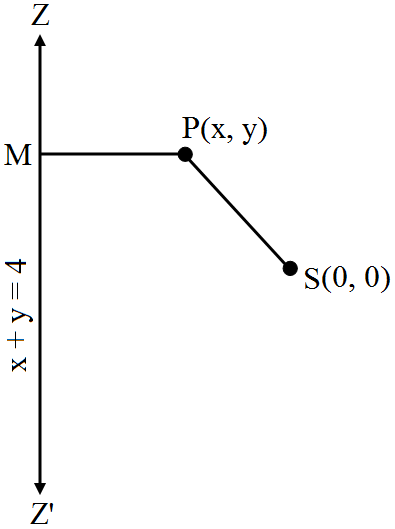
Draw PM perpendicular to x + y + 7 = 0.
Then, we have:
SP = PM
$\Rightarrow SP^2 = PM^2$
$\Rightarrow\ (\text{x} - 1)^2+ (\text{y} + 1)^2= \Big(\frac{\text{x+y+7}}{\sqrt{1+1}}\Big)^2$
$\Rightarrow\ (\text{x} - 1)^2+ (\text{y} + 1)^2= \Big(\frac{\text{x+y+7}}{\sqrt{2}}\Big)^2$
$\Rightarrow\ 2(\text{x}^2+1-2\text{x}+\text{y}^2+1+2\text{y})\\ \ \ =\text{x}^2+\text{y}^2+49+2\text{xy}+14\text{y}+14\text{x}$
$\Rightarrow\ (2\text{x}^2+2-4\text{x}+2\text{y}^2+2+4\text{y})\\ \ \ =\text{x}^2+\text{y}^2+49+2\text{xy}+14\text{y}+14\text{x}$
$\Rightarrow\ \text{x}^2+\text{y}^2-45-10\text{y}-2\text{xy}-18\text{x}=0$
Hence, the required equation is $x^2 + y^2 - 2xy - 18x - 10y - 45 = 0$. View full question & answer→MCQ 1371 Mark
If the lines $3 x-4 y-7=0$ and $2 s-3 y-5=0$ are two diameters of a circle of area $49 \pi$ square units, the equation of the circle is:
- A
$x^2+y^2+2 x-2 y-62=0$
- B
$x^2+y^2-2 x+2 y-62=0$
- ✓
$x^2+y^2-2 x+2 y-47=0$
- D
$x^2+y^2+2 x-2 y-47=0$
AnswerCorrect option: C. $x^2+y^2-2 x+2 y-47=0$
View full question & answer→MCQ 1381 Mark
One of the diameters of the circle $x^2+y^2-12 x+4 y+6=0$ is given by:
Answer
- x + 3y = 0
Solution:
The coordinate of the centre of the circle $x^2+y^2-12 x+4 y+6=0$ are $(6,-2)$
Clearly, the line $x+3 y$ passes through this point.
$x+3 y=0$ is a diameter of the given circle. View full question & answer→MCQ 1391 Mark
The latus-rectum of the conic $3\text{x}^2+4\text{y}^2-6\text{x}+8\text{y}-5=0$ is:
- ✓
$3$
- B
$\frac{\sqrt{3}}{2}$
- C
$\frac{2}{\sqrt{3}}$
- D
$\text{none of these}$
Answer$3\text{x}^2+4\text{y}^2-6\text{x}+8\text{y}-5=0$
$\Rightarrow3(\text{x}^2-2\text{x})+4(\text{y}^2+2\text{y})=5$
$\Rightarrow3(\text{x}^2-2\text{x}+1)+4(\text{y}^2+2\text{y}+1)=5+3+4$
$\Rightarrow3(\text{x}-1)^2+4(\text{y}+1)^2=12$
$\frac{(\text{x-1})^2}{4}+\frac{(\text{y}+1)^2}{3}=1$
So, $\text{a}=2$ and $\text{b}=\sqrt{3}$
$\therefore\ $Latus rectum $=\frac{2\text{b}^2}{\text{a}}$
$\\=2\frac{\big[\sqrt{3}\big]^2}{2}\\=3$
View full question & answer→MCQ 1401 Mark
Choose the correct answer. Equation of the circle with centre on the y-axis and passing through the origin and the point $(2, 3)$ is:
- ✓
$x^2+y^2+13 y=0$
- B
$3 x^2+3 y^2+13 x+3=0$
- C
$6 x^2+6 y^2-13 x=0$
- D
$x^2+y^2+13 x+3=0$
AnswerCorrect option: A. $x^2+y^2+13 y=0$
- $x^2+y^2+13 y=0$
Solution:
Let the equation of the circle be,
$(x - h)^2 + (y - k)^2 = r^2$
Let the centre be (0, a)
$\therefore$ Radius r = a
So, the equation of the circle is
$(x - 0)^2 + (y - a)^2 = a^2$
$\Rightarrow x^2 + (y - a)^2 = a^2$
$\Rightarrow x^2 + y^2 + a^2 - 2ay = a^2$
$\Rightarrow x^2 + y^2 - 2ay = 0 .....(i)$
(image)
Now, CP = r
$\Rightarrow\sqrt{(2-0)^2+(3-\text{a}^2)}=\text{a}$
$\Rightarrow\sqrt{4+9+\text{a}^2-6\text{a}}=\text{a}$
$\Rightarrow\sqrt{13+\text{a}^2-6\text{a}}=\text{a}$
$\Rightarrow13+\text{a}^2-6\text{a}=\text{a}^2$
$\Rightarrow13-6\text{a}=0$
$\therefore\ \text{a}=\frac{13}{6}$
Putting the value of a in eq. (i) we get
$\text{x}^2+\text{y}^2-2\Big(\frac{13}{6}\Big)\text{y}=0$
$\Rightarrow3\text{x}^2+3\text{y}^2-3\text{y}=0$
Note: (a) option is correct and is should be (dout solution) View full question & answer→MCQ 1411 Mark
If (x, 3) and (3, 5) are the extremities of a diameter of a circle with centre at (2, y), then the values of x and y are:
AnswerThe end points of the diameter of a circle are (x, 3) and (3, 5).
According to the question, we have:
$\frac{\text{x}+3}{2}=2,\ \text{y}=\frac{5+3}{2}$
$\Rightarrow\text{x}=1,\ \text{y}=4$
View full question & answer→MCQ 1421 Mark
If the equation $(4 a-3) x^2+a y^2+6 x-2 y+2=0$ represents a circle, then its centre is:
- A
$(3,-1)$
- B
$(3,1)$
- ✓
$(-3,1)$
- D
AnswerCorrect option: C. $(-3,1)$
- $(-3, 1)$
Solution:
If the equation $(4 a-3) x^2+a y^2+6 x-2 y+2=0$ represents a circle, then we have:
Coefficient of $\mathrm{x}^2=$ Coefficient of $\mathrm{y}^2$
$\Rightarrow 4 a-3=a$
$\Rightarrow a=1$
$\therefore$ Equation of the circle $=x^2+y^2+6 x-2 y+2=0$
Thus, the coordinates of the centre is $(-3,1)$. View full question & answer→MCQ 1431 Mark
The length of latus rectum of the parabola $(x-2 a)^2+y^2=x^2$ is:
Answer
- 4a
Solution:
We have, $(x-2 a)^2+y^2=x^2$
$x^2-4 a x+4 a^2+y^2=x^2$
$y^2=4 a x-4 a^2=4 a(x-a)$
Comparing it with standard parabola $\mathrm{Y}^2=4 \mathrm{bX}$
$Y=y, X=x-a, b=a$
We know length of latus rectum of parabola $Y^2=4 b X$ is $4 b$ length of latus rectum of given parabola is $=4 \times a=4 a$ View full question & answer→MCQ 1441 Mark
The equation of the conic $9 x^2-16 y^2=144$ is
- ✓
$\frac{5}{4}$
- B
$\frac{4}{3} $
- C
$\frac{4}{5}$
- D
$\sqrt7$
AnswerCorrect option: A. $\frac{5}{4}$
- $\frac{5}{4}$
Solution:
Standard form of a hyperbola $=\frac{\mathrm{x}^2}{16}-\frac{\mathrm{y}^2}{9}=1$
Here, $a^2=16$ and $y^2=9$
The eccentricity is calculated in the following way:
$b^2=a^2\left(e^2-1\right)$
$\Rightarrow 9=16\left(e^2-1\right)$
$\Rightarrow e^2-1=\frac{9}{16}$
$\Rightarrow e^2=\frac{25}{16}$
$\Rightarrow e=\frac{5}{4}$ View full question & answer→MCQ 1451 Mark
An ambulance company provides services within an 80 mile radius of their headquarters If this service area is represented graphically with the headquarters located at the coordinates (0, 0) what is the equation that represents the service area:
- A
$x^2+y^2=80$
- B
$(x-0)^2+(y-0)^2=80$
- C
$x^2+y^2=1600$
- ✓
$x^2+y^2=6400$
AnswerCorrect option: D. $x^2+y^2=6400$
- $x^2+y^2=6400$
Solution:
The general equation of a circle with center at $(a, b)$ and radius $r$ is $(x-a)^2+(y-b)^2=r^2$ so substituting the values we get the circle equation as $x^2+y^2=80^2=6400$ View full question & answer→MCQ 1461 Mark
The equation of the parabola with focus (0, 0) and directrix x + y = 4 is
AnswerCorrect option: A. $x^2+y^2-2 x y+8 x+8 y-16=0$
- $x^2+y^2-2 x y+8 x+8 y-16=0$
Solution:
Let P (x, y) be any point on the parabola whose focus is S (0, 0) and the directrix is x + y = 4.
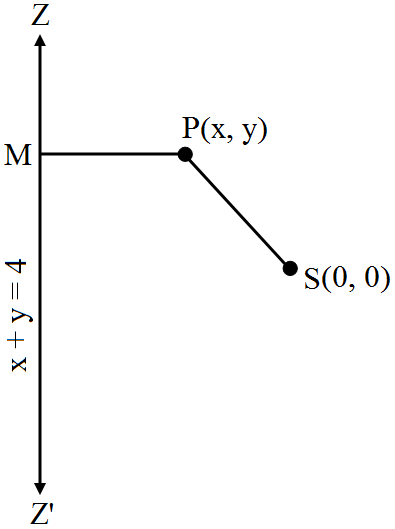
Draw PM perpendicular to x + y = 4.
Then, we have:
SP = PM
$\Rightarrow SP^2 = PM^2$
$\Rightarrow\ (\text{x}-0)^2+(\text{y}-0)^2=\Big(\frac{\text{x+y}-4}{\sqrt2}\Big)^2$
$\Rightarrow\ \text{x}^2+\text{y}^2=\Big(\frac{\text{x+y}-4}{\sqrt2}\Big)^2$
$\Rightarrow 2x^2 + 2y^2 = x^2 + y^2 + 16 + 2xy - 8x - 8y$
$\Rightarrow x^2 + y^2 - 2xy + 8x + 8y - 16 = 0$ View full question & answer→MCQ 1471 Mark
The length of the latus-rectum of the parabola $4 y^2+2 x-20 y+17=0$ is
- ✓
$3$
- B
$6$
- C
$\frac{1}{2}$
- D
$9$
Answer
- $\frac{1}{2}$
Solution:
Given:
$4 y^2+2 x-20 y+17=0$
$\Rightarrow\ \text{y}^2+\frac{\text{x}}{2}-5\text{y}+\frac{17}{4}=0$
$\Rightarrow\ \Big(\text{y}-\frac{5}{2}\Big)^2+\frac{\text{x}}{2}-2=0$
$\Rightarrow\ \Big(\text{y}-\frac{5}{2}\Big)^2=-1\Big(\frac{\text{x}}{2}-2\Big)$
$\Rightarrow\ \Big(\text{y}-\frac{5}{2}\Big)^2=\frac{-1}{2}(\text{x}-4)$
$\text{Let }\text{X}=\text{x}-4,\ \text{Y}=\text{y}-\frac{5}{2}$
$\therefore\ \text{Y}^2=\frac{-\text{X}}{2}$
$\therefore$ Length of the latus rectum $=\ 4\text{a}=\frac{1}{2}$ units View full question & answer→MCQ 1481 Mark
The radius of the circle with center (0, 0) and which passes through (-6, 8) is:
Answer$\text{r}=\sqrt{(6)^2+(-8)=10}$
View full question & answer→MCQ 1491 Mark
Find the area of $x^2+y^2=49$:
Answer
- 154
Solution:
Th eequation $x^2+y^2=49$ describes a circle with 7 as radius So the area is given as $\pi\text{r}^2$
$=\frac{22}{7}\times7^2=154$ View full question & answer→MCQ 1501 Mark
Choose the correct answer. The length of the latus rectum of the ellipse $3\text{x}^2+\text{y}^2=12$ is:
AnswerCorrect option: D. $\frac{4}{\sqrt{3}}$
- $\frac{4}{\sqrt{3}}$
Solution:
$3\text{x}^2+\text{y}^2=12$
$\Rightarrow\frac{\text{x}^2}{4}+\frac{\text{y}^2}{12}=1$
$\therefore\text{ a}^2=4$
$\Rightarrow\text{a}=2$
and $\text{b}^2=12$
$\Rightarrow\text{b}=2\sqrt{3}$
Since b > a, length of latus rectum $=\frac{2\text{a}^2}{\text{b}}=\frac{2\times4}{2\sqrt{3}}=\frac{4}{\sqrt{3}}$ View full question & answer→MCQ 1511 Mark
The equation of the ellipse with focus $(-1, 1),$ directrix $x - y + 3 = 0$ and eccentricity $\frac{1}{2}$ is:
- A
$7\text{x}^2+2\text{xy}+7\text{y}^2+10\text{x}+10\text{y}+7=0$
- ✓
$7\text{x}^2+2\text{xy}+7\text{y}^2+10\text{x}-10\text{y}+7=0$
- C
$7\text{x}^2+2\text{xy}+7\text{y}^2+10\text{x}-10\text{y}-7=0$
- D
$\text{None of these}$
AnswerCorrect option: B. $7\text{x}^2+2\text{xy}+7\text{y}^2+10\text{x}-10\text{y}+7=0$
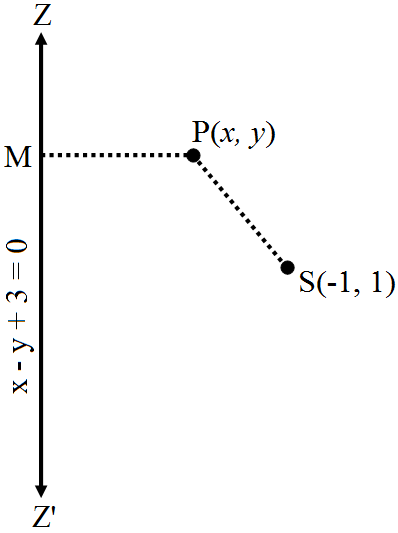
Let $P(x,y)$ be any point on the ellipse whose focus and eccentricity are $S(-1,1)$ and $\text{e}=\frac{1}{2},$
respectively.Let $PM$ be the perpendicular from $P$ on the directrix.
Then $\text{SP}=\text{e}\times\text{PM}$
$\Rightarrow\text{SP}=\frac{1}{2}\times\text{PM}$
$\Rightarrow2\text{SP}=\text{PM}$
$\Rightarrow4(\text{SP})^2=\text{PM}^2$
$\Rightarrow4\Big[(\text{x}+1)^2+(\text{y}-1)^2\Big]=\bigg(\frac{\text{x}-\text{y}+3}{\sqrt{1^2+}(-1)^2}\bigg)^2$
$\Rightarrow4\big[\text{x}^2+1+2\text{x}+\text{y}^2+1-2\text{y}\big]\\=\frac{{\text{x}^2+\text{y}^2+9-2\text{xy}-6\text{y}+6\text{x}}}{2}$
$\Rightarrow8\text{x}^2+8+16\text{x}+8\text{y}^2+8-16\text{y}\\=\text{x}^2+\text{y}62+9-2\text{xy}-6\text{y}+6\text{x}$
$\therefore7\text{x}^2+7\text{y}^2+2\text{xy}-10\text{y}+10\text{x}+7=0$
This is the required equation of the ellipse. View full question & answer→MCQ 1521 Mark
The difference of the focal distances of any point on the hyperbola is equal to
- A
length of the conjugate axis.
- B
- ✓
length of the transverse axis.
- D
AnswerCorrect option: C. length of the transverse axis.
Let P(x,y) be any point on the hyperbola, and S, S' be the focus with coordinates $(\pm\text{ae},0).$
⇒ S'P − SP = 2a
Thus, the difference of the focal distances of any point on the hyperbola is equal to the length of the transverse axis.
View full question & answer→MCQ 1531 Mark
A point moves in a plane so that its distances PA and PB from two fixed points A and B in the plane satisfy the relation PA − PB = k (k ≠ 0), then the locus of P is
- ✓
- B
A branch of the hyperbola.
- C
- D
AnswerLet P(x, y) be any point on the hyperbola $\frac{\text{x}^2}{\text{a}^2}-\frac{\text{y}^2}{\text{b}^2}=1.$
By definition, we have:
$\text{PA}=\text{e}\big(\text{x}-\frac{\text{a}}{\text{e}}\big)=\text{ex}-\text{a}$
$\text{and }\text{PB}=\text{e}\big(\text{x}+\frac{\text{a}}{\text{e}}\big)=\text{ex}+\text{a}$
$\therefore\text{PB}−\text{PA}=\text{(ex+a)}−\text{(ex}−\text{a})=\text{2a = k}$
View full question & answer→