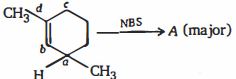
MCQ
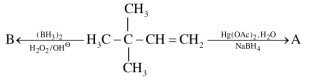
Choose the correct option for the following reactions.
  • A
    '$A$' and '$B$' are both Markovnikov addition products.
  • '$A$' is Markovnikov product and '$B$'is anti-Markovnikov product.
  • C
    '$A$' and '$B$' are both anti-Markovnikov products.
  • D
    '$B$' is Markovnikov and '$A$' is anti-Markovnikov product.
Answer

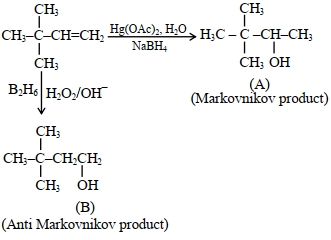
Correct option: B.
'$A$' is Markovnikov product and '$B$'is anti-Markovnikov product.
b

Need a full question paper?

Generate a complete, print-ready paper with questions like this in minutes — across 16+ boards, with answer keys.

Start Generating Free

Similar questions

Williamson synthesis of ether is an example of
The normality of $2.3\,M$  ${H_2}S{O_4}$ solution is ...... $N$ 
How the isomeric complexes $[Co(NH_3)_6][Cr(NO_2)_6]$ and $[Cr(NH_3)_6][Co(NO_2)_6]$ can be distinguished from one another by
Bromination take place at
Consider the following four elements which are represented according to long form of periodic table- Here $W, Y$ and $Z$ are left, up and right elements with respect to the element $'X'\,'Y'$ belongs to $16^{th}$ group and $2^{nd}$ period. Then according to given information the incorrect statement regarding given element is
A complex of certain metal has the magnetic moment of $4.91\, BM$ whereas another complex of the same metal with same oxidation state has zero magnetic moment. The metal ion could be
$\begin{array}{*{20}{c}}
  {C{H_3} - CH - C{H_3}\xrightarrow{{PB{r_3}}}X\xrightarrow{{{\text{Mg/ether}}}}Y\,\xrightarrow{{{{\text{H}}_2}{\text{O/}}{{\text{H}}^ + }}}} \\ 
  {|\,\,\,\,\,\,\,\,\,\,\,\,\,\,\,\,\,\,\,\,\,\,\,\,\,\,\,\,\,\,\,\,\,\,\,\,\,\,\,\,\,\,\,\,\,\,\,\,\,\,\,\,\,\,\,\,\,\,\,\,\,\,\,\,\,\,\,\,\,\,\,\,\,\,} \\ 
  {OH\,\,\,\,\,\,\,\,\,\,\,\,\,\,\,\,\,\,\,\,\,\,\,\,\,\,\,\,\,\,\,\,\,\,\,\,\,\,\,\,\,\,\,\,\,\,\,\,\,\,\,\,\,\,\,\,\,\,\,\,\,\,\,\,\,\,\,\,\,} 
\end{array}$ The final product is
The major product $(C)$ is
Compound $'P'$ on nitration with dil. $HNO _{3}$ yields two isomers $(A)$ and $(B).$ These isomers can be separated by steam distillation. Isomers $(A)$ and $(B)$ show the intramolecular and intermolecular hydrogen bonding respectively. Compound $(P)$ on reaction with conc. $HNO _{3}$ yields a yellow compound $'C',$ a strong acid. The number of oxygen atoms is present in compound ${ }^{\prime} C'\,....$
What amount of $Cl_2$ gas liberated at anode, if $1 $ amp. current is passed for $ 30 $ min. from $NaCl $ solution.