Question
Choose the correct option:

Answer

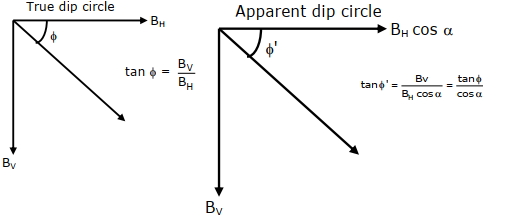
If apparent dip circle is at an angle $\alpha$ with true dip circle then

True dip circle

$[Image]$

Apparent dip circle

$[Image]$

As $\cos \alpha\,<1$

Hence true $\operatorname{dip}(\phi)$ is less than apparent $\operatorname{dip}\left(\phi^{\prime}\right)$
Need a full question paper?

Generate a complete, print-ready paper with questions like this in minutes — across 16+ boards, with answer keys.
Start Generating Free

Similar questions

A body of mass $m$ is accelerated uniformly from rest to a speed $v$ in a time $T$ . The instantaneous power delivered to the body as a function of time is given by
For a certain organ pipe, the first three resonance frequencies are in the ratio of $1:3:5$ respectively. If the frequency of fifth harmonic is $405\,Hz$ and the speed of sound in air is $324 \,ms ^{-1}$ the length of the organ pipe is $..........m.$
Vibration magnetometer before use, should be set
A student has $10$ resistors of resistance ‘$r$’. The minimum resistance made by him from given resistors is
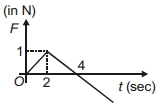
Force acting on a body varies with time as shown below. If initial momentum of the body is $\vec{p}$, then the time taken by the body to retain its momentum $\vec{p}$ again is ........... $s$
The equation of a stationary wave along a stretched string is given by $y = 5\,sin\, \frac{2\pi }{3}x\, cos\, 40\pi t$ where $x$ and $y$ are in $cm$ and $t$ is in $s$. The separation between two adjacent nodes is ..... $cm$
A watch shows time as $3:25$ when seen through a mirror, time appeared will be
Escape velocity on earth is $11.2\, km/s$. What would be the escape velocity on a planet whose mass is $1000$ times and radius is $10$ times that of earth ......... $km/sec$​
A particle of mass $m$ is moving in a circular path of constant radius $r$ such that its centripetal acceleration $a_c$ is varying with time $t$ as, $a_c = k^2rt^2,$ the power delivered to the particle by the forces acting on it is
In a circuit for finding the resistance of a galvanometer by half deflection method, a  $6\,V$  battery and a high resistance of  $11\,k\Omega $  are used. The figure of merit of the galvanometer $60\,\mu A/$  division. In the absence of shunt resistance, the galvanometer produces a deflection of  $\theta = 9$  divisions when current flows in the circuit. The value of the shunt resistance that can cause the deflection of $\theta /2 ,$  is closest to ..................  $\Omega$