Question
A watch shows time as $3:25$ when seen through a mirror, time appeared will be

Answer

(a)Subtract the given time from $\mathop {11}\limits^{hr.} :\mathop {60}\limits^{\min .} $

Need a full question paper?

Generate a complete, print-ready paper with questions like this in minutes — across 16+ boards, with answer keys.
Start Generating Free

Similar questions

In an $npn$ transistor, $108$ electrons enter the emitter in $10^{-8}$ second. If $1\%$ electrons are lost in the base, the fraction of current that enters the collector and current amplification factor are respectively
A $4\,\mu F$ condenser is connected in parallel to another condenser of $8\,\mu F$. Both the condensers are then connected in series with a $12\,\mu F$ condenser and charged to $20\;volts$. The charge on the plate of $4\,\mu F$ condenser is......$\mu C$
A thin rod of length$f/3$ lies along the axis of a concave mirror of focal length $f.$ One end of its magnified image touches an end of the rod. The length of the image is
The average dipole moment of $Fe$ atoms is $1.8 × 10^{-23}\ A-m^2$ . The magnetic moment of an iron rod of length $10\ cm$ and diameter $1\,cm$ is........$A-m^2$ : (density and at. wt. of $Fe$ are $7.87\ g/cm^3$ and   $55.87$ )
A charge of $8\; mC$ is located at the origin. Calculate the work done in $J$ in taking a small charge of $-2 \times 10^{-9} \;C$ from a point $P (0,0,3\; cm )$ to a point $Q (0,4\; cm , 0),$ via a point $R (0,6\; cm , g \;cm )$
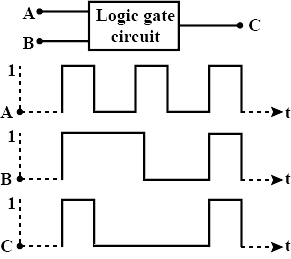
The following figure shows a logic gate circuit with two inputs $A$ and $B$ and the output $C.$ The voltage waveforms of $A, B$ and $C$ are as shown below. The logic circuit gate is
Statement I: In Young’s double slit experiment,the fringes produced by red light are closer as compared to those produced by blue light.
Statement II : The fringe width is directly proportional to the wavelength of light. In the light of above statements, choose the correct answer from the options given below :
Which of the following does not vary with plate or grid voltages
A mass of $1\, kg$ is hanging from a spring of spring constant $1\, N/m$. If Saroj pulls the mass down by $2\,m$. The work done by Saroj is......$J$
Two cars of masses $m_1$ and $m_2$ are moving in circles of radii $r_1$ and $r_2$, respectively. Their speeds are such that they make complete circles in the same time $t$. The ratio of their centripetal acceleration is