MCQ
Choose the correct option:
  • A
    Zeroth law gives the concept of temperature.
  • B
    Temperature measures the 'hotness' of the body.
  • C
    Heat flows from higher temperature to lower temperature until thermal equilibrium is attained.
  • D
    All of the above.

Answer

  1. All of the above.

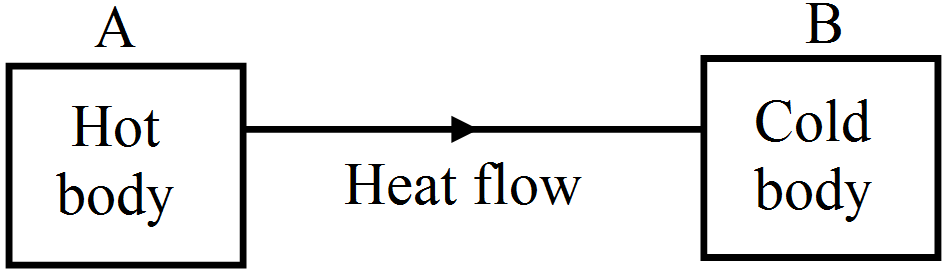
Heat flows from body A to body B because temperature of body A is higher. At thermal equilibrium, $\text{T}_\text{A}'=\text{T}_\text{B}'$

A in equilibrium with C A in equilibrium with B
B in equilibrium with C

Need a full question paper?

Generate a complete, print-ready paper with questions like this in minutes — across 16+ boards, with answer keys.

Start Generating Free

Similar questions

The mean free path of molecules of a certain gas at $STP$ is $1500\,d$, where $d$ is the diameter of the gas molecules. While maintaining the standard pressure, the mean free path of the molecules at $373\,K$ is approximately $..........\,d$
An organ pipe of length $L$ is open at one end and closed at other end. The wavelengths of the three lowest resonating frequencies that can be produced by this pipe are
A body of mass $2\,kg$ is moving with velocity $10 \,m/s$ towards east. Another body of same mass and same velocity moving towards north collides with former and coalsces and moves towards north-east. Its velocity is
The escape velocity from the surface of earth is ${V_e}$. The escape velocity from the surface of a planet whose mass and radius are $3$ times those of the earth will be
A flat plate is moving normal to its plane through a gas under the action of constant force $F$. The gas is kept at a very low pressure. The speed of the plate $v$ is much less than the average speed $u$ of the gas molecules. Which of the following options is/are true?

[$A$] The resistive force experienced by the plate is proportional to $\mathrm{v}$

[$B$] The pressure difference between the leading and trailing faces of the plate is proportional to uv

[$C$] The plate will continue to move with constant non-zero acceleration, at all times

[$D$] At a later time the external force $F$ balances the resistive force.

Faraday is the unit of
$Assertion :$ The Carnot cycle is useful in understanding the performance of heat engines.
$Reason :$ The Carnot cycle provides a way of determining the maximum possible efficiency achievable with reservoirs of given temperatures.
An ideal gas in a closed container is slowly heated. As its temperature increases, which of the following statements are true$?$

$(A)$ the mean free path of the molecules decreases.

$(B)$ the mean collision time between the molecules decreases.

$(C)$ the mean free path remains unchanged.

$(D)$ the mean collision time remains unchanged.
A train starting from rest first accelerates uniformly up to a speed of $80 \mathrm{~km} / \mathrm{h}$ for time $t$, then it moves with a constant speed for time 3t. The average speed of the train for this duration of journey will be (in $\mathrm{km} / \mathrm{h}$ ) :
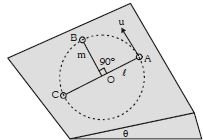
A small sphere of mass $m$ is suspended by a light and inextensible string of length $l$ from a point $O$ fixed on a smooth inclined plane of inclination $\theta $ with the horizontal. The sphere is moving in a circle on the incline as shown. If the sphere has a velocity $u$ at the top most position $A$ . Then,