MCQ
Choose the correct representation of conductometric titration of benzoic acid vs sodium hydroxide.
- A
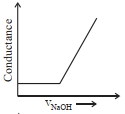
- ✓
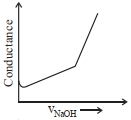
- C
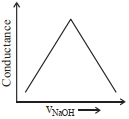
- D
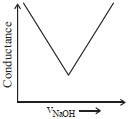
$( A ) \rightarrow( B )$ Free $H ^{+}$ions are replaced by $Na ^{\oplus}$ which decreases conductance.
$(B) \rightarrow (C)$ Un-dissociated benzoic acid reacts with $NaOH$ and forms salt which increases ions \ conductance increases.
$(C) \rightarrow (D)$ After equivalence point at (3), $NaOH$ added further increases $Na ^{\oplus}$ and $OH ^{\circ}$ ions which further increases the conductance.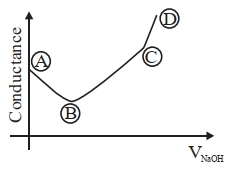
Generate a complete, print-ready paper with questions like this in minutes — across 16+ boards, with answer keys.
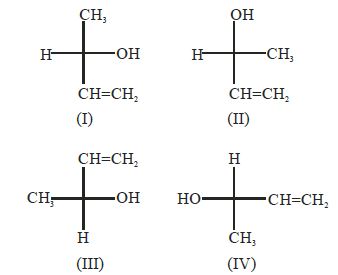
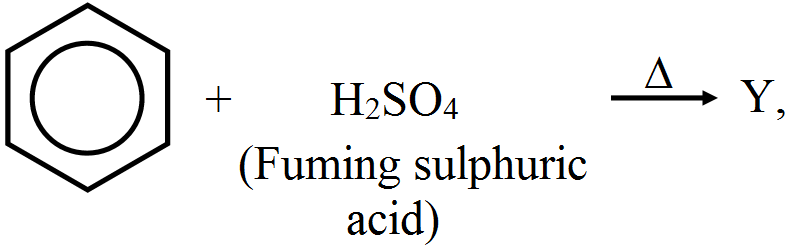
$ \mathrm{CH}_3-\mathrm{CH}_2-\mathrm{CH}\left(\mathrm{NO}_2\right)-\mathrm{COOH} $
$ \mathrm{CH}_3-\mathrm{CH}_2-\mathrm{CHBr}-\mathrm{CH}_2-\mathrm{CH}_3 $
$ \mathrm{CH}_3-\mathrm{CH}(\mathrm{I})-\mathrm{CH}_2-\mathrm{NO}_2 $
$ \mathrm{CH}_3-\mathrm{CH}_2-\mathrm{CH}(\mathrm{OH})-\mathrm{CH}_2 \mathrm{OH} $
$ \mathrm{CH}_3-\mathrm{CH}-\mathrm{CH}(\mathrm{I})-\mathrm{C}_2 \mathrm{H}_5 $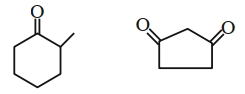
Here $A$ and $B$ on hydrolysis respectively gives