Question
Choose the correct statement

Answer

(d)

Need a full question paper?

Generate a complete, print-ready paper with questions like this in minutes — across 16+ boards, with answer keys.
Start Generating Free

Similar questions

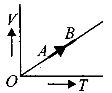
The volume $( V)$ of a monatomic gas varies with its temperature $(T)$ , as shown in the graph. The ratio of work done by the gas , to the heat absorbed by it, when it undergoes a change from state $A$ to state $B$ , is
The equation of a wave is $y = 2\sin \pi (0.5x - 200t)$, where $x$ and $y$ are expressed in $cm$ and $t$ in $sec.$ The wave velocity is  ...... $cm/sec$
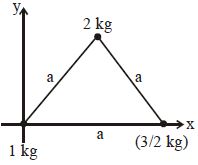
Three particles of masses $1\,kg,\,\frac {3}{2}\,kg$ , and $2\,kg$ are located at the vertices of an equilateral triangle of side $a$ . The $x, y$ coordinates of the centre of mass are
If $P = \frac{{{A^3}}}{{{B^{5/2}}}}$ and $\Delta A$ is absolute error in $A$ and $\Delta B$ is absolute error in $B$ then absolute error $\Delta P$ in $P$ is
The ratio of gravitational force and electrostatic repulsive force between two electrons is approximately (gravitational constant $=6.7 \times 10^{-11} \,Nm ^2 / kg ^2$, mass of an electron $=9.1 \times 10^{-31} \,kg$, charge on an electron $=1.6 \times 10^{-19} C$ )
If modulation index $\mu=\frac{1}{2}$ and $V_{ M }=2$ then $V_{ c }=\,?$
The binding energy of deuteron is $2.2\,\, MeV$ and that of $_2^4He $ is $28 \,\,MeV.$ If two deuterons are fused to form one $_2^4He $ then the energy  released is.........$MeV$
A fraction $f_1$ of a radioactive sample decays in one mean life, and a fraction $f_2$ decays in one half-life.
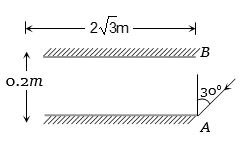
Two plane mirrors. $A$ and $B$ are aligned parallel to each other, as shown in the figure. A light ray is incident at an angle of $30^\circ $ at a point just inside one end of $A.$ The plane of incidence coincides with the plane of the figure. The maximum number of times the ray undergoes reflections (including the first one) before it emerges out is
Two waves are simultaneously passing through a string and their equations are :

${y}_{1}={A}_{1} \sin {k}({x}-v {t}), {y}_{2}={A}_{2} \sin {k}\left({x}-{vt}+{x}_{0}\right) .$ Given amplitudes ${A}_{1}=12\, {mm}$ and ${A}_{2}=5\, {mm}$ ${x}_{0}=3.5\, {cm}$ and wave number ${k}=6.28\, {cm}^{-1}$. The amplitude of resulting wave will be $......\,{mm}$