Question
Choose the correct statement

Answer

(d)

Nuclear force being a short range force becomes unstable with too many nucleons.

Need a full question paper?

Generate a complete, print-ready paper with questions like this in minutes — across 16+ boards, with answer keys.

Start Generating Free

Similar questions

A galvanometer having a resistance of $20\,\Omega $ and $30\, divisions$ on both sides has figure of merit $0.005\, ampere /division$. The resistance that should be connected in series such that it can be used as a voltmeter upto $15\, volt$ is ........... $\Omega$
Charge $Q$ is given a displacement $\vec r = a\hat i + b\hat j$ in an electric field $\vec E = E_1\hat i + E_2\hat j$ . The work done is
An electron has a mass of $9.1 \times {10^{ - 31}}kg$. It revolves round the nucleus in a circular orbit of radius $0.529 \times {10^{ - 10}}metre$ at a speed of $2.2 \times {10^6}m/s$. The magnitude of its linear momentum in this motion is
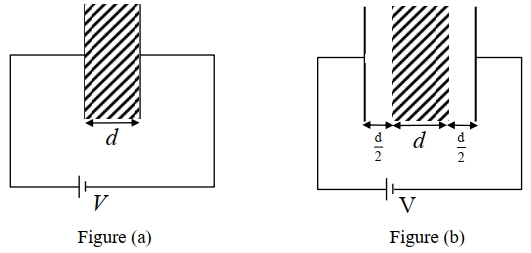
A medium having dielectric constant $K>1$ fills the space between the plates of a parallel plate capacitor. The plates have large area, and the distance between them is $d$. The capacitor is connected to a battery of voltage $V$. as shown in Figure ($a$). Now, both the plates are moved by a distance of $\frac{d}{2}$ from their original positions, as shown in Figure ($b$).

In the process of going from the configuration depicted in Figure ($a$) to that in Figure ($b$), which of the following statement($s$) is(are) correct?
If $\overrightarrow {\rm A} = 2\hat i + 3\hat j - \hat k$ and $\overrightarrow B = - \hat i + 3\hat j + 4\hat k$ then projection of $\overrightarrow A $ on $\overrightarrow B $ will be
A magnetic needle of negligible breadth and thickness compared to its length, oscillates in a horizontal plane with a period $T$. The period of oscillation of each part obtained on breaking the magnet into $n$ equal parts perpendicular to the length is
A particle is performing simple harmonic motion with amplitude A and angular velocity ${\omega }$. The ratio of maximum velocity to maximum acceleration is
A body starts from the origin and moves along the $X-$axis such that the velocity at any instant is given by $(4{t^3} - 2t)$, where $t$ is in sec and velocity in$m/s$. What is the acceleration of the particle, when it is $2\, m$ from the origin..........$m/{s^2}$
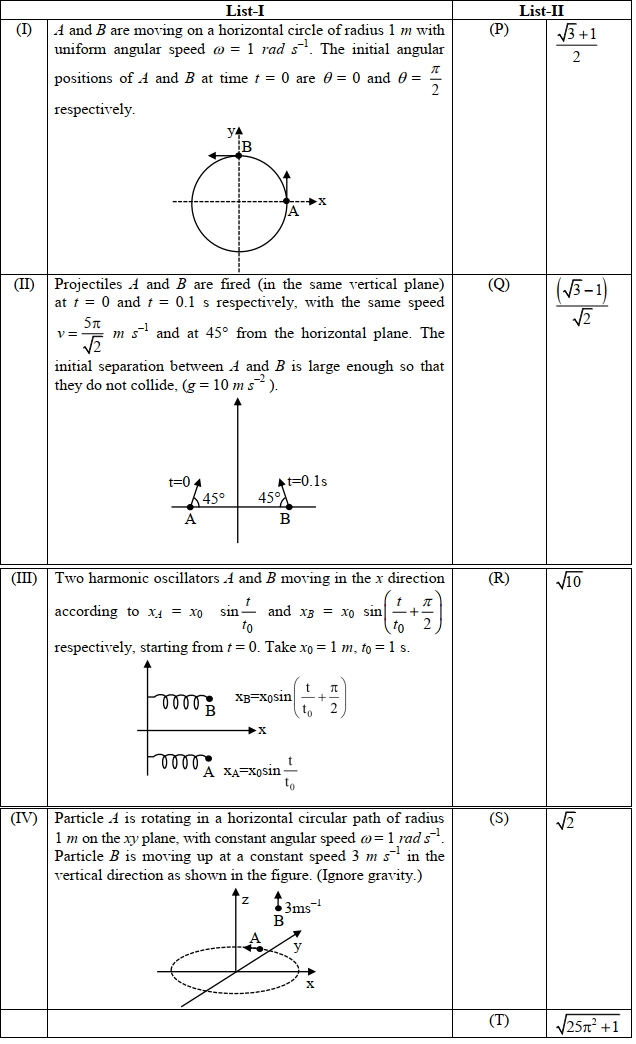
$List I$ describes four systems, each with two particles $A$ and $B$ in relative motion as shown in figure. $List II$ gives possible magnitudes of then relative velocities (in $ms ^{-1}$ ) at time $t=\frac{\pi}{3} s$.

Which one of the following options is correct?
A spherical solid ball of $10\,kg$ mass and radius $3\,cm$ is rotating about an axis passing through its centre with an angular velocity of $50\,radian/s$ the kinetic energy of rotation is ....... $J.$