MCQ
Choose the incorrect statement about the two circles whose equations are given below

$x^{2}+y^{2}-10 x-10 y+41=0$ and $x^{2}+y^{2}-16 x-10 y+80=0$

  • A
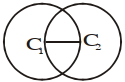
    Distance between two centres is the average of radii of both the circles.
  • Both circles' centres lie inside region of one another.
  • C
    Both circles pass through the centre of each other.
  • D
    Circles have two intersection points.

Answer

Correct option: B.
Both circles' centres lie inside region of one another.
b
$r _{1}=3, c _{1}(5,5)$

$r _{2}=3, c _{2}(8,5)$

$C _{1} C _{2}=3, r _{1}=3, r _{2}=3$

Need a full question paper?

Generate a complete, print-ready paper with questions like this in minutes — across 16+ boards, with answer keys.

Start Generating Free

Similar questions

Seven white balls and three black balls are randomly placed in a row. The probability that no two black balls are placed adjacently equals:
A variable straight line $AB$ divides the circumference of the circle $x^2 + y^2 = 25$ in the ratio $1 : 2$ . If a tangent $CD$ is drawn to the smaller arc parallel to $AB$ , such that $ABCD$ is a rectangle, then locus of $C$ & $D$ is (as shown in the figure) 
The quadratic equation whose one root is $2 - \sqrt 3 $ will be
If the coordinates of one end of the diameter of the circle ${x^2} + {y^2} - 8x - 4y + c = 0$ are $(-3, 2)$, then the coordinates of other end are
The equation of the circle whose diameters have the end points $(a, 0), (0, b)$ is given by
If $\lambda $ be the ratio of the roots of the quadratic equation in $x, 3m^2x^2 + m(m -4)x + 2 = 0$, then the least value of $m$ for which $\lambda  + \frac{1}{\lambda } = 1$, is
If $\text{e}^{\text{f(x)}}=\frac{10+\text{x}}{10-\text{x}},\text{ x}\in(-10,10)$ and $\text{f(x)}=\text{kf}\Big(\frac{200\text{x}}{100+\text{x}^2}\Big),$ then k =
If $\text{z}_1,\text{z}_2$ and $\text{z}_1,\text{z}_4$ are two pairs of con ju gate com plex num bers, then $\text{arg}\Big(\frac{\text{z}^1}{\text{z}^4}\Big)+\text{arg}\Big(\frac{\text{z}^2}{\text{z}^3}\Big)$is equal to:
If the equation $y = mx + c$ and $x\cos \alpha + y\sin \alpha = p$ represents the same straight line, then
Suppose A1, A2, ..., A30  are thirty sets each having 5 elements and B1, B2, ..., Bn are n sets each with 3 elements. Let $\bigcup\limits^{30}_\text{i = 1}\text{A}_\text{i}=\bigcup\limits^{\text{n}}_\text{j = 1}\text{B}_\text{j}=\text{S}$  and each element of S belong to exactly 10 of the Ai's and exactly 9 of the Bj's, then n is equal to:
  1. 15
  2. 3
  3. 45
  4. 35.