MCQ
Choose the state variable from the given options:
  • A
    Heat.
  • B
    Work.
  • Internal energy.
  • D
    All of these.

Answer

Correct option: C.
Internal energy.

Need a full question paper?

Generate a complete, print-ready paper with questions like this in minutes — across 16+ boards, with answer keys.
Start Generating Free

Similar questions

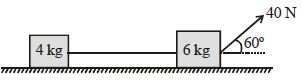
The tension in the string which connected the blocks as shown in the following figure  ............ $ N$
A projectile is projected with speed $u$ at an angle $\theta$ with the horizontal. The average velocity of the projectile between the instants it crosses the same level is ............
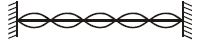
A string fixed at its both ends vibrates in $5\,\,loops$  as shown in the figure  

The total number of nodes and antinodes are respectively
A spherical cavity of radius $r$ is curved out of a uniform solid sphere of radius $R$ as shown in the figure below. The distance of the centre of mass of the resulting body from that of the solid sphere is given by
A horizontal curve on $a$ racing track is banked at a $45^o $ angle. When a vehicle goes around this curve at the curve’s safe speed (no friction needed to stay on the track), what is its centripetal acceleration?
A spring block system in horizontal oscillation has a time-period $T$. Now the spring is cut into four equal parts and the block is re-connected with one of the parts. The new time period of vertical oscillation will be
The process in which no heat enters or leaves the system is termed as
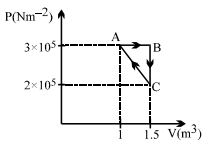
Considere the thermodynamics cycle shown on $PV$ diagram. The process $A \rightarrow B$ is isobaric, $B \rightarrow C$ is isochoric and $C \rightarrow A$ is a straight line process. The following internal energy and heat are given $: \Delta U_{A \rightarrow B} = + 400\,\, kJ$ and $Q_{B \rightarrow C} = - 500\,\, kJ$ The heat flow in the process $Q_{C \rightarrow A}$ is  ...... $kJ$
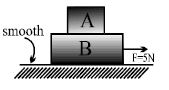
In the shown arrangement mass of $A = 1\,\,kg$  mass of  $B = 2\,\,kg.$  Coefficient of friction between $A $ and $B = 0.2.$  There is no friction between $B$  and ground. The frictional force exerted by $A$ on $B$ equals to
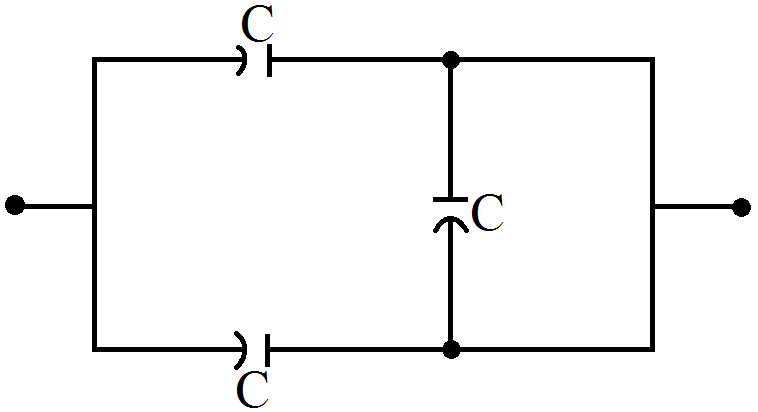
The equivalent capacitance of the combination shown in figure is: