MCQ
Choose the wrong option.
  • A
    Inertial mass is a measure of difficulty of accelerating a body by an external force whereas the gravitational mass is relevant in determining the gravitational force on it by an external mass.
  • B
    That the gravitational mass and inertial mass are equal is an experimental result.
  • C
    That the acceleration due to gravity on earth is the same for all bodies is due to the equality of gravitational mass and inertial mass.
  • Gravitational mass of a particle like proton can depend on the presence of neighouring heavy objects but the inertial mass cannot.
Answer

Correct option: D.
Gravitational mass of a particle like proton can depend on the presence of neighouring heavy objects but the inertial mass cannot.
Key concept:
Inertial mass: It is the mass of the material body, which measures its inertia.
Gravitational Mass: It is the mass of the material body, which determines the gravitational pull acting upon it. According to the principle of equivalence, Gravitational mass of proton is equivalent to its inertial mass and is independent of presence of neighboring heavy objects.
Important point: Comparison between inertial and gravitational mass:
Both are measured in the same units.
Both are scalars.
Both do not depend on the shape and state of the body.
Inertial mass is measured by applying Newton’s second law of motion whereas gravitational mass is measured by applying Newton’s law of gravitation.
Spring balance measures gravitational mass and inertial balance measure inertial mass.

Need a full question paper?

Generate a complete, print-ready paper with questions like this in minutes — across 16+ boards, with answer keys.

Start Generating Free

Similar questions

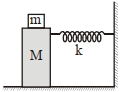
In the given figure, a mass $M$ is attached to a horizontal spring which is fixed on one side to a rigid support. The spring constant of the spring is $k$. The mass oscillates on a frictionless surface with time period $T$ and amplitude $A$. When the mass is in equilibrium position, as shown in the figure, another mass $m$ is gently fixed upon it. The new amplitude of oscillation will be
A metal block of mass $m$ is suspended from a rigid support through a metal wire of diameter $14\,mm$. The tensile stress developed in the wire under equilibrium state is $7 \times 10^5\,Nm ^{-2}$. The value of mass $m$ is $......kg$.

(Take, $g =9.8\,ms ^{-2}$ and $\left.\pi=\frac{22}{7}\right)$

If a capillary tube is dipped into liquid and the levels of the liquid inside and outside are same, then the angle of contact is ...... $^o$
A tuning fork of frequency $340\,\, Hz$ is vibrated just above a cylindrical tube of length $120 \,\,cm$. Water is slowly poured in the tube. If the speed of sound is $340\,\, ms^{-1}$ then the minimum height of water required for resonance is .... $cm$
A meter stick is held vertically with one end on the floor and is allowed to fall. The speed of the other end when it hits the floor assuming that the end at the floor does not slip is ......... $m / s$ $\left(g=9.8 \,m / s ^2\right)$
A stone is projected from the ground with velocity $50 \,m/s$ at an angle of ${30^o}$. It crosses a wall after $3$ sec. How far beyond the wall the stone will strike the ground ..........  $m$ $(g = 10\,m/{\sec ^2})$
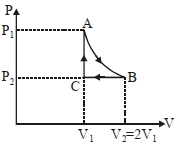
$n$ mole a perfect gas undergoes a cyclic process $ABCA$ (see figure) consisting of the following processes.

$A \rightarrow B :$ Isothermal expansion at temperature $T$ so that the volume is doubled from $V _{1}$ to $V _{2}=2 V _{1}$ and pressure changes from $P _{1}$ to $P _{2}$

$B \rightarrow C :$ Isobaric compression at pressure $P _{2}$ to initial volume $V _{1}$

$C \rightarrow A$ : Isochoric change leading to change of pressure from $P _{2}$ to $P _{1}$

Total workdone in the complete cycle $ABCA$ is

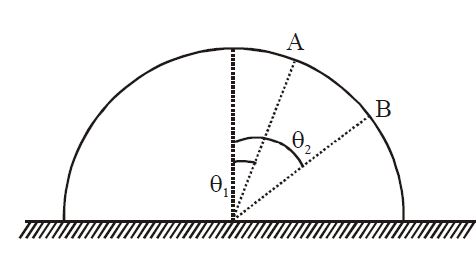
A small block slides down from rest at point $A$ on the surface of a smooth cylinder, as shown. At point $B$, the block falls off (leaves) the cylinder. The equation relating the angles $\theta_1$ and $\theta_2$ is given by
The electrical resistance $R$ of a conductor of length $l$ and area of cross section $a$ is given by $R = \frac{{\rho l}}{a}$ where $\rho$ is the electrical resistivity. What a is the dimensional formula for electrical conductivity $\sigma $ which is reciprocal of resistivity?
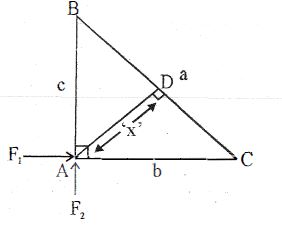
Two forces acting on point $A$ along their side and having magnitude reciprocal to length of side then resultant of these forces will be proportional to