MCQ
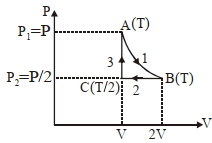
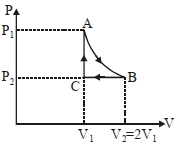
$n$ mole a perfect gas undergoes a cyclic process $ABCA$ (see figure) consisting of the following processes.

$A \rightarrow B :$ Isothermal expansion at temperature $T$ so that the volume is doubled from $V _{1}$ to $V _{2}=2 V _{1}$ and pressure changes from $P _{1}$ to $P _{2}$

$B \rightarrow C :$ Isobaric compression at pressure $P _{2}$ to initial volume $V _{1}$

$C \rightarrow A$ : Isochoric change leading to change of pressure from $P _{2}$ to $P _{1}$

Total workdone in the complete cycle $ABCA$ is
  • A
    $0$
  • B
    $nRT \left(\ln 2+\frac{1}{2}\right)$
  • C
    $nRTIn2$
  • $nRT \left(\ln 2-\frac{1}{2}\right)$
Answer

Correct option: D.
$nRT \left(\ln 2-\frac{1}{2}\right)$
d
$W _{\text {Isothermal }}= nRT \ln \left(\frac{ v _{2}}{ v _{1}}\right)$

$W _{\text {Isobaric }}= P \Delta V = nR \Delta T$

$W _{\text {Isochoric }}=0$

$W _{1}= nRT \ln \left(\frac{2 V }{ V }\right)= nRT \ln 2$

$W _{2}= nR \left(\frac{ T }{2}- T \right)=- nR \frac{ T }{2}$

$W _{3}=0$

$\Rightarrow W _{ net }= W _{1}+ W _{2}+ W _{3}$

$W _{ net }= nRT \left(\ln 2-\frac{1}{2}\right)$

Need a full question paper?

Generate a complete, print-ready paper with questions like this in minutes — across 16+ boards, with answer keys.

Start Generating Free

Similar questions

A sample of gas expands from $V_1$ to $V _2$. In which of the following, the work done will be greatest ?
Of the following the one which emits sound of higher pitch is
Block of $1 kg$ is initially in equilibrium and is hanging by two identical springs $A$ and $B$ as shown in figures. If spring $A$ is cut from lower point at $t=0$ then, find acceleration of block in $ms^{^{-2}}$ at $t = 0.$
The frequency of a sound wave is $n$ and its velocity is $v.$ If the frequency is increased to $4n,$ the velocity of the wave will be:
Angular momentum is
The variation of the acceleration $a$ of the particle executing $S.H.M.$ with displacement $x$ is as shown in the figure
A metallic sphere having mass $2\ kg$ is moving with a velocity of $10\ m/ s.$ The momentum of the sphere in $\ce{kg metre/ sec.}$ will be$-$
According to Bernoulli's equation, $\frac{\text{P}}{\rho\text{g}}+\text{h}+\frac{1\text{v}^2}{2\text{g}}=\text{constant}.$ The term, $\frac{\text{P}}{\rho\text{g}},\text{h}$ and $\frac{1\text{v}^2}{\text{2g}}$ are generally called respectively:
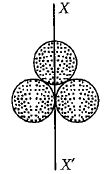
Three identical spherical shells, each of mass $m$ and radius $r$ are placed as shown in figure. Consider an axis $XX'$ which is touching to two shells and passing through diameter of third shell. Moment of inertia of the system consisting of these three spherical shells about $XX'$ axis is
A particle moves along a circle with a constant angular speed $\omega$ Its displacement,with respect to this position of the particle at time $t = 0$ is plotted against time. The graph would look like