MCQ
Chromatic aberration of lens can be corrected by
  • A
    Reducing its aperature
  • B
    Proper polishing of its two surfaces
  • Suitably combining it with another lens
  • D
    Providing different suitable curvature to its two surfaces

Answer

Correct option: C.
Suitably combining it with another lens
c
(c)

Need a full question paper?

Generate a complete, print-ready paper with questions like this in minutes — across 16+ boards, with answer keys.
Start Generating Free

Similar questions

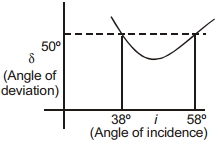
A plot between the angle of deviation and angle of incidence is shown in figure. From the graph one can say that the prism angle is .......
Consider the two idealised systems $(i)$ a parallel plate capacitor with large plates and small separation and $(ii)$ a long solenoid of length $L >> R$, radius of cross-section. In $(i)\, E$ ideally treated as a constant between plates and zero outside. In $(ii)$ magnetic field is constant inside the solenoid and zero outside. These idealised assumptions, however, contradict fundamental laws as below
The resistance of the series combination of two resistance is $S$. When they are joined in parallel the total resistance is $P$. If $S = nP$, then the minimum possible value of $n$ is
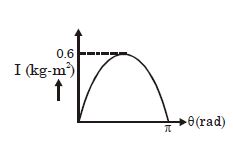
Figure shows the variation of the moment of inertia of a uniform rod, about an axis passing through its centre and inclined at an angle $\theta$ to the length. The moment of inertia of the rod about an axis passing through one of its ends and making an angle $\theta  = \frac{\pi }{3}$ will be ........ $ kg-m^2$.
A car sometimes overturns while taking a turn. When it overturns, it is
If the length of the simple pendulum is increased by $44\%$, then what is the change in time period of pendulum ..... $\%$
The speed of sound in air at a given temperature is $350 m/s$. An engine blows whistle at a frequency of $1200 \,cps$. It is approaching the observer with velocity $50 m/s$. The apparent frequency in cps heard by the observer will be
If the length of the second's hand in a stop clock is $3 \,cm$ the angular velocity and linear velocity of the tip is
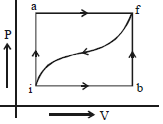
When a system is taken from a state $i$ to $f$ along the path $iaf$ (as shown in the figure). $Q = 50\, cal$ and $W = 20\, cal$ ; along path $ibf,$ $Q = 36\, cal.$

$(i)$ What is $W$ along path $ibf$ ?

$(ii)$ If $W = 13$ cal for path $fi$, what is $Q$ for the path $fi$ ?

$(iii)$ Take $E_{int,i} = 10\,\, cal$ then what is $E_{int,f}$ ?
$3$ identical bulbs are connected in series and these together dissipate a power $P$. If now the bulbs are connected in parallel, then the power dissipated will be