Question
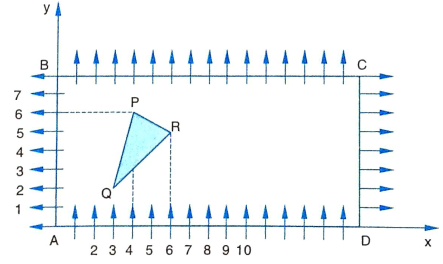
Class IX students of a school in Moti Nagar, Delhi have been allotted a rectangular plot of land, adjacent to their school, for gardening activity. Saplings of Gulmohar are planted on the boundary at a distance of 1 m from each other. There is a triangular grassy lawn in the plot as shown in Fig. The students are to sow seeds of flowering plants on the remaining area of the plot. Considering A as origin, AD along $x$-axis and AB along $y$-axis, answer the following questions:
Image
(i) The coordinates of A are
(a) $(0,1)$$\quad$(b) $(1,0)$$\quad$(c) $(0,0)$$\quad$(d) $(-1,-1)$
(ii) The coordinates of P are
(a) $(4,6)$$\quad$(b) $(6,4)$$\quad$(c) $(4,5)$$\quad$(d) $(5,4)$
(iii) The coordinates of R are
(a) $(6,5)$$\quad$(b) $(5,6)$$\quad$(c) $(6,0)$$\quad$(d) $(7,4)$
(iv) The coordinates of D are
(a) $(16,0)$$\quad$(b) $(6,0)$$\quad$(c) $(0,16)$$\quad$(d) $(16,1)$
Answer

(i) (c): A is the origin, so its coordinates are $(0,0)$.
(ii) (a): The coordinates of P are $(4,6)$.
(iii) (a): The coordinates of R taking AD and AB as the coordinate axes are $(6,5)$.
(iv) (a): Point D lies on $x$-axis at 16 units away from the origin. So, coordinates of D are $(16,0)$.

Need a full question paper?

Generate a complete, print-ready paper with questions like this in minutes — across 16+ boards, with answer keys.

Start Generating Free

Similar questions

A carton contains both fragrant and non-fragrant liquid soap bottles.
Write an equation representing the number of fragrant and non$-$fragrant bottles in the carton.
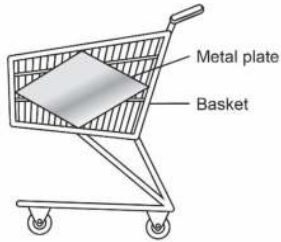
The figure below shows the side view of a shopping trolley. The metal plate is fixed on the side by the store keeper for advertisement.Image
$6.$ Three angles of the basket are obtuse. Which type of angle is the fourth$?$
$A.$ Acute
$B.$ Obtuse
$C.$ Right
$D.$ Relex
$7.$ What is the shape of the metal plate$?$
$A.$ Square
$B.$ ectangle
$C.$ Rhombus
$D.$ Parallelogram
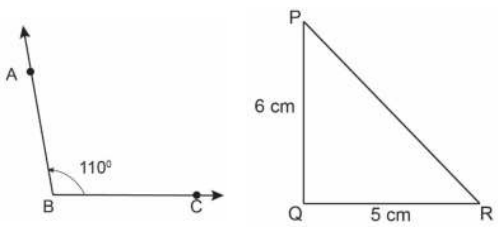
Raghvan claims that the magnitude of the angle $ABC$ is greater than the magnitude of the area of the right triangle $PQR.$Image
$7.$ Is his claim correct$?$ Why$?$
$8.$ Two lines intersect at a point $P.$
Which of the following is true for the distance between the two lines as they travel beyond point $P?$
$A.$ The distance becomes constant.
$B.$ The distance increases continuously.
$C.$ The distance decreases continuously.
$D.$ The distance increases and decreases depending upon the intersection point.
$9. $ Balan says, ‘The measure of all right angles cannot be equal as their arms can be of different lengths.’
Why is Balan’s statement not true$?$
$A.$ The measure of an angle depends upon its orientation.
$B.$ The measure of an angle depends upon the instrument used to measure it.
$C.$ The measure of an angle depends on the length of its angle arms.
$D.$ The measure of an angle depends upon the rotation of one arm on another.
$10.$ TAB is a straight line. $C$ is the mid-point of $AB. D$ is the mid-point of $AC.$
Which of the following shows the relation between the line segments?
$A. AD =\frac{1}{2} AB$
$B. AD =\frac{1}{2} CB$
$C. AD =2 AC$
$D. AD =2 DC$
Read the following text carefully and answer the questions that follow:
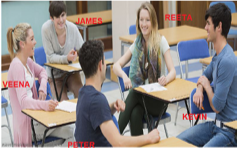
Peter, Kevin James, Reeta and Veena were students of Class $9^{th}\ B$ at Govt Sr Sec School, Sector $5,$ Gurgaon.
Once the teacher told Peter to think a number $x$ and to Kevin to think another number $y$ so that the difference of the numbers is $10 (x > y).$
Now the teacher asked James to add double of Peter's number and that three times of Kevin's number, the total was found $120.$
Reeta just entered in the class, she did not know any number.
The teacher said Reeta to form the $1^{st}$ equation with two variables $x$ and $y.$
Now Veena just entered the class so the teacher told her to form $2^{nd}$ equation with two variables $x$ and $y.$
Now teacher Told Reeta to find the values of $x$ and $y.$ Peter and kelvin were told to verify the numbers $x$ and $y.$
Image

$i.$ What are the equation formed by Reeta and Veena?
$ii.$ What was the equation formed by Veena?
$iii.$ Which number did Peter think?
OR
Which number did Kelvin think?
Which of the following statements is true$?$
$3.$ Irrational numbers can provide more precision on measuring scale.
What can be the possible arguments in favour and against this statement$?$
Read the Source/ Text given below and answer these questions:

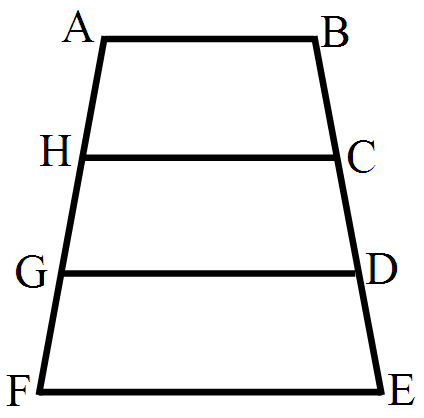
Sohan wants to show gratitude towards his teacher by giving her a card made by him. He has three pieces of trapezium pasted one above the other as shown in fig. These pieces are arranged in a way that $AB \| HC \| GD \| FE.$ Also $BC = CD = DE$ and $AH = HG = GF = 6\ cm.$ He wants to decorate the card by putting up a colored tape on the nonparallel sides of the trapezium.

$i.$ Find the total length of colored tape required if $DE = 4\ cm.$
$a. 20\ cm$
$b. 30\ cm$
$c. 40\ cm$
$d. 50\ cm$
$ii. \text{ABHC}$ is a trapezium in which $AB \| HC$ and $\angle\text{A}=\angle\text{B}=45^\circ.$ Find angles $C$ and $H$ of the trapezium.
$a. 135, 130$
$b. 130, 135$
$c. 135, 135$
$d. 130, 130$
$iii.$ What is the difference between trapezium and parallelogram$?$
$a.$ Trapezium has $2$ sides, and parallelogram has $4$ sides.
$b.$ Trapezium has $4$ sides, and parallelogram has $2$ sides.
$c.$ Trapezium has $1$ pair of parallel sides, and parallelogram has $2$ pairs of parallel sides.
$d.$ Trapezium has $2$ pairs of parallel sides, and parallelogram has $1$ pair of parallel sides.
$iv.$ Diagonals in isosceles trapezoid are $ ...........$
$a.$ parallel.
$b.$ opposite.
$c.$ vertical.
$d.$ equal.
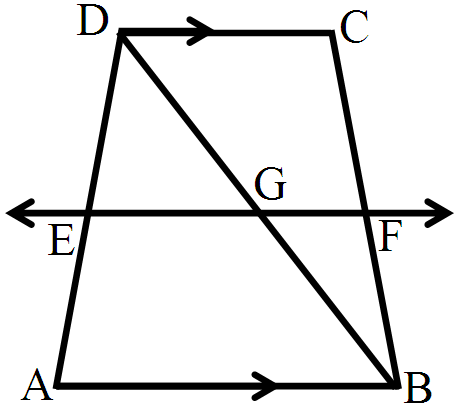
$v. \text{ABCD}$ is a trapezium where $AB \| DC, BD$ is the diagonal and $E$ is the midpoint of $AD. A$ line is drawn through $E$ parallel to $AB$ intersecting $BC$ at $F.$ Which of these is true$?$

$a. BF = FC$
$b. EA = FB$
$c. CF = DE$
$d.$ None of these