Questions

Case study (4 Marks)

Take a timed test

5 questions · self-marked practice — reveal the answer and mark yourself.

Question 14 Marks
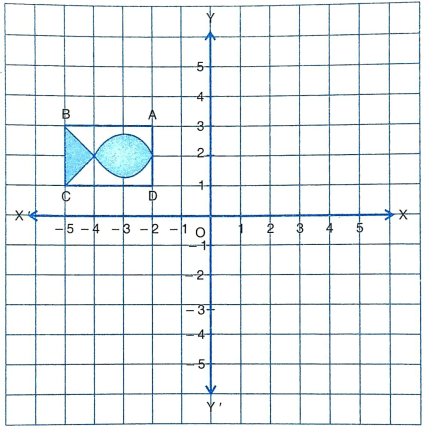
For Maths integrated project, Sonia created a symmetrical design on Cartesian plain. She drew a fish in a rectangle ABCD in the 2nd quadrant as shown in figure.
Image
Based on the above information, answer the following questions:
(i) Find the sum of abscissa of points A and B.
(ii) Find the area of rectangle ABCD.
(iii) What will be the new coordinates of A, B, C and D to draw the reflection of fish in the $3^{\text {rd }}$ quadrant across $x$-axis.
(iv) What will be the new coordinates of A, B, C and D to draw the fish by shifting each vertex of the rectangle 5 units to the right.
Answer
(i) -7
(ii) 6 sq. units
(iii) $A(-2,-3), B(-5,-3), C(-5,-1), D(-2,-1)$
(iv) $A(3,3), B(0,3), C(0,1), D(3,1)$
View full question & answer
Question 24 Marks
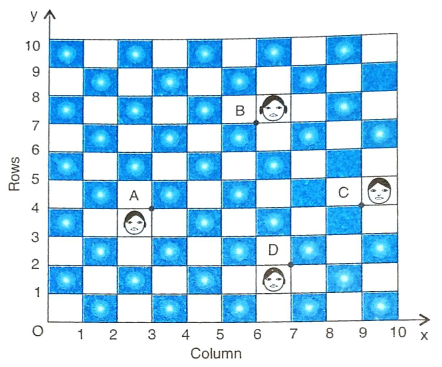
Four persons John, Saurabh, Salim and Ratan are sitting in a courtyard at points A, B, C and D respectively as shown in Fig. The courtyard has been divided into small squares by drawing equally spaced horizontal and vertical lines. Taking OX and OY as the coordinates axes answer the following questions:
Image
(i) The distance between John and Salim is
(a) 6 units $\quad$(b) 4 units $\quad$(c) 5 units $\quad$(d) 7 units
(ii) The distance between John and Saurabh is
(a) 6 units $\quad$(b) $3 \sqrt{2}$ units $\quad$(c) $6 \sqrt{2}$ units $\quad$(d) $2 \sqrt{2}$ units
(iii) The distance between John and Ratan is
(a) $2 \sqrt{5}$ units $\quad$(b) $2 \sqrt{10}$ units $\quad$(c) $\sqrt{5}$ units $\quad$(d) 20 units
(i) The coordinates of point A are
(a) $(4,3)$ $\quad$(b) $(3,4)$ $\quad$(c) $(3,3)$ $\quad$(d) $(4,4)$
Answer
(i) (a): If we start from John and move horizontally, we reach to Salim after moving through 6 units. So, distance between John and Salim is 6 units.
(ii) (b): To reach to Saurabh from John, we first move 3 units horizontally and again 3 units vertically. So, a right triangle is formed with base and perpendicular each equal to 3 units.
$\therefore \quad$ Distance between Saurabh and John $=\sqrt{3^2+3^2}=3 \sqrt{2}$ units
(iii) (a): In order to reach to Ratan from John, first move 4 units horizontally and then 2 units vertically downward forming a right triangle with two sides of lengths 4 units and 2 units respectively.
$\therefore \quad$ Distance between John and Ratan $=\sqrt{4^2+2^2}=2 \sqrt{5}$ units
(vi) (b): Point A is 3 units away from $y$-axis and 4 units from $x$-axis, so its coordinates are $(3,4)$.
View full question & answer
Question 34 Marks
Four persons John, Saurabh, Salim and Ratan are sitting in a courtyard at points A, B, C and D respectively as shown in Fig. The courtyard has been divided into small squares by drawing equally spaced horizontal and vertical lines. Taking OX and OY as the coordinates axes answer the following questions:
Image
(i) The coordinates of point A are
(a) $(4,3)$ $\quad$(b) $(3,4)$ $\quad$(c) $(3,3)$ $\quad$(d) $(4,4)$
(ii) The coordinates of point B are
(a) $(7,6)$ $\quad$(b) $(7,7)$ $\quad$(c) $(6,6)$ $\quad$(d) $(6,7)$
(iii) The coordinates of point C are
(a) $(9,3)$ $\quad$(b) $(9,4)$ $\quad$(c) $(4,9)$ $\quad$(d) $(10,4)$
(iv) The coordinates of point D are
(a) $(7,2)$ $\quad$(b) $(8,2)$ $\quad$(c) $(6,2)$ $\quad$(d) $(2,7)$
Answer
(i) (b): Point A is 3 units away from $y$-axis and 4 units from $x$-axis, so its coordinates are $(3,4)$.
(ii) (d): To reach to point B , we first move 6 units along $x$-axis and then vertically 7 units parallel to $y$-axis. So, its coordinates are $(6,7)$.
(iii) (b): The point C can be reached by moving 9 units horizontally and then 4 units vertically. So, its coordinates are $(9,4)$.
(iv) (a): If 7 units are moved along $x$-axis and then 2 units parallel to $y$-axis, the point D is obtained. So, its coordinates are $(7,2)$.
View full question & answer
Question 44 Marks
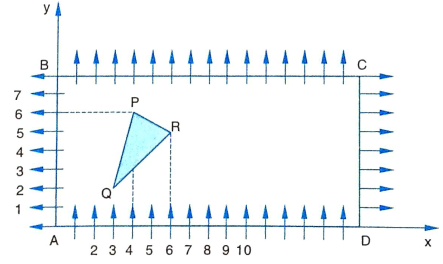
Class IX students of a school in Moti Nagar, Delhi have been allotted a rectangular plot of land, adjacent to their school, for gardening activity. Saplings of Gulmohar are planted on the boundary at a distance of 1 m from each other. There is a triangular grassy lawn in the plot as shown in Fig. The students are to sow seeds of flowering plants on the remaining area of the plot. Considering A as origin, AD along $x$-axis and AB along $y$-axis, answer the following questions:
Image
(i) The coordinates of A are
(a) $(0,1)$$\quad$(b) $(1,0)$$\quad$(c) $(0,0)$$\quad$(d) $(-1,-1)$
(ii) The coordinates of P are
(a) $(4,6)$$\quad$(b) $(6,4)$$\quad$(c) $(4,5)$$\quad$(d) $(5,4)$
(iii) The coordinates of R are
(a) $(6,5)$$\quad$(b) $(5,6)$$\quad$(c) $(6,0)$$\quad$(d) $(7,4)$
(iv) The coordinates of D are
(a) $(16,0)$$\quad$(b) $(6,0)$$\quad$(c) $(0,16)$$\quad$(d) $(16,1)$
Answer
(i) (c): A is the origin, so its coordinates are $(0,0)$.
(ii) (a): The coordinates of P are $(4,6)$.
(iii) (a): The coordinates of R taking AD and AB as the coordinate axes are $(6,5)$.
(iv) (a): Point D lies on $x$-axis at 16 units away from the origin. So, coordinates of D are $(16,0)$.
View full question & answer
Question 54 Marks
Answer
42. (i) (a), (ii) (c), (iii) (d), (iv) (c)
View full question & answer
Case study (4 Marks) - Maths STD 9 Questions - Vidyadip