MCQ
Class width of any class interval is ....
  • A
    Lower limit + upper limit
  • B
    Lower limit-upper limit
  • Upper limit - lower limit
  • D
    None of the above.

Answer

Correct option: C.
Upper limit - lower limit

Need a full question paper?

Generate a complete, print-ready paper with questions like this in minutes — across 16+ boards, with answer keys.
Start Generating Free

Similar questions

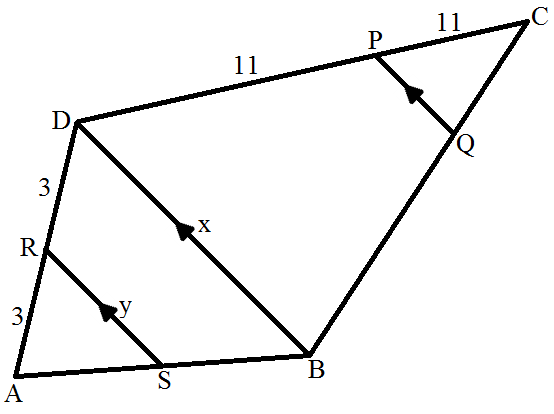
In the figure, $\ce{RS \| DB \| PQ.}$ If $\text{CP = PD} = 11\ cm$ and $\text{DR = RA} = 3\ cm.$ Then the values of $x$ and $y$ are respectively:
If a pair of linear equations in two variables is consistent, then the lines represented by two equations are:
Degree of quadratic equation is always ---------------.
Fill in the blanks using correct alternatives.
Out of the following, point ........ lies to the right of the origin on X- axis.
A. (-2,0)
B. (0,2)
C. (2,3)
D. (2,0)

The value of determinant $\left|\begin{array}{ll}5 & 2 \\ 7 & 4\end{array}\right|$ is ________ .
If point P ( 1 , 1 ) divide segment joining point A and point B ( -1 , -1 ) in the ratio 5 : 2 then the coordinates of A are ---------
The circumference of a circle is $100m.$ The side of a square inscribed in the circle is:
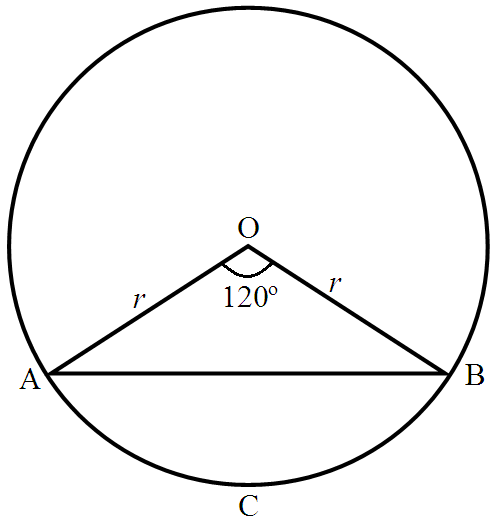
In the following figure, the area of segment $\text{ACB}$ is:
Choose the correct alternative answer for each of the following sub questions.
In an A.P. first two terms are $– 3, 4$ then $21^{st}$ term is . . .
A. $– 143$
B. $143$
C. $137$
D. $17$
Assertion and Reason Type
Each question consists of two statements, namely, Assertion $(A)$ and Reason $(R)$. For selecting the correct answer, use the following code:
Assertion $(A)$
Reason $(R)$
If the radii of the circular ends of a bucket $24\ cm$ high are $15\ cm$ and $5\ cm$ respectively, then the surface area of the bucket is $545\pi\text{cm}^2.$
if the radii of the circular ends of the frustum of a cone are $R$ and $r$ respectively and its height is $h,$ surface area is:
$\pi\big\{\text{R}^2+\text{r}^2+\text{l}(\text{R}-\text{r})\big\}$
where $\text{l}^2=\text{h}^2+(\text{R}+\text{r})^2.$