Question
Classify the following angles as acute, obtuse, straight, right, zero and complete angle:
(i) $118^{\circ}$  (ii) $29^{\circ}$  (iii) $145^{\circ}$  (iv) $165^{\circ}$  (v) $0^{\circ}$  (vi) $75^{\circ}$  (vii) $180^{\circ}$  (viii) $89.5^{\circ}$  (ix) $30^{\circ}$  (x) $90^{\circ}$  (xi) $179^{\circ}$  (xii) $360^{\circ}$  (xiii) $90 \frac{1}{2}^{\circ}$

Answer

Zero: (v); Acuten (ii), (vi), (viii), (ix); Obtuse: (i), (iii), (iv), (xi), (xiii); Straight (vii) ; Right: (x); Complete : (xii).

Need a full question paper?

Generate a complete, print-ready paper with questions like this in minutes — across 16+ boards, with answer keys.

Start Generating Free

Similar questions

Write the fraction representing the shaded portion

Nasreen bought $3\ m\ 20 \ cm$ cloth for her shirt and $2\ m\ 5 \ cm$ cloth for her another shirt. Find the total length of cloth bought by her.
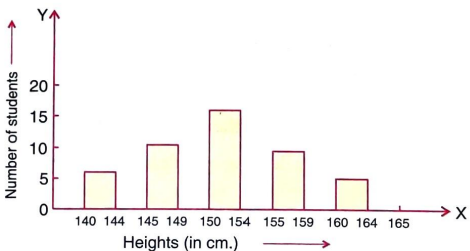
The following bar graph Fig. represents the heights (in cm) of 50 students of Class XI of a particular school. Study the graph and answer the following questions:
Image
(i) What percentage of the total number of students have their heights more than 149 cm?
(ii) How many students in the class are in the range of maximum height of the class?
(iii) The school wants to provide a particular type of tonic to each student below the height of 150 cm to improve his height. If the cost of the tonic for each student comes out to be ₹55, how much amount of money is required?
(iv) How many students are in the range of shortest height of the class?
(v) State whether true or false:
(a) There are 9 students in the class whose heights are in the range of 155-159 cm.
(b) Maximum height (in cm) of a student in the class is 17.
(c) There are 29 students in the class whose heights are in the range of 145-154 cm.
(d) Minimum height (in cm) of a student is the class is in the range of 140-144 cms.
(e) The number of students in the class having their heights less than150 cm is 12.
(f) There are 14 students each of whom has height more than 154 cm.
Solve the following equation and verify the answer: $\frac{\text{x}}{2}=\frac{\text{x}}{3}+1$
Fill in the missing fraction: $\square-\frac{3}{6}=\frac{3}{6}$
Construct the following angles with the help of your protractor:
(i) $45^{\circ}$  (ii) $52^{\circ}$  (iii) $110^{\circ}$  (iv) $90^{\circ}$  (v) $180^{\circ}$  (vi) $32^{\circ}$  (vii) $165^{\circ}$  (viii) $15^{\circ}$  (ix) $75^{\circ}$  (x) $95^{\circ}$  (xi) $185^{\circ}$
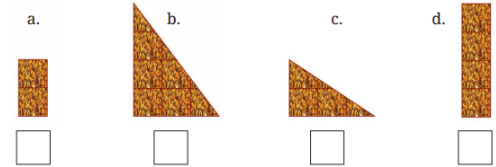
The figure below shows different fractional units of a whole chikki. How much of a whole chikki is each piece?
Image
Write each of the following as a Hindu-Arabic numeral:
S.No.
Roman numeral
$i$
$XXVII$
$ii$
$XXXIV$
$iii$
$XLV$
$iv$
$LIV$
$v$
$LXXIV$
$vi$
$XCI$
$vii$
$XCVI$
$viii$
$CXI$
$ix$
$CLIV$
$x$
$CCXXIV$
$xi$
$CCCLXV$
$xii$
$CDXIV$
$xiii$
$CDLXIV$
$xiv$
$DVI$
$xv$
$DCCLXVI$
Use a pair of compasses and construct the following angles: $22\frac{1}{2}^\circ$
Compare $\frac{4}{5}$ and $\frac{5}{6}$.