Questions

5 Marks Questions

Take a timed test

18 questions · self-marked practice — reveal the answer and mark yourself.

Question 15 Marks
Construct the following angles with the help of your protractor:
(i) $45^{\circ}$  (ii) $52^{\circ}$  (iii) $110^{\circ}$  (iv) $90^{\circ}$  (v) $180^{\circ}$  (vi) $32^{\circ}$  (vii) $165^{\circ}$  (viii) $15^{\circ}$  (ix) $75^{\circ}$  (x) $95^{\circ}$  (xi) $185^{\circ}$
Answer
self
View full question & answer
Question 25 Marks
Draw any $\angle A O B$ and take a ray $O C$ in the interior of this angle. Verify by measurement that $\angle A O B$ is equal to the sum of the angles $\angle A O C$ and $\angle B O C$.
Answer
self
View full question & answer
Question 35 Marks
Draw a line $D B$ and take a point $A$ on it between $D$ and $B$ draw ray $A C$. Verify by measurement that $\angle B A C$ and $\angle C A D$ are supplementary.
Answer
self
View full question & answer
Question 45 Marks
Construct a right angle $A B C$ with the help of a protractor. Mark a point $D$ in the interior of $\angle A B C$. Draw ray $B D$. Measure $\angle A B D, \angle D B C$. Verify that they are complementary.
Answer
self
View full question & answer
Question 55 Marks
Draw any three triangles and write the measures of their angles adjacent to the corresponding vertices. For each triangle add up the three measures. What do you get?
Answer
self
View full question & answer
Question 65 Marks
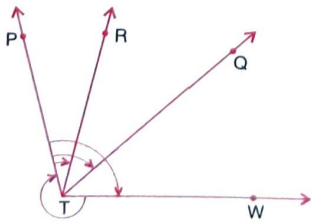
Use a protractor to find the measure of each angle. Then classify each angle as acute, obtuse, right, or reflex.
Image
(a) $\angle P T R$  (b) $\angle P T Q$  (c) $\angle P T W$  (d) $\angle W T P$
Answer
self
View full question & answer
Question 75 Marks
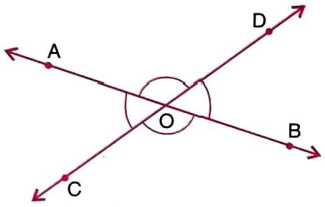
Draw two intersecting lines $A B$ and $C D$ as shown in Fig. . Measure $\angle A O D$ and $\angle B O C$. Are they equal? Measure $\angle A O C$ and $\angle B O D$. Are they equal? What conclusion can you draw from it?
Image
Answer
self
View full question & answer
Question 85 Marks
Classify the following angles as acute, obtuse, straight, right, zero and complete angle:
(i) $118^{\circ}$  (ii) $29^{\circ}$  (iii) $145^{\circ}$  (iv) $165^{\circ}$  (v) $0^{\circ}$  (vi) $75^{\circ}$  (vii) $180^{\circ}$  (viii) $89.5^{\circ}$  (ix) $30^{\circ}$  (x) $90^{\circ}$  (xi) $179^{\circ}$  (xii) $360^{\circ}$  (xiii) $90 \frac{1}{2}^{\circ}$
Answer
Zero: (v); Acuten (ii), (vi), (viii), (ix); Obtuse: (i), (iii), (iv), (xi), (xiii); Straight (vii) ; Right: (x); Complete : (xii).
View full question & answer
Question 95 Marks
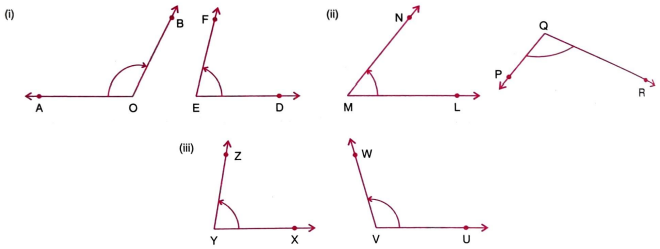
By simply looking at the pair of angles given in Fig., state which of the angles in each of the pairs is greater:
Image
Answer
(i) $\angle A O B$ (ii) $\angle P Q R$ (iii) $\angle U V W$
View full question & answer
Question 105 Marks
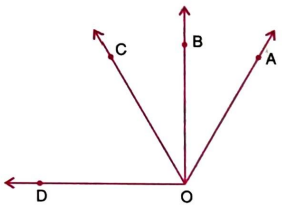
In Fig., which of the following statements are true:
Image
(i) Point $B$ is the interior of $\angle A O B$
(ii) Point $B$ is the interior of $\angle A O C$
(iii) Point $A$ is the interior of $\angle A O D$
(iv) Point $C$ is the exterior of $\angle A O B$
(v) Point $D$ is the exterior of $\angle A O C$.
Answer
(i) false
(ii) true
(iii) false
(iv) true
(v) true
View full question & answer
Question 115 Marks
Mark any four points on a paper so that no three of them are on one line. Label them $A, B, C, D$. Draw all possible lines going through pairs of these points. How many lines do you get? Name them. How many angles can you name using $A, B, C, D$ ? Write them all down, and mark each of them.
Answer

$\begin{array}{l}\text {Six: } A B, A C, A D, B C, B D, C D ; 12: \angle B A D, \angle C A D, \angle B A C, \angle A B D, \angle C B D, \angle A B C, \angle A C B, \angle A C D \text {, }\angle B C D, \angle A D B, \angle A D C, \angle B D C\end{array}$
View full question & answer
Question 125 Marks
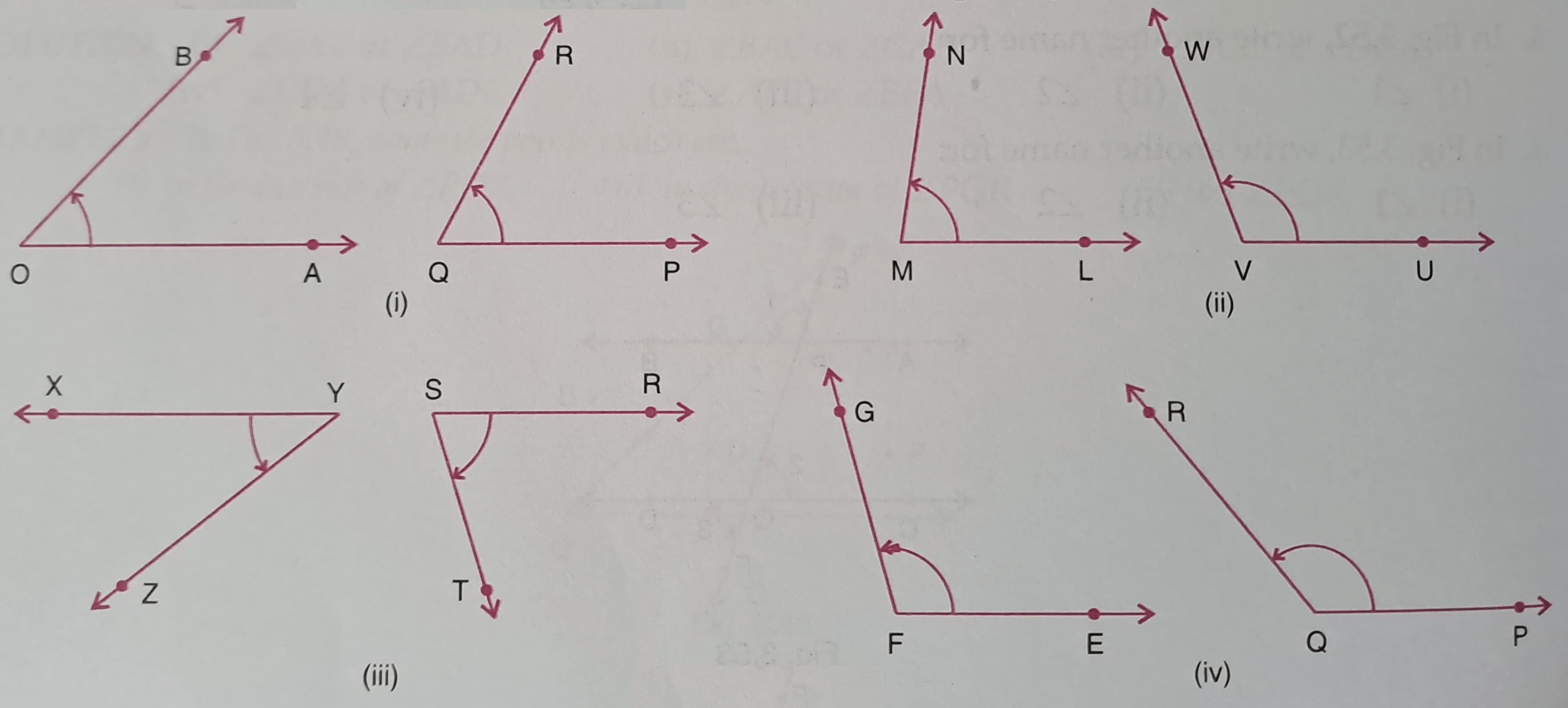
By using tracing paper compare the angles in each of the pairs given in Fig.
Image
Answer
(i) $\angle P Q R>\angle A O B$
(ii) $\angle U V W>\angle L M N$
(iii) $\angle R S T>\angle X Y Z$
(iv) $\angle P Q R>\angle E F G$
View full question & answer
Question 145 Marks
In Fig., name all rays with initial points as $A, B$ and $C$ respectively.
Image
(i) Is ray $\overrightarrow{A B}$ different from ray $\overrightarrow{A C}$ ?
(ii) Is ray $\overrightarrow{B A}$ different from ray $\overrightarrow{C A}$ ?
(iii) Is ray $\overrightarrow{C P}$ different from ray $\overrightarrow{C Q}$ ?
Answer
$
\overrightarrow{A P},(\overrightarrow{A B} \text { or } \overrightarrow{A C} \text { or } \overrightarrow{A Q}),(\overrightarrow{B P} \text { or } \overrightarrow{B A}),(\overrightarrow{B C} \text { or } \overrightarrow{B Q}),(\overrightarrow{C Q} \text { or } \overrightarrow{C A} \text { or } \overrightarrow{C B}), \overrightarrow{C Q}
$
(i) No
(ii) Yes
(iii) Yes
View full question & answer
Question 155 Marks
Mark the following points on a sheet of paper. Tell how many line segments can be obtained in each case:
(i) Two points $A, B$.
(ii) Three non-collinear points $A, B, C$.
(iii) Four points such that no three of them belong to the same line.
(iv) Any five points so that no three of them are collinear.
[Hint: Put $n=2,3,4,5$ in the following formula and check the truth of the statement in each case: If there are $n$ points in a plane such that no three of them are collinear, then the number of line segments obtained by joining these points is equal to $\frac{n(n-1)}{2}$ ]
Answer
(i) 1
(ii) 3
(iii) 6
(iv) 10
View full question & answer
Question 165 Marks
In each of the following cases, state whether you can draw line segments on the given surfaces:
(i) The face of a cuboid.
(ii) The surface of an egg or apple.
(iii) The curved surface of a cylinder.
(iv) The curved surface of a cone.
(v) The base of a cone.
Answer
(i) Yes, (ii) No, (iii) No, (iv) No, (v) Yes
View full question & answer
Question 175 Marks
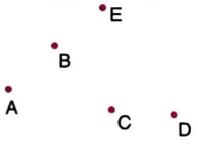
Using a ruler, check whether the following points given in Fig. are collinear or not:
Image
(i) $D, A$ and $C$      (ii) $A, B$ and $C$
(iii) $A, B$ and $E$      (iv) $B, C$ and $E$
Answer
(i) Collinear
(ii) Non-collinear
(iii) Collinear
(iv) Non-collinear
View full question & answer
Question 185 Marks
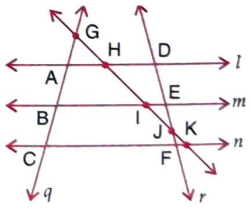
From Fig, write
Image
(i) all pairs of parallel lines.
(ii) all pairs of intersecting lines.
(iii) lines whose point of intersection is $I$.
(iv) lines whose point of intersection is $D$.
(v) lines whose point of intersection is $E$.
(vi) lines whose point of intersection is $A$.
(vii) collinear points
Answer
(i) $l, m ; m, n ; l, n$
(ii) $l, p ; m, p ; n, p ; l, r ; m, r ; n, r ; p, r ; l, q ; m, q ; n, q ; q, p ; q, r$
(iii) $m, p$
(iv) $l, r$
(v) $m, r$
(vi) $l, q$
(vii) $G, A, B, C ; D, E, J, F ; G, H, I, J, K ; A, H, D ; B, I, E ; C, F, K$
View full question & answer