Question
Classify the following functions as injection, surjection or bijection:f: $Q \rightarrow Q$, defined by $f(x)=x^3+1$

Answer

$f: Q \rightarrow Q$, defined by $f(x)=x^3+1$ Injective: Let $x, y \in Q$ such that
$f(x) = f(y)$
$\Rightarrow x^3 + 1 = y^3 + 1$
$\Rightarrow (x^3 - y^3) = 0$
$\Rightarrow (x - y)(x^2 + xy + y^2) = 0$
but $\text{x}^2+\text{xy}+\text{y}^2\geq0$
$\therefore$ $x - y = 0$
$\Rightarrow x = y$
$\therefore$ f is injective.
Surjective: Let $\text{y}\in\text{Q}$ be arbitrary, then
$f(x) = y$
$\Rightarrow x^3 + 1 - y = 0$
We know that a degree 3 equation has alteast one real solution.
Let $\text{x}=\alpha$ be that solution
$\therefore\ \alpha^3+1=\text{y}$
$\therefore\ \text{f}(\alpha)=\text{y}$
$\therefore$ f is onto.

Need a full question paper?

Generate a complete, print-ready paper with questions like this in minutes — across 16+ boards, with answer keys.
Start Generating Free

Similar questions

Let S be the set of all real numbers except -1 and let '*' be an operation defined by a * b = a + b + ab for all a, b ∈ S. Determine whether '*' is a binary operation on S. If yes, check its commutativity and associativity. Also, solve the equation (2 * x) * 3 = 7.
If $\text{x}=\text{a}\sin\text{t}-\text{b}\cos\text{t},\text{y}=\text{a}\cos\text{t}+\text{b}\sin\text{t},$ Prove that $\frac{\text{d}^2\text{y}}{\text{dx}^2}=-\frac{\text{x}^2+\text{y}^2}{\text{y}^2}$
Let $\text{A}=\begin{bmatrix}3 & 2&7 \\1 & 4&3\\-2&5&8 \end{bmatrix}.$ Find matrices X and Y such that X + Y = A, where X is a symmetric and Y is a skew-symmetric matrix.
Evaluate the following integrals:$\int\limits^{7}_0\frac{\sqrt[3]{\text{x}}}{\sqrt[3]{\text{x}}+\sqrt[3]{7}-\text{x}}\text{ dx}$
$\int\frac{2\text{x}+1}{\sqrt{3\text{x}+2}}\text{dx}$
Evaluate the following integrals:$\int^\limits{(\pi)^\frac{2}{3}}_{0}\sqrt{\text{x}}\cos^2\text{x}^{\frac{3}{2}}\text{ dx}$
Let $\vec{\text{a}}=\hat{\text{i}}+4\hat{\text{j}}+2\hat{\text{k}},\vec{\text{b}}=3\hat{\text{i}}-2\hat{\text{j}}+7\hat{\text{k}}$ and $\vec{\text{c}}=2\hat{\text{i}}-\hat{\text{j}}+4\hat{\text{k}}.$Find a vector $\vec{\text{d}}$ which is perpendicular to both $\vec{\text{a}}$ and $\vec{\text{d}}$ and $\vec{\text{c}}.\vec{\text{d}}=15.$
Show the solution zone of the following inequalities on a graph paper:
$\text{x}+\text{y}\leq50$
$3\text{x}+\text{y}\geq90$
$\text{x},\text{y}\geq0$
A small firm manufactures gold rings and chains. The total number of rings and chains manufactured per day is at most 24. It takes 1 hour to make a ring and 30 minutes to make a chain. The maximum number of hours available per day is 16. If the profit on a ring is Rs. 300 and that on a chain is Rs. 190, find the number of rings and chains that should be manufactured per day, so as to earn the maximum profit. Make it as an LPP and solve it graphically.
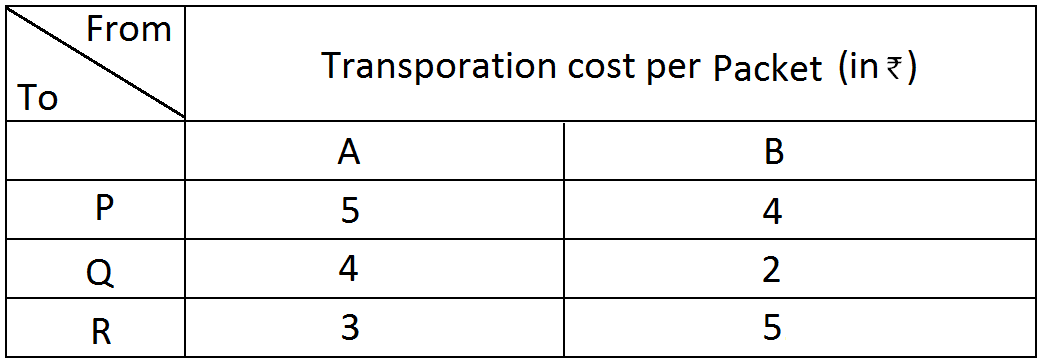
A medical company has factories at two places, A and B. From these places, supply is made to each of its three agencies situated at P, Q and R. The monthly requirements of the agencies are respectively 40, 40 and 50 packets of the medicines, while the production capacity of the factories, A and B, are 60 and 70 packets respectively. The transportation cost per packet from the factories to the agencies are given below:
How many packets from each factory be transported to each agency so that the cost of transportation is minimum? Also find the minimum cost?