Question
  1. Classify the following substances into elements, compounds and mixtures.
  1. 2-Carat gold.
  2. Sucrose.
  3. Diamond.
  4. Sodium chloride.
  1. How many significant figures are there in each of the following numbers?
  1. 12
  2. 2.084
  1. What do you understand by the rounding off a number?
  2. Write balanced chemical equations for the following:

Na2CO(aq) + NO(g) + NO3(g) → NaNO2(aq) + CO2(g)
Answer

  1.  
    1. Mixture (Homogeneous).
    2. Compound.
    3. Element.
    4. Compound.
  2.  
    1. 2
    2. 4
  3. Rounding off a number means that figures which are not significant for the purpose at hand are dropped.
  4. Na2CO3(aq) + NO(g) + N03(g) → 2NaNO2(aq) + C02(g)

Need a full question paper?

Generate a complete, print-ready paper with questions like this in minutes — across 16+ boards, with answer keys.

Start Generating Free

Similar questions

“Stability of carbocations depends upon the electron releasing inductive effect of groups adjacent to positively charged carbon atom involvement of neighbouring groups in hyperconjugation and resonance.”
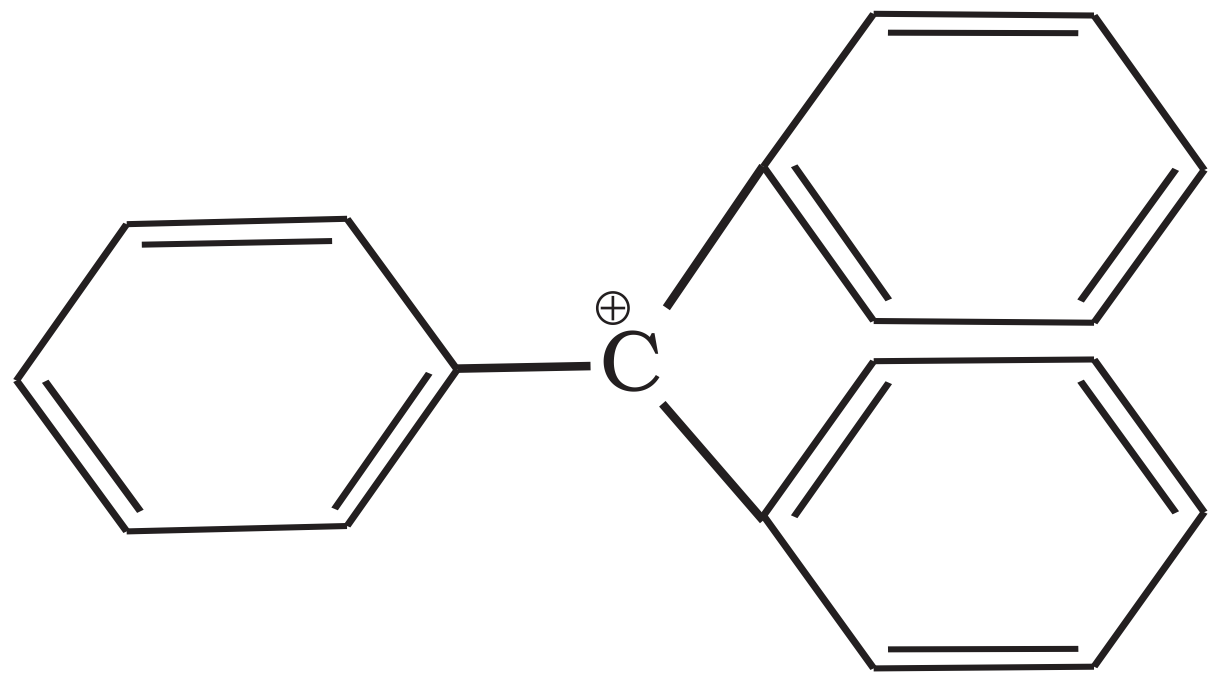
The structure of triphenylmethyl cation is given below. This is very stable and some of its salts can be stored for months. Explain the cause of high stability of this cation.

What happen when: (i) Methane is oxidised by oxygen in presence of M0203. (ii) Ethane is oxidised in presence of manganese acetate. (iii) Isobutane is oxidised by KMnO4.
Calculate the wavelength for the emission transition if it starts from the orbit having radius 1.3225 nm and ends at 211.6 pm . Name the series to which this transition belongs and the region of the spectrum.
For the reaction : $\text{N}_2\text{(g)}+\text{3H}_2\text{(g)}\rightleftharpoons\text{2NH}_3\text{(g)}$

Equilibrium constant $\text{K}_\text{c}=\frac{[\text{NH}_3]^2}{[\text{N}_2][\text{H}_2]^3}$

Some reactions are written below in Column I and their equilibrium constants in terms of Kc are written in Column II. Match the following reactions with the corresponding equilibrium constant.

Column I (Reaction)

Column II (Equilibrium constant)

i.

$2\text{N}_2\text{(g)}+\text{6H}_2\text{(g)}\rightleftharpoons\text{4NH}_3\text{(g)}$

a.

$2\text{K}_\text{c}$

ii.

$2\text{NH}_3\text{(g)}\rightleftharpoons\text{N}_2\text{(g)}+\text{3H}_2\text{(g)}$

b.

$\text{K}_\text{c}^\frac{1}{2}$

iii.

$\frac{1}{2}\text{N}_2\text{(g)}+\frac{3}{2}\text{H}_2\text{(g)}\rightleftharpoons\text{NH}_3\text{(g)}$

c.

$\frac{1}{\text{K}_\text{c}}$


d.

$\text{K}_\text{c}^2$

The concentration of hydrogen ion in a sample of soft drink is 3.8 × 10⁻³M. what is its pH?
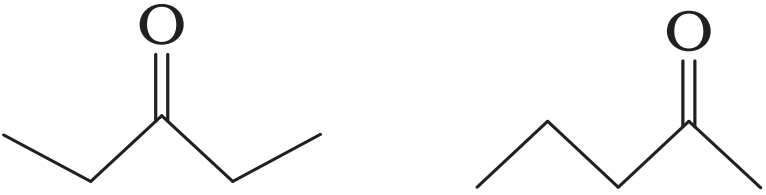
What is the relationship between the members of following pairs of structures? Are they structural or geometrical isomers or resonance contributors?

  1. State Hess's Law of constant heat summation. How does it follow from the first law of thermodynamics.
  2. Determine $\Delta_\text{r}\text{H}^\circ,$ at 298K for reaction:

$\text{C(graphite)}+2\text{H}_2(\text{g})\overrightarrow{\ \ \ \ \ \ \ \ }\ \text{CH}_4(\text{g});\ \Delta_\text{r}\text{H}^\circ=?$

You are given:

  1. $\text{C(graphite)}+\text{O}_2(\text{g})\overrightarrow{\ \ \ \ \ \ \ }\ \text{CO}_2(\text{g});$ $\Delta_\text{r}\text{H}^\circ=-393.51\text{kJ/ mol}$

  2. $\text{H}_2\text{(g)}+\frac{1}{2}\text{O}_2(\text{g})\overrightarrow{ \ \ \ \ \ \ \ }\ \text{H}_2\text{O(l)};$ $\Delta_\text{r}\text{H}^\circ=-285.8\text{kJ/ mol}$

  3. $\text{CO}_2(\text{g})+2\text{H}_2\text{O(l)}\overrightarrow{\ \ \ \ \ \ \ \ \ }\ \text{CH}_4(\text{g})+2\text{O}_2(\text{g});$ $\Delta_\text{r}\text{H}=+890.3\text{kJ/ mol}$

  1. Sulphuric acid is a very strong acid, yet it can also act as base in some reactions. Explain how?
  2. All Bronsted acids are not Lewis acids. Explain.
Draw the resonating structure of
1. ozone molecule
2. nitrate ion
  1. State first law of thermodynamics.
  2. Heat (q) and work function (w) individually are not state functions but their sum is always a state function. Why?
  3. Define extensive property with example.