Question
  1. State first law of thermodynamics.
  2. Heat (q) and work function (w) individually are not state functions but their sum is always a state function. Why?
  3. Define extensive property with example.

Answer

  1. First law of thermodynamics: It states energy can neither be created, nor be destroyed. It can change from one from to another. The total energy of universe remains constant.

$\Delta\text{U}=\text{q}+\text{w}$

  1. 'q' and 'w' depend upon path, therefore, these are path function.

$\text{q}+\text{w}=\Delta\text{U}$

$\Delta\text{U}$ is internal energy change which is state function because it depends upon initial and final state of the system and not on path, therefore, 'q + w' is state function.

  1. Extensive property: The property which depends upon amount of substance is called extensive property, e.g., mass, volume are extensive properties.

Need a full question paper?

Generate a complete, print-ready paper with questions like this in minutes — across 16+ boards, with answer keys.
Start Generating Free

Similar questions

What is the energy in joules, required to shift the electron of the hydrogen atom from the first Bohr orbit to the fifth Bohr orbit and what is the wavelength of the light emitted when the electron returns to the ground state? The ground state electron energy is $-2.18 \times 10^{-11}$ ergs.
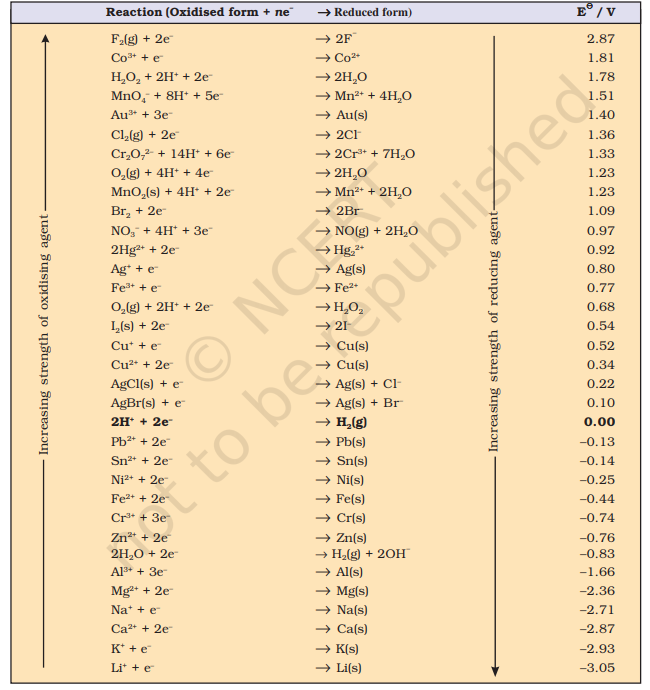
Using the standard electrode potentials given in the Table, predict if the reaction between the following is feasible:

Ag+(aq) and Cu(s).

  1. Using the data given below, calculate the value of equilibrium constant for the reaction at 298K.

$3\text{CH}\equiv\text{CH}(\text{g})\rightleftharpoons\text{C}_6\text{H}_6(\text{g})$ assuming ideal gas behaviour, $\Delta_\text{f}\text{G}^\circ[\text{HC}\equiv\text{CH(g)}]=2.09\times10^5\text{J mol}^{-1},$ $\Delta_\text{f}\text{G}^\circ[\text{C}_6\text{H}_6(\text{g})]=1.24\times10^5\text{J mol}^{-1},$ R = 8.314JK-1 mol-1.

  1. Based on your calculated value, comment whether this process can be recommended as a practical method for making benzene.
How many atoms are present in 1ml of NH3 at STP?
What happens when :
(i) ethylene dibromide is heated with zinc.
(ii) solution of sodium succinate is electrolysed.
(iii) ethylene dichloride is heated with zinc.
A mixture of gases containing H2 and O2 in the ratio of 1 : 4 by mass. What is their molar ratio.
Give the structures of A and B.

Which of the following species, do not show a disproportionation reaction and why?
$ClO ^{-}, ClO _2^{-}, ClO _3^{-}$and $ClO _4^{-}$
Also, write the reaction for each of the species that disproportionate.
Calculate the mass percent of different elements present in sodium sulphate (Na2SO4).
Predict the dipole moment of
i. a molecule of the type $AX _2$ having a linear geometry.
ii. a molecule of the type $AX _4$ having tetrahedral geometry.
iii. a molecule of the type $AX _2$ having angular geometry.
iv. a molecule of the type $AX _4$ having square planar geometry.