Sources of Business Finance — OCM STD 11 Commerce — Question
Gujarat BoardEnglish MediumSTD 11 CommerceOCMSources of Business Finance5 Marks
Question
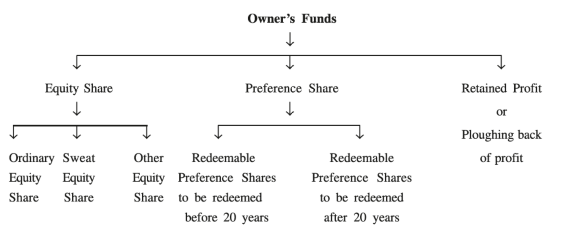
Classify the sources of Owner's Fund.
✓
Answer
Introduction :
There are two types of capital in any type of business.
$(1)$ Owner's Funds $(2)$ Borrowed Funds.
It is not advisable to borrow fund as long as business can be carried on with one own fund because fixed rate of interest is to be paid on borrowed fund.
But when owner's fund is not sufficient one has borrow money.
Meaning of Owner's Fund :
When the owners of business invest their owner's capital in their business, is called owner's fund.
Owner's Funds in company form mainly include share capital.
Define Equity share and explain the characteristics of equity share.
Introduction :
During industrial revolutions many technological inventions were made.
Mechanization started in industrial sector.
Large scale production started form large scale needs and demand, which required huge capital. Individual proprietorship was not in capacity to create huge capital.
Then partnership business emerged and along with it company came into existence.
Along with its share capital and various sources of business finance came in to existence.
What is 'Share' ? :
In English language 'share' means part.
In corporate form its capital is divided in small equal parts and every part of this capital is called a 'share'.
Illustration : Share capital of one company is $Rs. 5,00,00,000$ (Five Crore) which is divided among $50$ Lacs shares each of Rs. $10$ (Five Crores). The share capital of the company is Rs. Five Crores.
Meaning of Ordinary Equity Share :
The share having last right to receive dividend as well as capital as compared to preference shares are known as equity share. It is compulsory for the company to issue Ordinary Equity Share.
Dividend is uncertain on this type of shares.
These shareholders bear the risk of business at the time of dissolution or liquidation of company.
They are called the real or 'true owners of the company.
Characteristics of Ordinary Equity Shares : They are as below :
True Owners :
Ordinary Equity Shareholders are the real and loyal shares holders of the company.
They are with the company from the beginning to the end. They undertake risks also.
Right to Vote :
Ordinary Equity Shareholders have right to attend general meeting and have right to vote not per head but per share.
Rate of Dividend :
It is not fixed whether to pay the dividend or not to pay to the shareholders of ordinary Equity Share. The rate of dividend also is not fixed.
Profit related Dividend :
Dividend is profit related on Ordinary Equity Share. Rate of dividend is variable. It is connected with the profit of the company.
General Meeting :
Ordinary Equity Shareholders are the true owners of the company. Their general meeting is held once in a year in which accounts are sanctioned and policy decisions are taken.
Repayment of Capital :
Capital is not refunded to the shareholders till the existence of the company.
Dissolution (liquidation) :
At the time of dissolution of the company, after refunding the capital to Preference Shareholders if there is surplus fund, then proportionately capital is refunded to Equity Shareholders.
Benefit of Capital :
Equity shareholders get the benefit of Right Shares, Bonus Shares, and increased market price of share.
Shares of Qualification :
As per the provisions of memorandum of association, if the consent is given to become director and the shares are purchased is called the shares of qualification.
Registration of Shares :
The listing of this type shares is registered in recognized stock exchange. This type of shares is freely traded in the stock market.
Compulsory :
Ordinary Equity Shareholders undertake risk. When the company is dissolved or liquidated then after repaying capital to all others if the fund remains it is paid to Equity Shareholders. It is not compulsory to pay them dividend. When the company makes more profit it gives higher dividend or gives bonus share.
Conclusion :
Ordinary Equity Shareholders are repaid their capital last when the company is in liquidation or dissolved.
These shareholders undertake risk. It is not compulsory to pay them dividend.
If the company earns more it pays higher dividend or pays bonus share.
Need a full question paper?
Generate a complete, print-ready paper with questions like this in minutes — across 16+ boards, with answer keys.
 Define Equity share and explain the characteristics of equity share.