Question
Clear the difference between interference and diffraction.

Answer

S.No.InterferenceDiffraction
1.Interference occurs due to the superposition of two or more in phase waves of the same frequency.Diffractioon occurs due to superposition of secondary wavelets emitted from the same wave front.
2.In the interference pattern all illuminated fringes have the same intensity.In the diffraction pattern, the intensity of the central illuminated fringe is maximum and the intensity of other illuminated fringes is in decreasing order.
3.In the interference pattern of waves of equal amplitude the intensity of the dark fringe is zero.The dark fringes in the diffraction pattern are not to zero intensity
4.The fringes in an interference pattern are generally of equal width.The fringes in a diffraction pattern are always of   unequal width.
5.There is a good contrast between bright and dark particles.There is poor contrast in bright or fork fringes.

Need a full question paper?

Generate a complete, print-ready paper with questions like this in minutes — across 16+ boards, with answer keys.
Start Generating Free

Similar questions

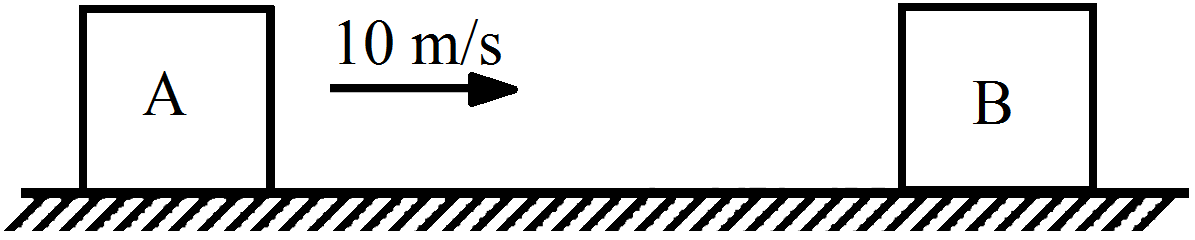
The blocks shown in figure have equal masses. blocks in the process. The surface of A is smooth but that of B has a friction coefficient of 0.10 with the floor. Block A is moving at a speed of 10m/s towards B which is kept at rest. Find the distance travelled by B if
  1. The collision is perfectly elastic
  2. The collision is perfectly inelastic. $($Take $g = 10m/s^2)$
Obtain the answers to (a) and (b) in Exercise 7.15 if the circuit is connected to a 110V, 12kHz supply? Hence, explain the statement that a capacitor is a conductor at very high frequencies. Compare this behaviour with that of a capacitor in a dc circuit after the steady state.
Doubly-ionised helium ions are projected with a speed of $10km/s^{-1}$ in a direction perpendicular to a uniform magnetic field of magnitude 1.0T. Find
  1. The force acting on an ion.
  2. The radius of the circle in which it circulates.
  3. The time taken by an ion to complete the circle.
Two coils A and B have inductances 1.0H and 2.0H respectively. The resistance of each coil is $10\Omega.$ Each coil is connected to an ideal battery of emf 2.0V at t = 0 Let $i_A$  and $i_B$ be the currents in the two circuit at time t. Find the ratio $\frac{\text{i}_\text{A}}{\text{i}_\text{B}}$
  1. t = 100ms
  2. t = 200ms
  3. t = 1s.
A gun is mounted on a railroad car. The mass of the car, the gun, the shells and the operator is 50m where m is the mass of one shell. If the velocity of the shell with respect to the gun (in its state before firing) is 200m/s, what is the recoil speed of the car after the second shot? Neglect friction.
A square-shaped copper coil has edges of length 50cm and contains 50 turns. It is placed perpendicular to a 1.0T magnetic field. It is removed from the magnetic field in 0·25s and restored in its original place in the next 0·25s. Find the magnitude of the average emf induced in the loop during:
  1. Its removal.
  2. Its restoration.
  3. Its motion.
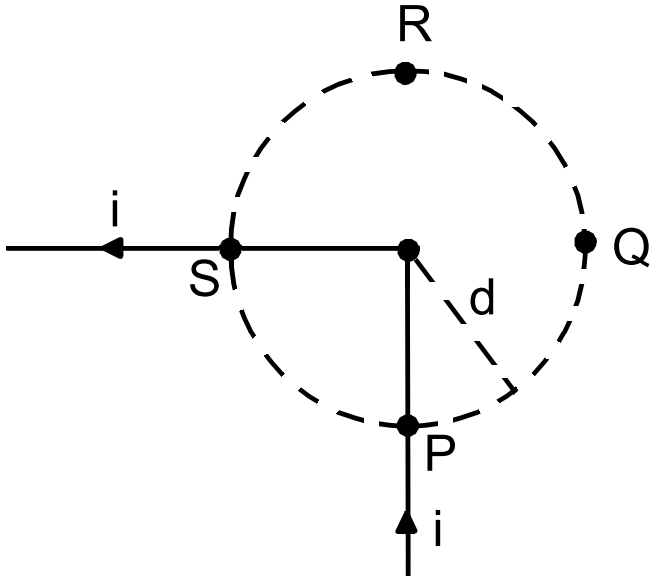
Figure shows a long wire bent at the middle to form a right angle. Show that the magnitudes of the magnetic fields at the points P, Q, R and S are equal and find this magnitude.
Given below are two electrical circuits A and B. Calculate the ratio of power factor of circuit B to the power factor of circuit A.
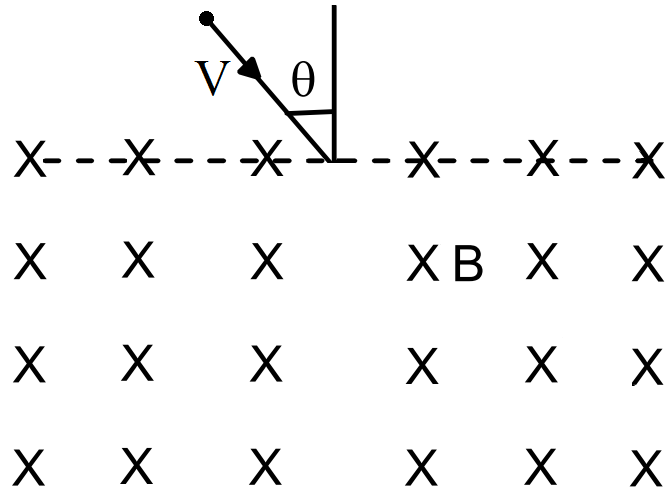
A particle of mass m and positive charge q, moving with a uniform velocity v, enters a magnetic field B, as shown,
  1. Find the radius of the circular arc it describes in the magnetic field.
  2. Find the angle subtended by the arc at the centre.
  3. How long does the particle stay inside the magnetic field?
  4. Solve the three parts of the above problem if the charge q on the particle is negative.
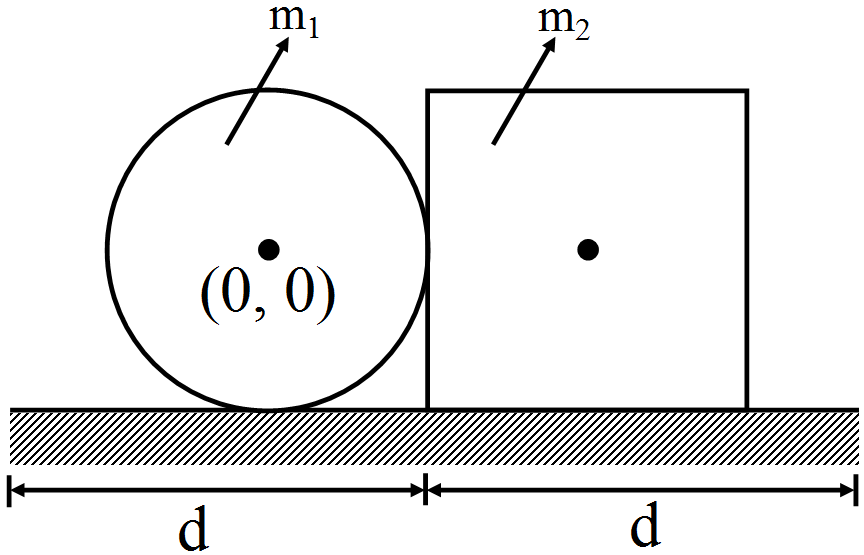
A square plate of edge d and a circular disc of diameter d are placed touching each other at the midpoint of an edge of the plate as shown in figure. Locate the centre of mass of the combination, assuming same mass per unit area for the two plates.