Questions

5 Marks Questions

🎯

Test yourself on this topic

7 questions · timed · auto-graded

Question 15 Marks
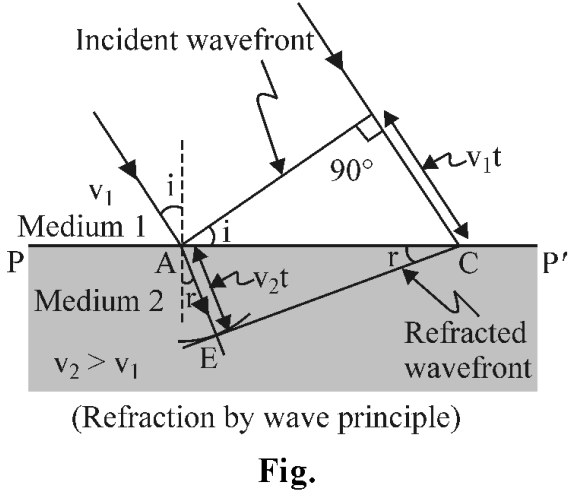
Derive Snell's law for refraction of light by Huygen's wave theory.
Answer
Consider that PP' represents a line which separates medium 1 and 2 . Consider that $v_1$ and $v_2$ represents speed of light of medium 1 and medium 2 respectively. We over here considered that one plane wave $AB , A ^{\prime} A$ is incident on the surface as shown in the diagram making an angle i with the surface. Consider to travel a distance BC time taken by wave is $t$.
Hence, $\quad$ $BC=v_1 t$
Image
To know the where is wave formed, we have to mark an arc in medium 2 of radius of distance between A to $v_2 t$ (speed of wave of medium 2 is $v_2$ ). Consider CE point from C will denote the arc which is drawn. Then $AE =v_2 t$ and CE will denote wave. Now if we consider triangles ABC and AEC , we will get
$\sin i=\frac{ BC }{ AC }=\frac{v_1 t}{ AC } \ldots(1) $
$\sin r=\frac{ AE }{ AC }=\frac{v_2}{ AC } \ldots(2) $
Here $i$ and $r$ are angle of incidence and angle of refraction.
From (1) and (2)
$\frac{\sin i}{\sin r}=\frac{v_1}{v_2} \ldots(3) $
From above we get an important result. If $r<i$ then speed of light of second medium $v_2$ is less than that of medium $1 v_1$. Now if speed of light in vacuum, is represented by $c$ then,From above we get an important result. If $r<i$ then speed of light of second medium $v_2$ is less than that of medium $1 v_1$. Now if speed of light in vacuum, is represented by $c$ then,
$n_1=\frac{c}{v_1}\ldots(4) $
and $\quad n_2=\frac{c}{v_2}\ldots(5) $
$n_1$ and $n_2$ are refractive index of medium 1 and medium 2 respectively. Refractive index can be written in form of (3) as :
$n_1 \sin i=n_2 \sin r$
or $\quad \frac{\sin i}{\sin r}=\frac{n_2}{n_1}=n_{21}$
This is the proof of refraction of Snell's law.

View full question & answer
Question 25 Marks
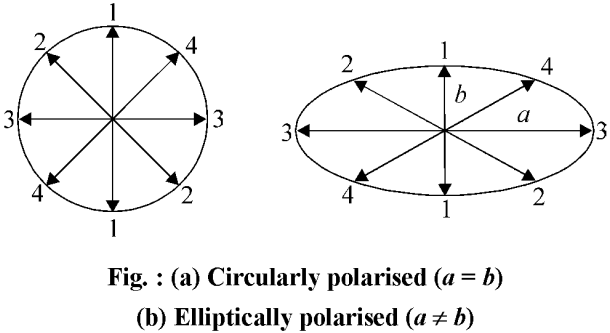
What are circular and elliptically polarized light?
View full question & answer
Question 35 Marks
Explain the uses of Polaroid.
Answer
Uses of Polaroid :
1. To remove glare : Polaroid is used to reduce the glare caused by reflection of light from extremely white or bright surfaces or wet roads or the scorching sun. Glare consists of partially polarized light. If polaroid glasses are worn on the eyes, it will cut off the horizontal vibrations of partially polarized light. Hence the glare will be eliminated.
2. To prevent accidents : When the light emitted from the headlights of motor cars and trucks falls on the hood of a motor car or truck coming from the other side, the reflected light reaches the eyes and causes glare. This not only causes pain to the eyes, but there is also a possibility of an accident. To overcome this, headlight cover glass and windscreen are made of polaroid.
3. In polaroid camera or photography : A polaroid is placed in front of the lens of the polaroid camera so that the polarized light coming in its background is blocked by the polaroid.
4. To determine the concentration of sugar: The concentration of sugar is determined by polari meter. Polaroids are used to produce and analyze plane polarized light in a polari meter.
5. In the study of optical properties of metals.
6. To study the effect of stresses.
View full question & answer
Question 45 Marks
Describe the main difference between Fraunhofer and Fresnel's diffraction. 
Answer
There are following differences between these two :
S.No.Fraunhofer DiffractionFresnel Diffraction
1.The center of the diffraction pattern is always bright.The center of the diffraction pattern is sometimes bright and sometimes dark.
2.Both the source and the screen are located at an effectively or actually infinite distance from the diffractor.Both the source and the screen are at a limited distance from the diffractor
3.Wave fronts are plane.Wave fronts are spherical or cylindrical.
4.Convex lens is used in this.Convex lenses are not used in this.
5.There may be a combined effect of diffraction of more than one diffractor.In this there is diffraction effect of only one diffractor.
6.Its theoretical analysis is done with the help of adequate and precise mathematics.Its theoretical analysis is complex and gives only approximate values.
7.In this type of diffraction, the inclination of the wave fronts towards the diffractor is important.In this diffraction, the distances of the source and the screen from the diffractor are important.
View full question & answer
Question 55 Marks
Clear the difference between interference and diffraction.
Answer
S.No.InterferenceDiffraction
1.Interference occurs due to the superposition of two or more in phase waves of the same frequency.Diffractioon occurs due to superposition of secondary wavelets emitted from the same wave front.
2.In the interference pattern all illuminated fringes have the same intensity.In the diffraction pattern, the intensity of the central illuminated fringe is maximum and the intensity of other illuminated fringes is in decreasing order.
3.In the interference pattern of waves of equal amplitude the intensity of the dark fringe is zero.The dark fringes in the diffraction pattern are not to zero intensity
4.The fringes in an interference pattern are generally of equal width.The fringes in a diffraction pattern are always of   unequal width.
5.There is a good contrast between bright and dark particles.There is poor contrast in bright or fork fringes.
View full question & answer
Question 65 Marks
What will be the path difference between two light waves $y_1=a_1 \sin \omega t$ and $y_2=a_2 \cos (\omega t+$ $\phi)$ ?
Answer
Equation of first wave
$y_1=a_1 \sin \omega t$
Equation of second wave
$y_2=a_2 \cos (\omega t+\phi)$
or $y_2=\sin \left(\omega t+\phi+\frac{\pi}{2}\right)$
Phase difference between first and second wave
$\Delta \phi=\phi_2-\phi_1$
$=\left(\omega t+\phi+\frac{\pi}{2}\right)-\omega t$
or $\Delta \phi=\phi+\frac{\pi}{2}$
Phase difference due to path difference
$\Delta \phi=\frac{2 \pi}{\lambda} \times \Delta x$
Path difference
$\Delta x=\frac{\Delta \phi \times \lambda}{2 \lambda}$
$\therefore$ For given waves $I^{\text {st }}$ and $2^{\text {nd }}$, the path difference
$\Delta x=\frac{\lambda}{2 \pi}\left(\phi+\frac{\pi}{2}\right)$ $\qquad Ans. $
View full question & answer
Question 75 Marks
Write the upper and lower limits of interference in terms of path difference.
Answer
We know that :
Phase difference $=\frac{2 \pi}{\lambda} \times$ path difference
or $\phi=\frac{2 \pi}{\lambda} y \quad \ldots(i)$
We also know that for constructive interference to $\quad \phi=2 n \pi \ldots(ii)$
From equation (i) and (ii)
$\frac{2 \pi}{\lambda} y=2 n \pi$
or $y=2 n \cdot \frac{\lambda}{2}$
For $n$th maxima, $y=y_n$
$\underline {y_n=2 n \cdot \frac{\lambda}{2}}$
Thus, to occur the constructive interference, path difference must be even multiple of $\frac{\lambda}{2}$
For minimum intensity $\quad \phi=(2 n+1) \pi$
or $\frac{2 \pi}{\lambda} y=(2 n+1) \pi$
$\therefore$ $y=(2 n+1) \frac{\lambda}{2}$
For $n$th minima : $y=y_n$
$\therefore$$y_n=(2 n+1) \frac{\lambda}{2}$
Thus, for destructive interference, path difference must be odd multiple of $\frac{\lambda}{2}$.
View full question & answer
5 Marks Questions - Physics STD 12 Science Questions - Vidyadip