Question
Cloudy nights are warmer than the nights with clean sky. Explain.

Answer

During night, the earth's surface radiates infrared radiation of larger wavelength. Gas molecules in the air absorb some of this energy and radiate energy of their own in all directions. Also, water molecules, like the vapour that makes the clouds, absorb more frequencies of infrared energy than clear air does.
Both these factors contribute to the fact that clouds radiate more heat in all directions (including the earth) than clear air does. In turn, this makes the overall temperature on the earth warmer when there is a cloud cover. The heat energy radiated by the earth is reflected back to earth. Due to this, cloudy nights are warmer than the nights with clean sky.
Need a full question paper?

Generate a complete, print-ready paper with questions like this in minutes — across 16+ boards, with answer keys.

Start Generating Free

Similar questions

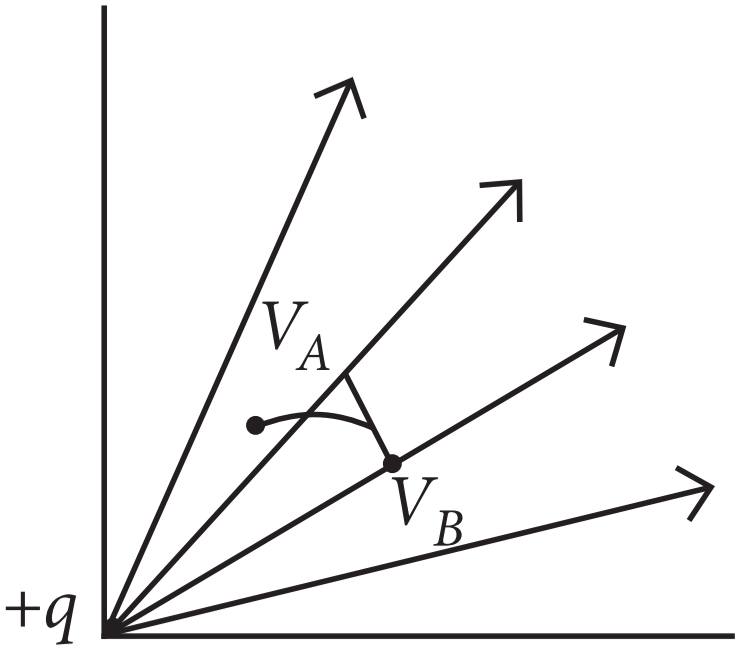
Electrostatic potential energy of a system of point charges is defined as the total amount of work done in bringing the different charges to their respective positions from infinitely charge mutual separations. The work is stored in the system of two point charges in the form of electrostatic potential energy U of the system. Electric potential difference between any points A and B in an electric field is the amount of work done in moving a unit positive test charge from A to B along any path agents the electrostatic force $\text{V}_\text{B}-\text{V}_\text{A}=\frac{\text{W}_\text{AB}}{\text{q}_\text{o}}=\int\vec{\text{E}}.\text{dl}.$

  1. A test charge is moved from lower potential point to a higher potential point. The potential energy of test charge wiII.
  1. Remain the same.
  2. Increase.
  3. Decrease.
  4. Become zero.
  1. Which of the following statement is not true?
  1. Electrostatic force is a conservative force.
  2. Potential energy of charge q at a point is the work done per unit charge in bringing a charge from any point to infinity.
  3. Spring force and gravitational force are conservative force.
  4. Both (a) and (c).
  1. Work done in moving a charge from one point to another inside a uniformly charged conducting sphere is:
  1. Always zero.
  2. Non-zero.
  3. May be zero.
  4. None of these.
  1. The work done in bringing a unit positive charge from infinite distance to a point at distance x from a positive charge Q is W. Then the potential $\phi$ at that point is:
  1. $\frac{\text{WQ}}{\text{x}}$

  2. W

  3. $\frac{\text{W}}{\text{x}}$

  4. WQ

  1. If $1\mu\text{C}$ charge is shifted from A to B and it is found that work done by an external force is $40\mu\text{J}.$ ln doing so against electrostatics force, the potential difference VA - VB is:
  1. 40V
  2. -40V
  3. 20V
  4. -60V
Derive $i+c= A +\delta$ for a triangular glass prism. Also write the condition for the angle of minimum devintion. Derive the formula for the refractive index of the material of the prism.
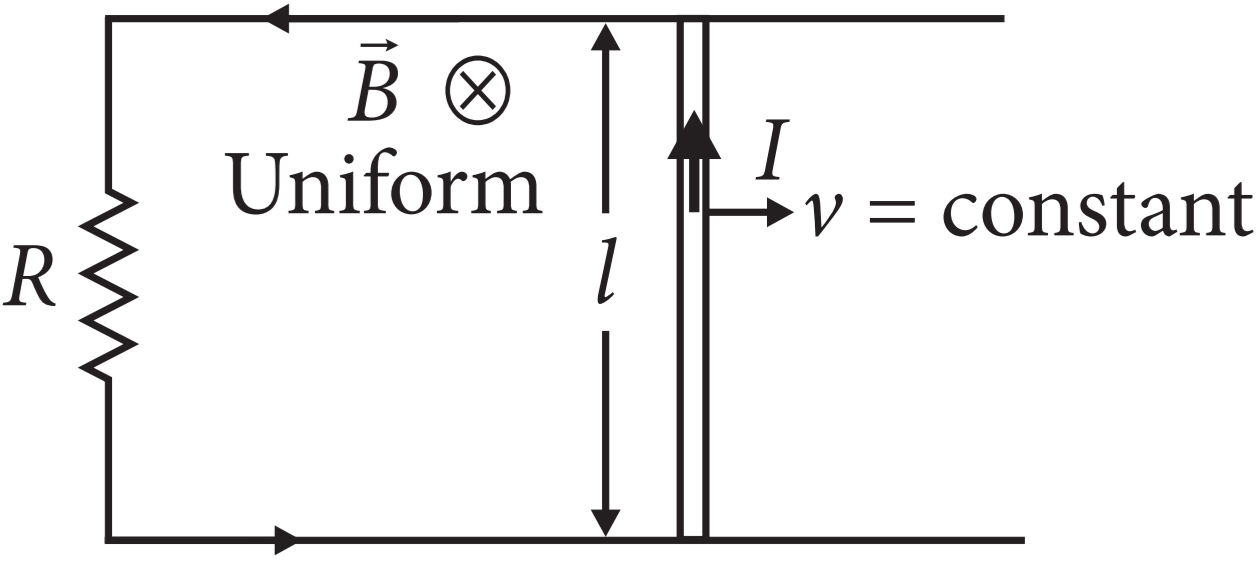
The emf induced across the ends of a conductor due to its motion in a magnetic field is called motional emf. It is produced due to the magnetic Lorentz force acting on the free electrons of the conductor. For a circuit shown in figure, if a conductor of length l moves with velocity v in a magnetic field B perpendicular to both its length and the direction of the magnetic field, then all the induced parametres are possible in the circuit.

  1. Direction of current induced in a wire moving in a magnetic field is found using
  1. Fleming's left hand rule.
  2. Fleming's right hand rule.
  3. Ampere's rule.
  4. Right hand clasp rule.
  1. A conducting rod of length l is moving in a transverse magnetic field of strength B with velocity v. The resistance of the rod is R. The current in the rod is:
  1. $\frac{\text{Blv}}{R}$

  2. $\frac{\text{B}^2\text{v}^2\text{l}^2}{\text{R}}$

  3. Blv
  4. Zero
  1. A 0.1m long conductor carrying a current of SO A is held perpendicular to a magnetic field of 1.25mT. The mechanical power required to move the conductor with a speed of I m s-1 is:
  1. 62.5 mW
  2. 625 mW
  3. 6.25 mW
  4. 12.5 mW
  1.  A bicycle generator creates 1.5 Vat 15km/ hr. The EMF generated at 10km/ hr is:
  1. 1.5 volts
  2. 2 volts
  3. 0.5 volts
  4. 1 volt
  1. The dimensional formula for emf E in MKS system will be:
  1. [ML2T-3A-1]
  2. [ML2T-1A]
  3. [ML2A]
  4. [MLT-3A-1]
In pair annihilation, an electron and a positron destroy each other to produce gamma radiation. How is the momentum conserved?
Professor C.V Raman surprised his students by suspending freely a tiny light ball in a transparent vacuum chamber by shining a laser beam on it. Which property of EM waves was he exhibiting? Give one more example of this property.
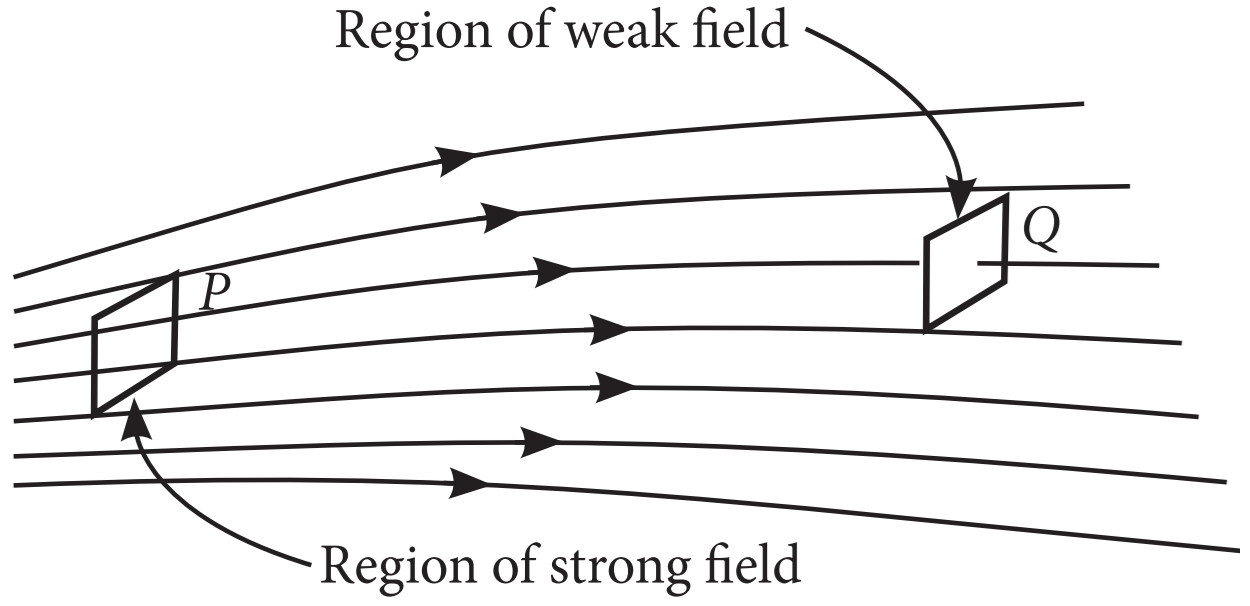
Electric field strength is proportional to the density of lines of force i.e., electric field strength at a point is proportional to the number of lines of force cutting a unit area element placed normal to the field at that point. As illustrated in the given figure, the electric field at P is stronger that at Q.

  1. Electric lines of force about a positive point charge are:
  1. Radially outwards.
  2. Circular clockwise.
  3. Radially inwards.
  4. Parallel straight lines.
  1. Which of the following is false for electric lines of force?
  1. They always start from positive charges and terminate on negative charges.
  2. They are always perpendicular to the surface of a charged conductor.
  3. They always form closed loops.
  4. They are parallel and equally spaced in a region of uniform electric field.
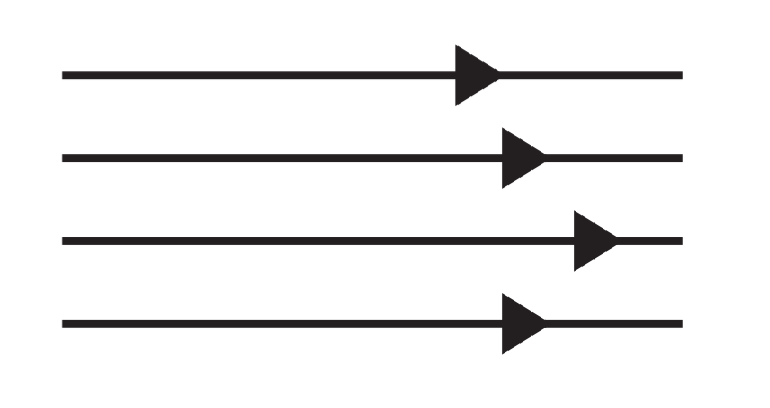
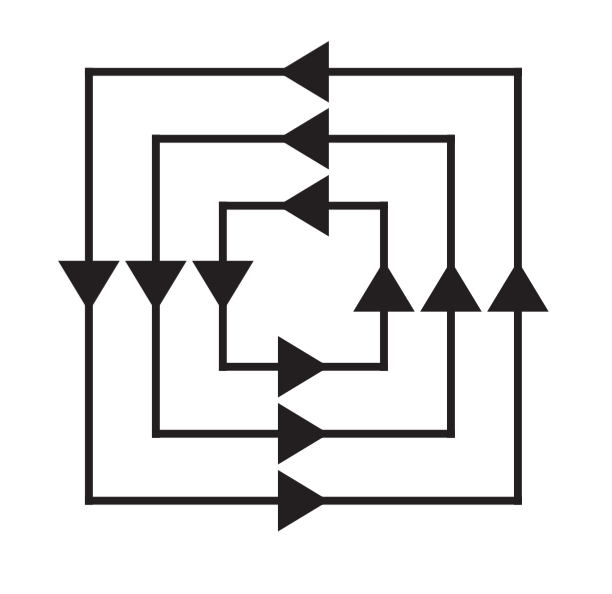
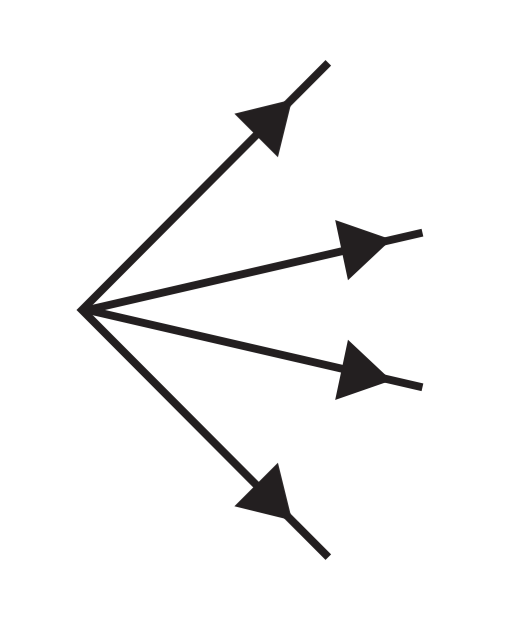
  1. Which one of the following pattern of electric line of force in not possible in filed due to stationary charges?
  1.  

  1.  

  1.  

  1.  

  1. Electric lines of force are curved:
  1. In the field of a single positive or negative charge.
  2. In the field of two equal and opposite charges.
  3. In the field of two like charges.
  4. Both (b) and (c).
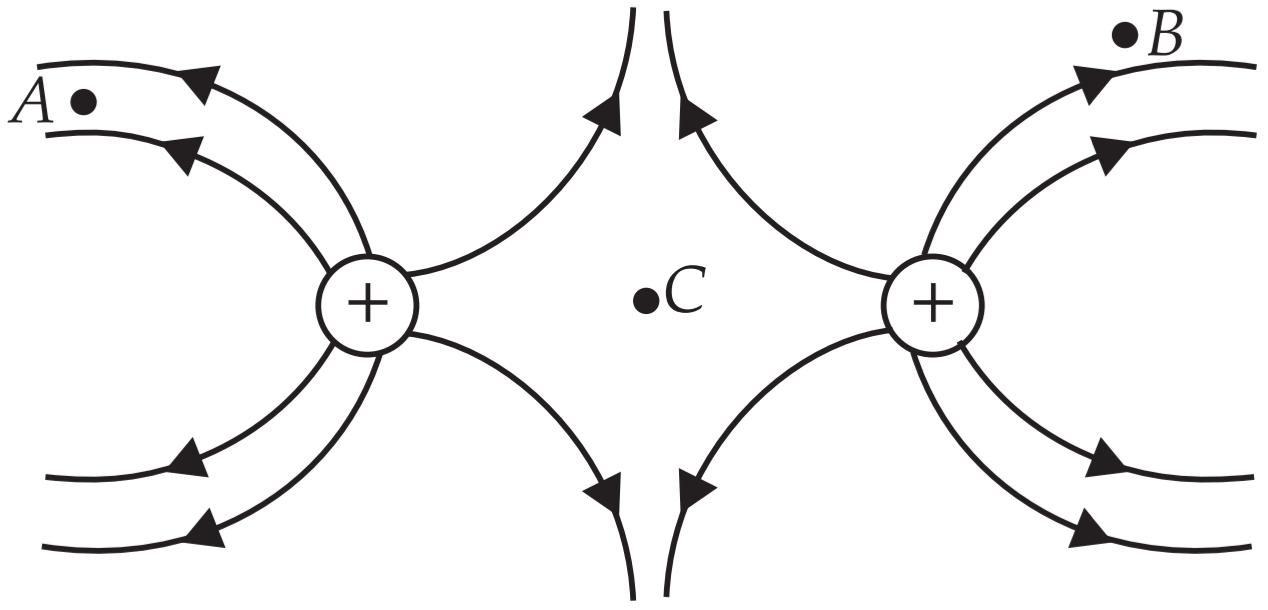
  1. The figure below shows the electric field lines due to two positive charges. The magnitudes EA, EB and EC of the electric fields at points A, Band C respectively are related as:

  1. EA > EB > EC
  2. EB > EA > EC
  3. EA = EB > EC
  4. EA > EB = EC
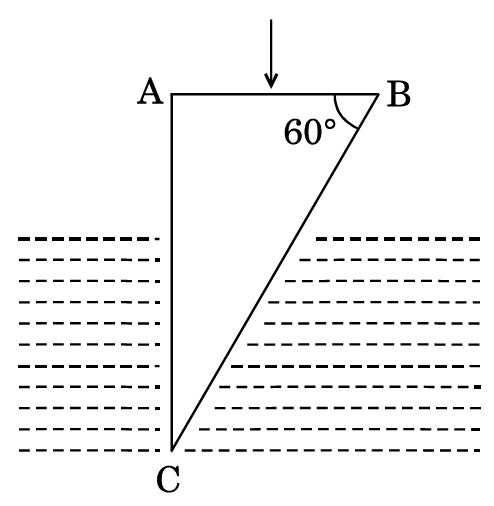
  1. A ray of light is incident normally on the face AB of a right-angled glass prism of refractive index $_{a}\mu_{g} =1.5$The prism is partly immersed in a liquid of unknown refractive index. Find the value of refractive index of the liquid so that the ray grazes along the face BC after refraction through the prism.

  1. Trace the path of the rays if it were incident normally on the face AC.
How long can an electric lamp of 100 W be kept glowing by fusion of 2.0 kg of deuterium? Take the fusion reaction as
\[{ }_1^2 H+{ }_1^2 H \longrightarrow{ }_2^3 He+n+3.27 MeV\]
A slide projector has to project a 35mm slide (35mm × 23mm) on a 2m × 2m screen at a distance of 10m from the lens. What should be the focal length of the lens in the projector?
Show that the magnetic field at a point due to a magnetic dipole is perpendicular to the magnetic axis if the line joining the point with the centre of the dipole makes an angle of $\tan^{-1}(\sqrt{2})$ with the magnetic axis.