Question
Derive $i+c= A +\delta$ for a triangular glass prism. Also write the condition for the angle of minimum devintion. Derive the formula for the refractive index of the material of the prism.

Answer

Self

Need a full question paper?

Generate a complete, print-ready paper with questions like this in minutes — across 16+ boards, with answer keys.
Start Generating Free

Similar questions

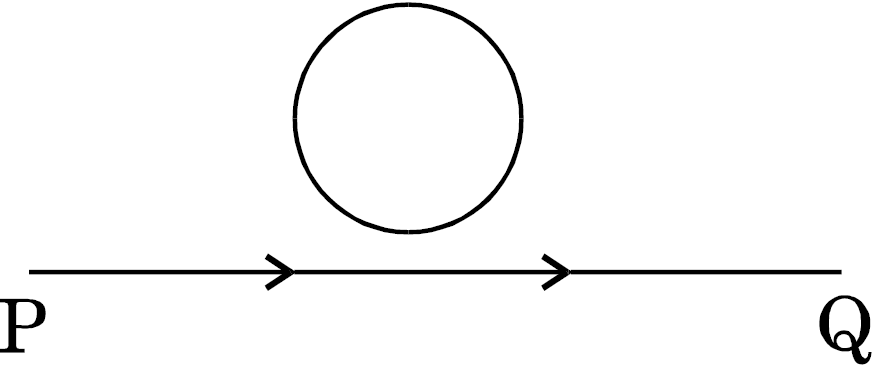
A conducting loop is held above a current carrying wire ‘PQ’ as shown in the figure. Depict the direction of the current induced in the loop when the current in the wire PQ is constantly increasing.

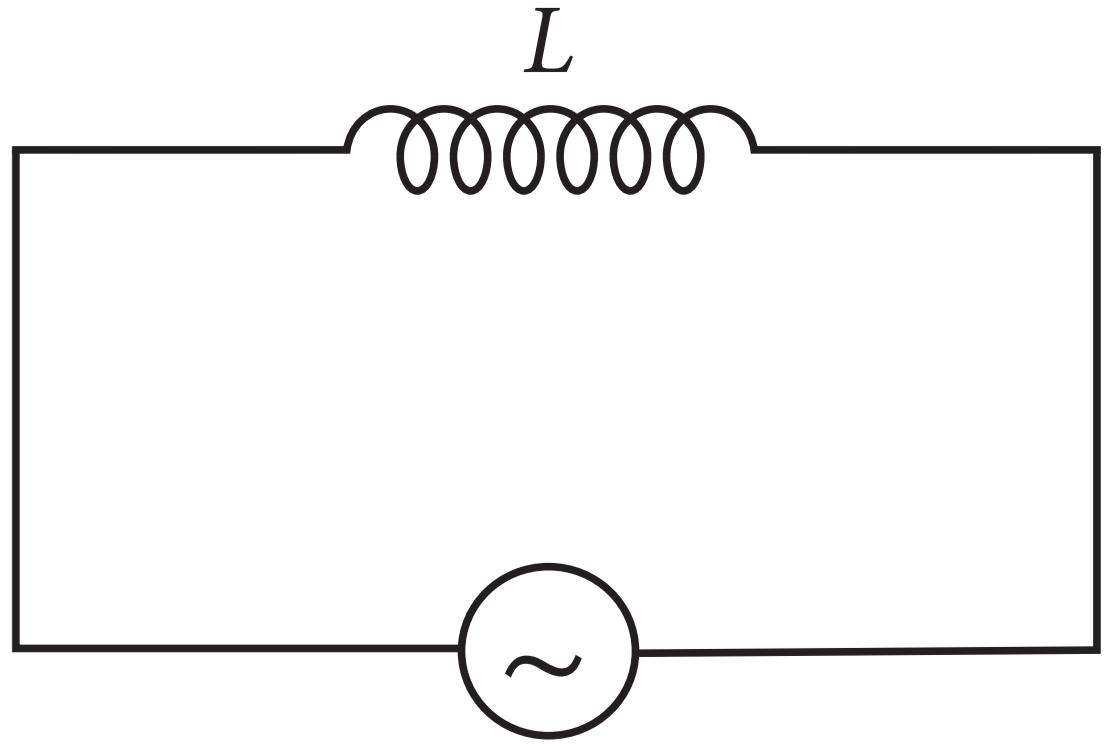
Let a source of alternating e.m.f. $\text{E} = \text{E}_\circ\sin\omega\text{t}$ be connected to a circuit containing a pure inductance L. If I is the value of instantaneous current in the circuit, then $\text{I}=\text{I}_\circ\sin\Big(\omega\text{t}-\frac{\pi}{2}\Big).$ The inductive reactance limits the current in a purely inductive circuit and is given by $\text{X}_\text{L}= \text{W}_\text{L}.$

  1. A 100 hertz a.c. is flowing in a 14mH coil. The reactance is:
  1. $15\Omega$
  2. $7.7\Omega$
  3. $8.8\Omega$
  4. $10\Omega$
  1. In a pure inductive circuit, resistance to the flow of current is offered by:
  1. Resistor
  2. Inductor
  3. Capacitor
  4. Resistor and inductor
  1. In a inductive circuit, by what value of phase angle does alternating current lags behind e.m.f.?
  1. 45º
  2. 90º
  3. 120º
  4. 75º
  1. How much inductance should be connected to 200V, 50Hz a.c. supply so that a maximum current of 0.9A flows through it?
  1. 5H
  2. 1H
  3. 10H
  4. 4.5H
  1. The maximum value of current when inductance of 2H is connected to 150V, 50Hz supply is:
  1. 0.337A
  2. 0.721A
  3. 1.521A
  4. 2.522A
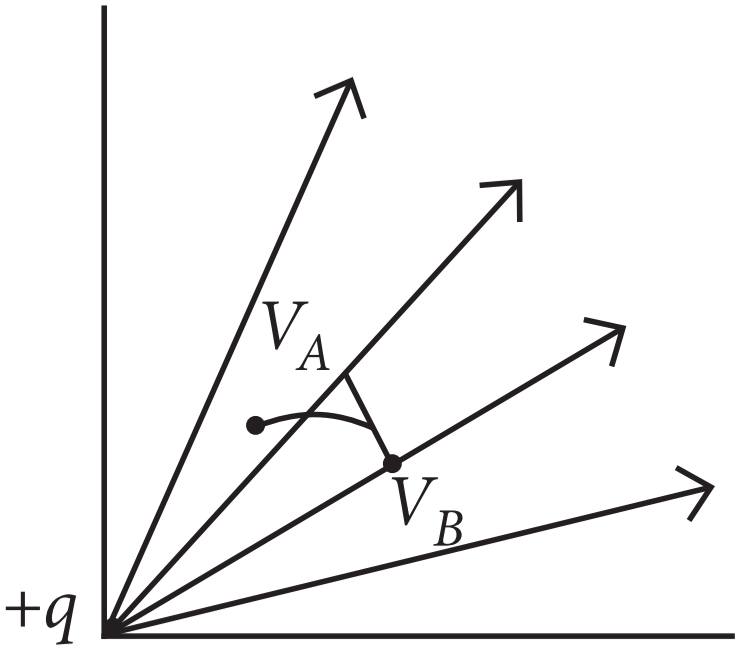
Electrostatic potential energy of a system of point charges is defined as the total amount of work done in bringing the different charges to their respective positions from infinitely charge mutual separations. The work is stored in the system of two point charges in the form of electrostatic potential energy U of the system. Electric potential difference between any points A and B in an electric field is the amount of work done in moving a unit positive test charge from A to B along any path agents the electrostatic force $\text{V}_\text{B}-\text{V}_\text{A}=\frac{\text{W}_\text{AB}}{\text{q}_\text{o}}=\int\vec{\text{E}}.\text{dl}.$

  1. A test charge is moved from lower potential point to a higher potential point. The potential energy of test charge wiII.
  1. Remain the same.
  2. Increase.
  3. Decrease.
  4. Become zero.
  1. Which of the following statement is not true?
  1. Electrostatic force is a conservative force.
  2. Potential energy of charge q at a point is the work done per unit charge in bringing a charge from any point to infinity.
  3. Spring force and gravitational force are conservative force.
  4. Both (a) and (c).
  1. Work done in moving a charge from one point to another inside a uniformly charged conducting sphere is:
  1. Always zero.
  2. Non-zero.
  3. May be zero.
  4. None of these.
  1. The work done in bringing a unit positive charge from infinite distance to a point at distance x from a positive charge Q is W. Then the potential $\phi$ at that point is:
  1. $\frac{\text{WQ}}{\text{x}}$

  2. W

  3. $\frac{\text{W}}{\text{x}}$

  4. WQ

  1. If $1\mu\text{C}$ charge is shifted from A to B and it is found that work done by an external force is $40\mu\text{J}.$ ln doing so against electrostatics force, the potential difference VA - VB is:
  1. 40V
  2. -40V
  3. 20V
  4. -60V
Two submarines are approaching each other in a calm sea. The first submarine travels at a speed of 36km/h and the other at 54km/h relative to the water. The first submarine sends a sound signal (sound waves in water are also called sonar) at a frequency of 2000Hz.
  1. At what frequency is this signal received by the second submarine?
  2. The signal is reflected from the second submarine. At what frequency is this signal received by the first submarine. Take the speed of the sound wave in water to be 1500m/s.
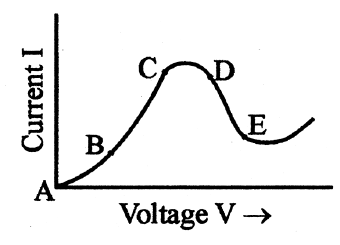
Graph showing the variation of current versus voltage for a material GaAs is shown in the figure. Identify the region of.
  1. Negative resistance.
  2. Where Ohm's law is obeyed.
Consider a gravity-free hall in which an experimenter of mass 50kg is resting on a 5kg pillow, 8ft above the floor of the hall. He pushes the pillow down so that it starts falling at a speed of 8ft/s. The pillow makes a perfectly elastic collision with the floor, rebounds and reaches the experimenter's head. Find the time elapsed in the process.
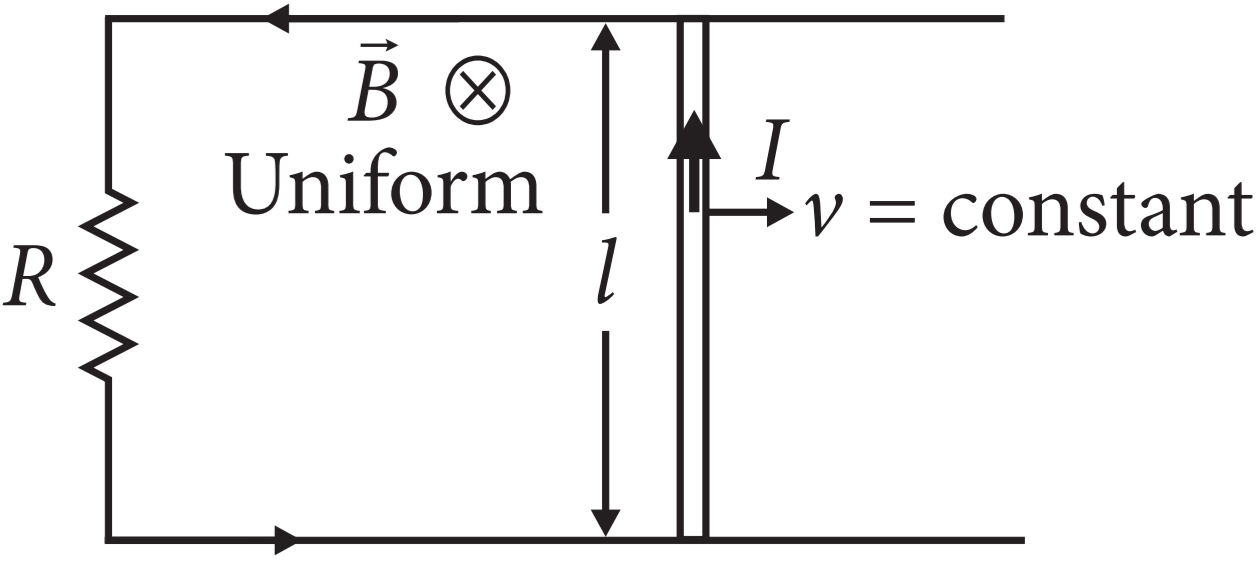
The emf induced across the ends of a conductor due to its motion in a magnetic field is called motional emf. It is produced due to the magnetic Lorentz force acting on the free electrons of the conductor. For a circuit shown in figure, if a conductor of length l moves with velocity v in a magnetic field B perpendicular to both its length and the direction of the magnetic field, then all the induced parametres are possible in the circuit.

  1. Direction of current induced in a wire moving in a magnetic field is found using
  1. Fleming's left hand rule.
  2. Fleming's right hand rule.
  3. Ampere's rule.
  4. Right hand clasp rule.
  1. A conducting rod of length l is moving in a transverse magnetic field of strength B with velocity v. The resistance of the rod is R. The current in the rod is:
  1. $\frac{\text{Blv}}{R}$

  2. $\frac{\text{B}^2\text{v}^2\text{l}^2}{\text{R}}$

  3. Blv
  4. Zero
  1. A 0.1m long conductor carrying a current of SO A is held perpendicular to a magnetic field of 1.25mT. The mechanical power required to move the conductor with a speed of I m s-1 is:
  1. 62.5 mW
  2. 625 mW
  3. 6.25 mW
  4. 12.5 mW
  1.  A bicycle generator creates 1.5 Vat 15km/ hr. The EMF generated at 10km/ hr is:
  1. 1.5 volts
  2. 2 volts
  3. 0.5 volts
  4. 1 volt
  1. The dimensional formula for emf E in MKS system will be:
  1. [ML2T-3A-1]
  2. [ML2T-1A]
  3. [ML2A]
  4. [MLT-3A-1]
An elevator is descending with uniform acceleration. To measure the acceleration, a person in the elevator drops a coin at the moment the elevator starts. The coin is 6ft above the floor of the elevator at the time it is dropped. The person observes that the coin strikes the floor in 1 second. Calculate from these data the acceleration of the elevator.
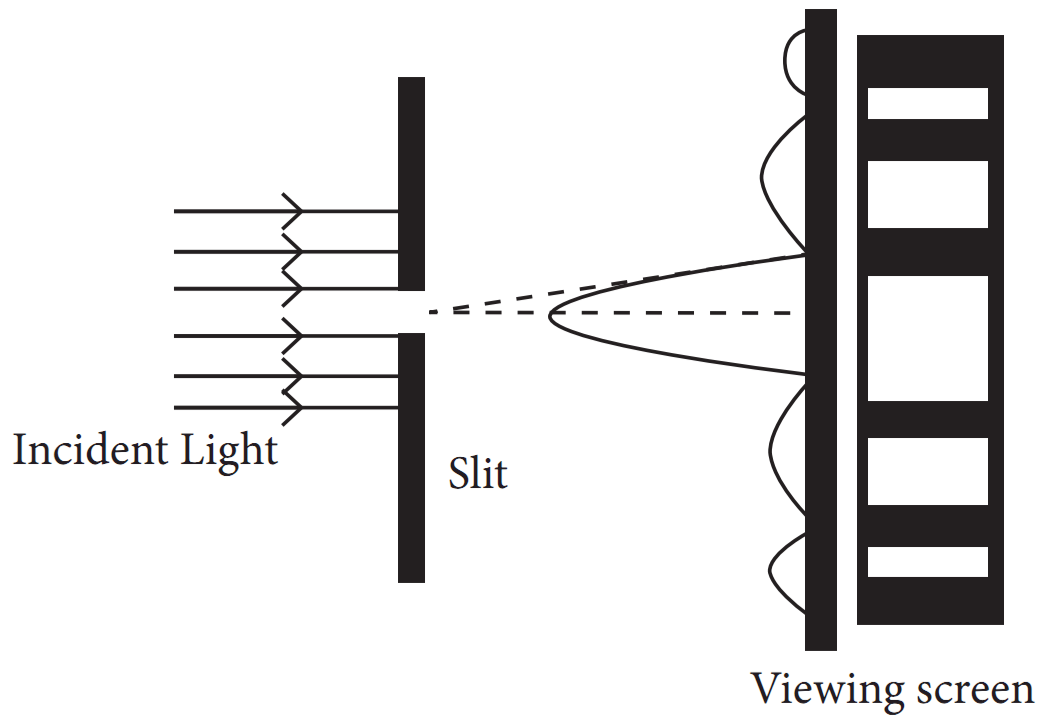
When light from a monochromatic source is incident on a single narrow slit, it gets diffracted and a pattern of ahem ate bright and dark fringes is obtained on screen, called "Diffraction Pattern" of single slit. ln diffraction pattern of single slit, it is found that.

  1. Central bright fringe is of maximum intensity and the intensity of any secondary bright fringe decreases with increase in its order.
  2. Central bright fringe is twice as wide as any other secondary bright or dark fringe.

  1. A single slit of width 0.1mm is illuminated by a parallel beam oftight of wavelength $6000\mathring{\text{A}}$ and diffraction bands are observed on a screen 0.5m from the slit. The distance of the third dark band from the central bright band is:

  1. 3mm
  2. 1.5mm
  3. 9mm
  4. 4.5mm
  1. ln Fraunhofer diffraction pattern, slit width is 0.2mm and screen is at 2m away from the lens. If wavelength of tight used is $5000\mathring{\text{A}}$ then the distance between the first minimum on either side the central maximum is:
  1. 10-1m
  2. 10-2m
  3. 2 × 10⁻²m
  4. 2 × 10⁻¹m
  1. Light of wavelength 600nm is incident normally on a slit of width 0.2mm. The angular width of central maxima in the diffraction pattern is (measured from minimum to minimum).
  1. 6 × 10⁻³rad
  2. 4 × 10⁻³rad
  3. 2.4 × 10⁻³rad
  4. 4.5 × 10⁻³rad
  1. A diffraction pattem is obtained by using a beam of red light. What will happen, if the red light is replaced by the blue light?
  1. Bands disappear
  2. Bands become broader and farther apart
  3. No change will take place
  4. Diffraction bands become narrower and crowded together.
  1. To observe diffraction, the size of the obstacle.
  1. Should be $\frac{\lambda}{2}$, where $\lambda$, is the wavelength.

  2. Should be of the order of wavelength.
  3. Has no relation to wavelength.
  4. Should be much larger than the wavelength.
A small object is embedded in a glass sphere $(\mu=1.5)$ of radius 5.0cm at a distance 1.5cm left to the centre. Locate the image of the object as seen by an observer standing.
  1. To the left of the sphere.
  2. To the right of the sphere.