Question
Cloudy nights are warmer than the nights with clean sky. Explain.

Answer

During night, the earth's surface radiates infrared radiation of larger wavelength. Gas molecules in the air absorb some of this energy and radiate energy of their own in all directions. Also, water molecules, like the vapour that makes the clouds, absorb more frequencies of infrared energy than clear air does.
Both these factors contribute to the fact that clouds radiate more heat in all directions (including the earth) than clear air does. In turn, this makes the overall temperature on the earth warmer when there is a cloud cover. The heat energy radiated by the earth is reflected back to earth. Due to this, cloudy nights are warmer than the nights with clean sky.
Need a full question paper?

Generate a complete, print-ready paper with questions like this in minutes — across 16+ boards, with answer keys.

Start Generating Free

Similar questions

The electrical capacitance of a conductor is the measure of its ability to hold electric charge. An isolated spherical conductor of radius R. The charge Q is uniformly distributed over its entire surface. It can be assumed to be concentrated at the centre of the sphere. The potential at any point on the surface of the spherical conductor will be $\text{V}=\frac{1}{4\pi\in_0}\frac{\text{Q}}{\text{R}}.$

Capacitance of the spherical conductor situated in vacuum is $\text{C}=\frac{\text{Q}}{\text{V}}=\frac{\text{Q}}{\frac{1}{4\pi\in_0}.\frac{\text{Q}}{\text{R}}}$ or $\text{C}=4\pi\in_0\text{R}$ Clearly, the capacitance of a spherical conductor is proportional to its radius. The radius of the spherical conductor of 1F capacitance is $\text{R}=\frac{1}{4\pi\in_0}.$ C and this radius is about 1500 times the radius of the earth $(\sim6\times10^3\text{km}).$
  1. If an isolated sphere has a capacitance 50pE Then radius is:
  1. 90cm
  2. 45cm
  3. 45m
  4. 90m
  1. How much charge should be placed on a capacitance of 25 pF to raise its potential to 105V?
  1. $1\mu\text{C}$
  2. $1.5\mu\text{C}$
  3. $2\mu\text{C}$
  4. $2.5\mu\text{C}$
  1. Dimensions of capacitance is:
  1. $[M L^{-2} T^4 A^2]$
  2. $[M^{-1} L^{-1} T^3 A^1]$
  3. $[M^-L^{-2} T^4 A^2]$
  4. $[M^0 L^{-2} T^4 A^1]$
  1. Metallic sphere of radius R is charged to potential V. Then charge q is proportional to:
  1. V
  2. R
  3. Both V and R
  4. None of these
  1. If 64 identical spheres of charge q and capacitance C each are combined to form a large sphere. The charge and capacitance of the large sphere is:
  1. 64q, C
  2. 16q, 4C
  3. 64q, 4C
  4. 16q, 64C
A small object is embedded in a glass sphere $(\mu=1.5)$ of radius 5.0cm at a distance 1.5cm left to the centre. Locate the image of the object as seen by an observer standing.
  1. To the left of the sphere.
  2. To the right of the sphere.
A transformer is essentially an a.c. device. It cannot work on d.c. It changes altemating voltages or currents. It does not affect the frequency of a.c. It is based on the phenomenon of mutual induction. A transformer essentially consists of two coils of insulated copper wire having different number of tums and wound on the same soft iron core.
The number of turns in the primary and secondary coils of an ideal transfonner are 2000 and 50 respectively. The primary coil is connected to a main supply of 120V and secondary coil is connected to a bulb of resistance $0.6\Omega.$
  1. The value of voltage across the secondary coil is:
  1. 5V
  2. 2V
  3. 3V
  4. 10V
  1. The value of current in the bulb is:
  1. 7A
  2. 15A
  3. 3A
  4. 5A
  1. The value of current in primary coil is:
  1. 0.125A
  2. 2.52A
  3. 1.51A
  4. 3.52A
  1. Power in primary coil is:
  1. 20W
  2. 5W
  3. 10W
  4. 15W
  1. Power in secondary coil is:
  1. 15W
  2. 20W
  3. 7W
  4. 8W
A bar magnet has a length of 8cm. The magnetic field at a point at a distance 3cm from the centre in the broadside-on position is found to be $4 \times 10^{-6} T.$ Find the pole strength of the magnet.
Two point charges $5 \mu C$ and $-5 \mu C$ are kept at a distance of 1 cm from each other. Calculate the intensity of the electric field at a distance of 0.30 cm from mid-point (i) in the axial position, (ii) in neutral position.
TV signals broadcast by Delhi studio cannot be directly received at Patna which is about 1000km away. But the same signal goes some 36000km away to a satellite, gets reflected and is then received at Patna. Explain.
In the year 1939, German scientist Otto Hahn and Strassmann discovered that when an uranium isotope was bombarded with a neutron, it breaks into two intermediate mass fragments. It was observed that, the sum of the masses of new fragments formed were less than the mass of the original nuclei. This difference in the mass appeared as the energy released in the process. Thus, the phenomenon of splitting of a heavy nucleus (usually A > 230) into two or more lighter nuclei by the bombardment of proton, neutron $\alpha$-particle, etc. with liberation of energy is called nuclear fission.
$\ _{92}\text{U}^{235}+\ _0\text{n}^{1}\rightarrow_{92}\text{U}^{236} \rightarrow\ _{56}\text{B}^{114}+\ _{36}\text{Kr}^{89}\ +3\ _{0}\text{n}^{1} + \text{Q}$
$\big[\because \ _{92}\text{U}^{236}= \text{Unstable nucleus}\big]$
  1. Nuclear fission can be explained on the basis of.
  1. Millikan's oil drop method
  2. Liquid drop model
  3. Shell model
  4. Bohr's model.
  1. For sustaining the nuclear fission chain reaction in a sample (of small size) of $_{92}^{235}\text{U}$ it is desirable to slow down fast neutrons by.
  1. Friction
  2. Elastic damping/ scattering
  3. Absorption
  4. None of these.
  1. Which of the following is/ are fission reaction(s)?
  1. $_0^1\text{n}\ +\ _{92}^{235}\text{U}\rightarrow\ _{92}^{235}\text{U}\rightarrow\ _{51}^{133}\text{Sb}+\ _{41}^{99}\text{nb}+\ 4_1^0\text{n}$
  2. $_0^1\text{n}\ +\ _{92}^{235}\text{U}\rightarrow\ _{54}^{1.40}\text{Xe}+\ _{38}^{94}\text{Sr}\ +2_0^1\text{n}$
  3. $_1^2\text{H}\ +\ _1^2\text{H}\rightarrow\ _2^3\text{He}+\ _0^1\text{n}$
  1. Both II and III
  2. Both I and III
  3. Only II
  4. Both I and II
  1. On an average, the number of neutrons and the energy of a neutron released per fission of a uranium atom are respectively.
  1. 2.5 and 2 keV
  2. 3 and 1 keV
  3. 2.5 and 2 MeV
  4. 2 and 2 keV
  1. In any fission process, ratio of mass of daughter nucleus to mass of parent nucleus is.
  1. Less than I
  2. Greater than I
  3. Equal to I
  4. Depends o the mass of parent nucleus.
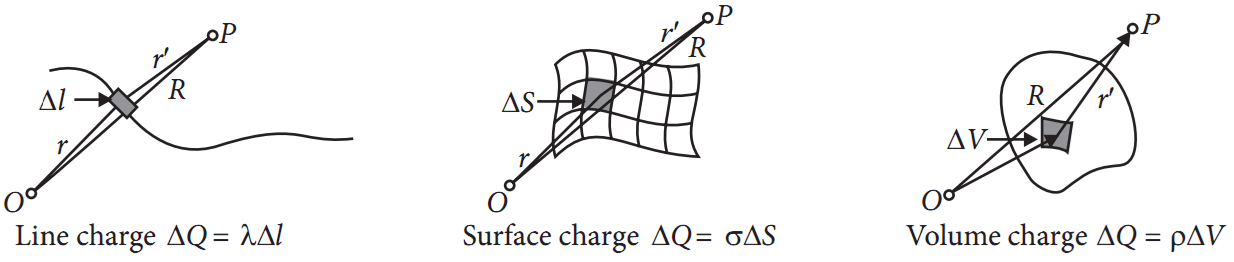
ln practice, we deal with charges much greater in magnitude than the charge on an electron, so we can ignore the quantum nature of charges and imagine that the charge is spread in a region in a continuous manner. Such a charge distribution is known as continuous charge distribution. There are three types of continuous charge distribution : (i) Line charge distribution (ii) Surface charge distribution (iii) Volume charge distribution as shown in figure.
  1. Statement 1: Gauss's law can't be used to calculate an electric field near an electric dipole.
Statement 2: Electric dipole don't have symmetrical charge distribution.
  1. Statement 1 and statement 2 are true.
  2. Statement 1 is false but statement 2 is true.
  3. Statement 1 is true but statement 2 is false.
  4. Both statements are false.
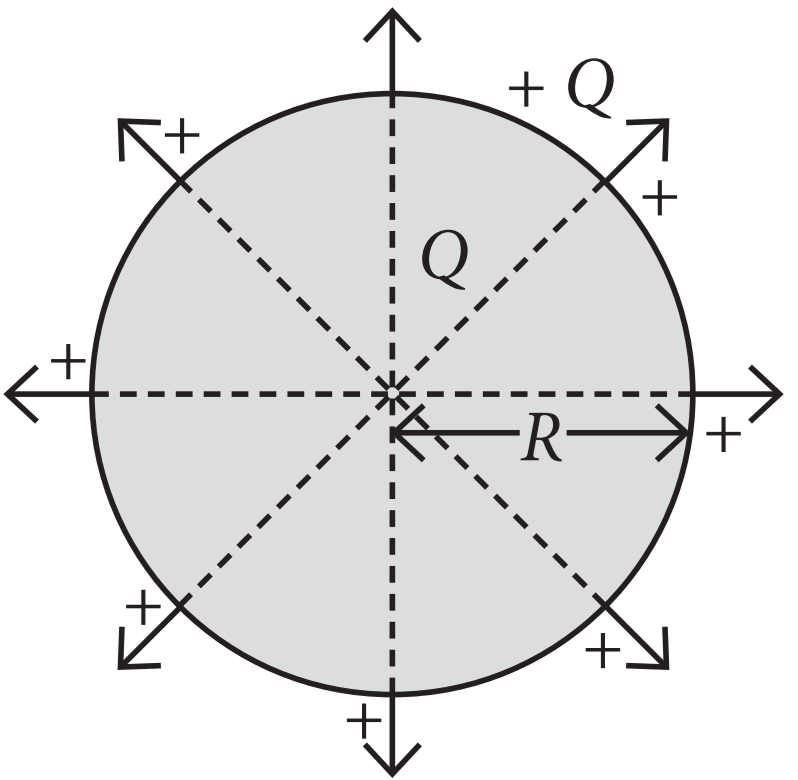
  1. An electric charge of $8.85 \times 10^{-13}C$ is placed at the centre of a sphere of radius 1m. The electric flux through the sphere is:
  1. $0.2NC^{-1} m^2$
  2. $0.1NC^{-1} m^2$
  3. $0.3NC^{-1} m^2$
  4. $0.01NC^{-1} m^2$
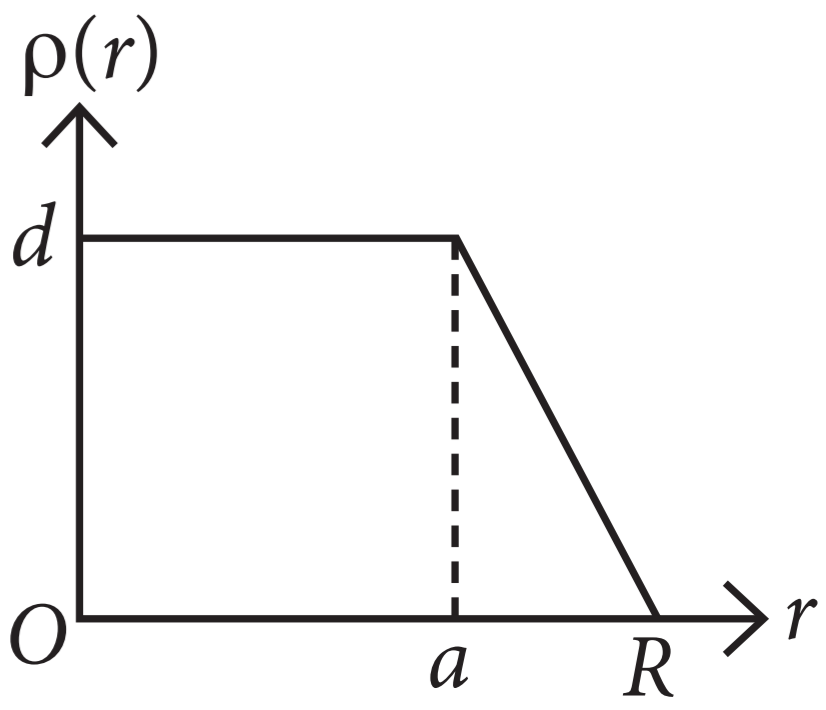
  1. The electric field within the nucleus is generally observed to be linearly dependent on r. So,
  1. a = 0
  2. $\text{a}=\frac{\text{R}}{2}$
  3. a = R
  4. $\text{a}=\frac{\text{2R}}{3}$
  1. What charge would be required to electrify a sphere of radius 25cm so as to get a surface charge density of $\frac{3}{\pi}\text{Cm}^{-2}?$
  1. 0.75C
  2. 7.5C
  3. 75C
  4. Zero
  1. The SI unit of linear charge density is:
  1. Cm
  2. $Cm^{-1}$
  3. $Cm^{-2}$
  4. $Cm^{-3}$
If the earth's magnetic field has a magnitude $3.4 \times 10^{-5} T$ at the magnetic equator of the earth what would be its value at the earth's geomagnetic poles?