MCQ
Cofficient of performance of refigerator is
  • A
    $\frac{{{Q_1}}}{W}$
  • B
    $\frac{{{W}}}{Q_1}$
  • $\frac{{{Q_2}}}{W}$
  • D
    $\frac{{{W}}}{Q_2}$

Answer

Correct option: C.
$\frac{{{Q_2}}}{W}$
c

Need a full question paper?

Generate a complete, print-ready paper with questions like this in minutes — across 16+ boards, with answer keys.

Start Generating Free

Similar questions

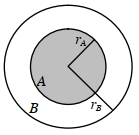
In the figure, the inner (shaded) region $A$ represents a sphere of radius $r_A=1$, within which the electrostatic charge density varies with the radial distance $r$ from the center as $\rho_A=k r$, where $k$ is positive. In the spherical shell $B$ of outer radius $r_B$, the electrostatic charge density varies as $\rho_{\bar{B}}=\frac{2 k}{r}$. Assume that dimensions are taken care of. All physical quantities are in their $SI$ units.

Which of the following statement($s$) is(are) correct?
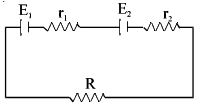
Under what condition current passing through the resistance $R$ can be increased by short circuiting the battery of emf $E_2$. The internal resistances of the two batteries are $r_1$ and $r_2$ respectively.
In Young's double slit experiment, the wavelength of red light is $7800\, Å$ and that of blue light is $5200\, Å$. The value of $n$ for which nth bright band due to red light coincides with $(n + 1)^{th}$ bright band due to blue light, is :
Work done in moving a positive charge on an equipotential surface is
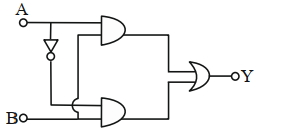
The truth table for this gvien circuit is:
In a $RA$ element the fraction of initiated amount remaining after its mean life time is 
If a particle moves in a circle describing equal angles in equal times, its velocity vector
Two spherical stars $A$ and $B$ have densities $\rho_A$ and $\rho_B$, respectively. $A$ and $B$ have the same radius, and their masses $M_A$ and $M_B$ are related by $M_B=2 M_A$. Due to an interaction process, star $A$ loses some of its mass, so that its radius is halved, while its spherical shape is retained, and its density remains $\rho_A$. The entire mass lost by $A$ is deposited as a thick spherical shell on $B$ with the density of the shell being $\rho_4$. If $v_A$ and $v_B$ are the escape velocities from $A$ and $B$ after the interaction process, the ratio $\frac{v_B}{v_A}=\sqrt{\frac{10 n}{15^{1 / 3}}}$. The value of $n$ is. . . . .
Heat is flowing through two cylindrical rods of the same material. The diameters of the rods are in the ratio $1 : 2$ and their lengths are in the ratio $2 : 1$. If the temperature difference between their ends is the same, then the ratio of the amounts of heat conducted through per unit time will be
The efficiency of carnot engine is $50\%$ and temperature of sink is $500\,K$ . If temperature of source is kept constant and its efficiency raised to $60\%$ , then the required temperature of the sink will be  .... $K$