MCQ
Cofficient of performance of refigerator is
  • A
    $\frac{{{Q_1}}}{W}$
  • B
    $\frac{{{W}}}{Q_1}$
  • $\frac{{{Q_2}}}{W}$
  • D
    $\frac{{{W}}}{Q_2}$

Answer

Correct option: C.
$\frac{{{Q_2}}}{W}$
c

Need a full question paper?

Generate a complete, print-ready paper with questions like this in minutes — across 16+ boards, with answer keys.
Start Generating Free

Similar questions

If a spring is extended to length $l,$ then according to Hook's law
The phase difference between the instantaneous velocity and acceleration of a particle executing simple harmonic motion is
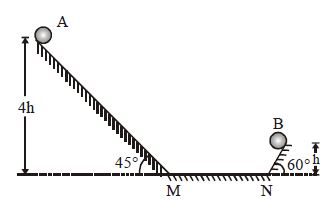
Two identical balls $A$ and $B$ are released from the positions shown in figure. They collide elastically on horizontal portion $MN$ . The ratio of the heights attained by $A$ and $B$ after collision will be : (neglect friction)
The cross sectional area of a horizontal tube increases along its length linearly, as we move in the direction of flow. The variation of pressure, as we move along its length in the direction of flow ($x-$ direction), is best depicted by which of the following graphs
A particle moves in $x-y$ plane according to rule $x = {\rm{asin}}\omega t$ and $\;y = {\rm{acos}}\omega t$. The particle follows  
The process of transformation of liquid into vapor is:
If a force of constant magnitude acts in direction perpendicular to the motion of a particle, then its
A table tennis ball has radius $(3 / 2) \times 10^{-2} m$ and mass $(22 / 7) \times 10^{-3} kg$. It is slowly pushed down into a swimming pool to a depth of $d=0.7 m$ below the water surface and then released from rest. It emerges from the water surface at speed $v$, without getting wet, and rises up to a height $H$. Which of the following option(s) is (are) correct?

[Given: $\pi=22 / 7, g=10 ms ^{-2}$, density of water $=1 \times 10^3 kg m ^{-3}$, viscosity of water $=1 \times 10^{-3} Pa$-s.]

$(A)$ The work done in pushing the ball to the depth $d$ is $0.077 J$.

$(B)$ If we neglect the viscous force in water, then the speed $v=7 m / s$.

$(C)$ If we neglect the viscous force in water, then the height $H=1.4 m$.

$(D)$ The ratio of the magnitudes of the net force excluding the viscous force to the maximum viscous force in water is $500 / 9$.

An observer finds the magnitudes of the acceleration of two bodies to be the same. This necessary implies that the two bodies.
A $15\,g$ mass of nitrogen gas is enclosed in a vessel at a temperature $27\,^oC.$ Amount of heat transferred to the gas, so that rms velocity of molecules is doubled, is about ...... $kJ$ [Take $R = 8.3\,J/K\,mole$ ]