MCQ
Coherent sources are those sources for which
  • A
    Phase difference remain constant
  • B
    Frequency remains constant
  • Both phase difference and frequency remains constant
  • D
    None of these

Answer

Correct option: C.
Both phase difference and frequency remains constant
c
A coherent source continuously emits light with a constant frequency and wavelength. Also, the phase difference in the light waves are always constant. If these properties are satisfied, only then a source is called coherent.

Need a full question paper?

Generate a complete, print-ready paper with questions like this in minutes — across 16+ boards, with answer keys.

Start Generating Free

Similar questions

If the voltage of X-ray tube is doubled, the intensity of X-rays will become
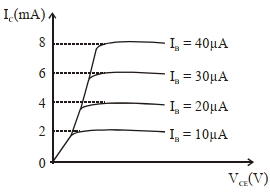
The typical output characteristics curve for a transistor working in the common-emitter configuration is shown in the figure.

The estimated current gain from the figure is
In a capacitor of capacitance 20 μF, the distance between the plates is 2mm. If a dielectric slab of width 1mm and dielectric constant 2 is inserted between the plates, then the new capacitance is
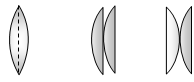
Two similar plano-convex lenses are combined together in three different ways as shown in the adjoining figure. The ratio of the focal lengths in three cases will be
A heavy nucleus $N$, at rest, undergoes fission $N \rightarrow P+Q$, where $P$ and $Q$ are two lighter nuclei. Let $\delta=M_N-M_P-M_Q$, where $M_P, M_Q$ and $M_N$ are the masses of $P, Q$ and $N$, respectively. $E_P$ and $E_Q$ are the kinetic energies of $P$ and $Q$, respectively. The speed of $P$ and $Q$ are $v_P$ and $v_Q$, respectively. If $c$ is the speed of light, which of the following statement(s) is(are) correct ?

$(A)$ $E_P+E_Q=c^2 \delta$

$(B)$ $E_P=\left(\frac{M_P}{M_P+M_Q}\right) c^2 \delta$

$(C)$ $\frac{v_P}{v_Q}=\frac{M_Q}{M_P}$

$(D)$ The magnitude of momentum for $P$ as well as $Q$ is $c \sqrt{2 \mu \delta}$, where $\mu=\frac{M_P M_Q}{\left(M_P+M_Q\right)}$

A lens of power $+ 2$ diopters is placed in contact with a lens of power $-1$ diopter. The combination will behave like
A hundred turns of insulated copper wire are wrapped around an iron cylinder of area $1 \times 10^{-3}\, m^2$ and are connected to a resistor. The total resistance in the circuit is $10$ ohms. If the longitudinal magnetic induction in the iron changes from $1$ weber $m^{-2}$, in one direction to $1$ Weber $m^{-2}$ in the opposite direction, how much charge flows through the circuit
Hydrogen atom excites energy level from fundamental state to $n = 3.$ Number of spectrum lines according to Bohr, is
The amplification factor of a triode is $20$. Its plate resistance is $10\, kilo\, ohms$. Mutual conductance is
$A$ thin prism of angle $5^o$ is placed at a distance of $10\,cm$ from object. What is the distance of the image from object? (Given $\mu$ of prism $= 1.5$)