MCQ
Colours of thin soap bubbles are due to
  • Interference
  • B
    Diffraction
  • C
    Dispersion
  • D
    Reflection

Answer

Correct option: A.
Interference
a
(a)Phenomenon of interference of light takes place.

Need a full question paper?

Generate a complete, print-ready paper with questions like this in minutes — across 16+ boards, with answer keys.
Start Generating Free

Similar questions

Which one of the following is a possible nuclear reaction
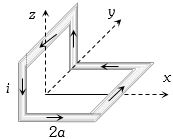
A non-planar loop of conducting wire carrying a current $I$ is placed as shown in the figure. Each of the straight sections of the loop is of length $2a$. The magnetic field due to this loop at the point $P$ $(a,0,a)$ points in the direction
A thin double convex lens has radii of curvature each of magnitude $40 \;cm$ and is made of glass with refractive index $1.65.$ Its focal length is nearly.......$cm$
In Young's double slit experiment, carried out with light of wavelength l = 5000 Å, the distance between the slits is 0.2 mm and the screen is at 200 cm from the slits. The central maximum is at x = 0. The third maximum (taking the central maximum as zeroth maximum) will be at x equal to
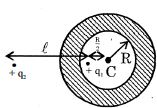
A solid conducting sphere has cavity, as shown in figure. A charge $+ {q_1}$ is situated away from the centre. A charge $+q_2$ is situated outside the sphere then true statement is
Assertion : Electric lines of force cross each other.
Reason : Electric field at a point superimpose to give one resultant electric field.
A proton and a deutron both having the same kinetic energy, enter perpendicularly into a uniform magnetic field B. For motion of proton and deutron on circular path of radius $R_p$ and $R_d$ respectively, the correct statement is
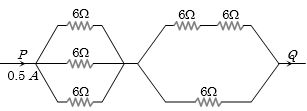
Resistances of $6\, ohm$ each are connected in the manner shown in adjoining figure. With the current $0.5\,ampere$ as shown in figure, the potential difference ${V_P} - {V_Q}$ is .............. $V$
In what order should three capacitors be connected so that the energy stored in them at the same potential is maximum?
An object of height $1.5 cm $ is placed on the axis of a convex lens of focal length $25 cm.$ A real image is formed at a distance of $75 cm$ from the lens. The size of the image will be........$cm$