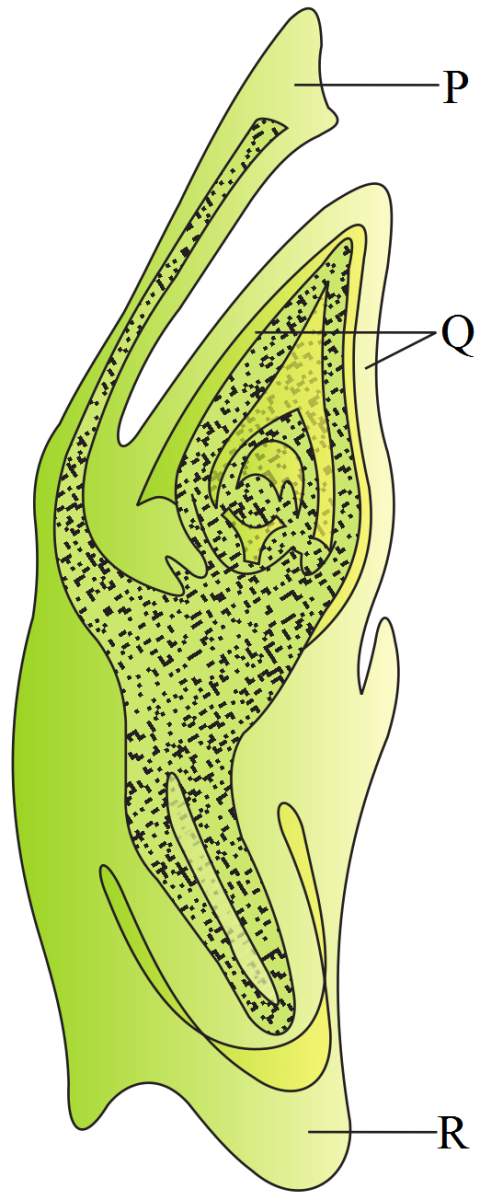
Question
| Column A | Column B |
| (1) Organism | (a) Large unit with specific climatic zone |
| (2) Population | (b) Different species in particular area |
| (3) Community | (c) Same species in a geographical area |
| (4) Biome | (d) Basic unit of ecological hierarchy |
| Column A | Column B |
| (1) Organism | (a) Large unit with specific climatic zone |
| (2) Population | (b) Different species in particular area |
| (3) Community | (c) Same species in a geographical area |
| (4) Biome | (d) Basic unit of ecological hierarchy |
| Column A | Column B |
| (1) Organism | (d) Basic unit of ecological hierarchy |
| (2) Population | (c) Same species in a geographical area |
| (3) Community | (b) Different species in particular area |
| (4) Biome | (a) Large unit with specific climatic zone |
Generate a complete, print-ready paper with questions like this in minutes — across 16+ boards, with answer keys.
| Column I [Organs] | Column II [Functions] |
| (1) Epididymis | (a) Transport of sperms |
| (2) Sertoli cells | (b) Copulatory organ |
| (3) Vas deferens | (c) Nourishment to developing sperms |
| (4) Penis | (d) Maturation of sperms |
| Events in cardiac cycle | Time duration |
| (1) Atrial systole | (a) 0.3 second |
| (2) Atrial diastole | (b) 0.5 second |
| (3) Ventricular systole | (c) 0.1 second |
| (4) Ventricular diastole | (d) 0.7 second |
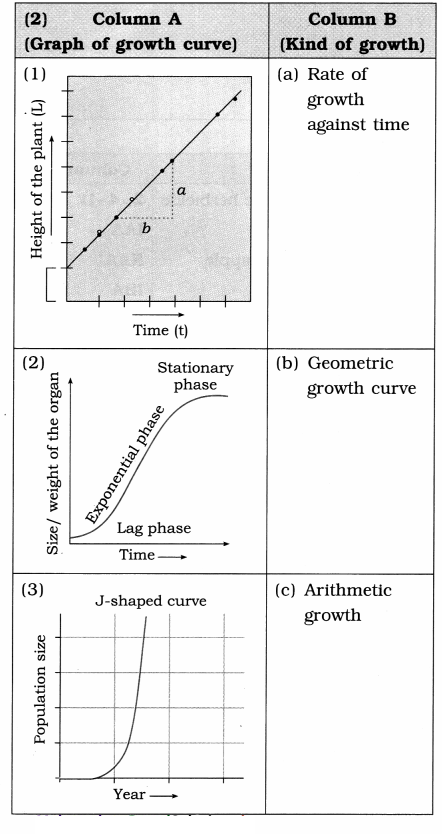
| Column A | Column B |
| (1) Tansley | (a) 10% law |
| (2) C. Elton | (b) Ecosystem services |
| (3) R. Lindemann | (c) Ecological pyramids |
| (4) Millennium Ecosystem Assessment report | (d) Ecosystem |
| Column A | Column B |
| (1) Nutritive tissue of embryo | (a) Perisperm |
| (2) Remnants of nucellus in seed | (b) Cotyledon |
| (3) Nutritive tissue of developing microspores | (c) Endosperm |
| (4) First photosynthetic organ of embryo | (d) Tapetum |
| Respiratory capacities | Respiratory volumes |
| (1) Residual volume (RV) | (a) 500 ml |
| (2) Vital capacity (VC) | (b) 2000 – 3000 ml |
| (3) Tidal volume (TV) | (c) 1100 – 1200 ml |
| (4) Inspiratory reserve volume (IRV) | (d) 4100 – 4600 ml |
| Restriction enzyme | Recognition sequence |
| (1) Alu I | (a) 5′ G-A-A-T-T-C 3′ 3′ C-T-T-A-A-G 5’ |
| (2) Bam HI | (b) 5′ G-T-C-G-A-C3′ 3′ C-A-G-C-T-G 5′ |
| (3) Eco RI | (c) 5′ A-G-C-T 3′ 3′ T-C-G-A5′ |
| (4) Hind II | (d) 5′ G-G-A-T-T-C 3′ 3′ C-C-T-A-A-G 5′ |