Question
Read the following and answer any four questions from (i) to (v) given below:
Embryo develops at the micropylar end of the embryo sac, where the zygote is situated. Most zygotes divided only after certain amount of endosperm is formed. The early stages of embryo development are similar in both monocotyledons and dicotyledons. The zygote gives rise to the proembryo and subsequently to the globular heart-shaped and mature embryo. A typical dicotyledonous embryo consists of an embryonal axis and two cotyledons. Embryo of monocotyledons possess only one cotyledon.
  1. True embryo develops as a result of fusion of:
  1. Two polar nuclei of embryo sac.
  2. An egg cell and a male gamete.
  3. Synergid and male gamete.
  4. A male gamete and antipodals.
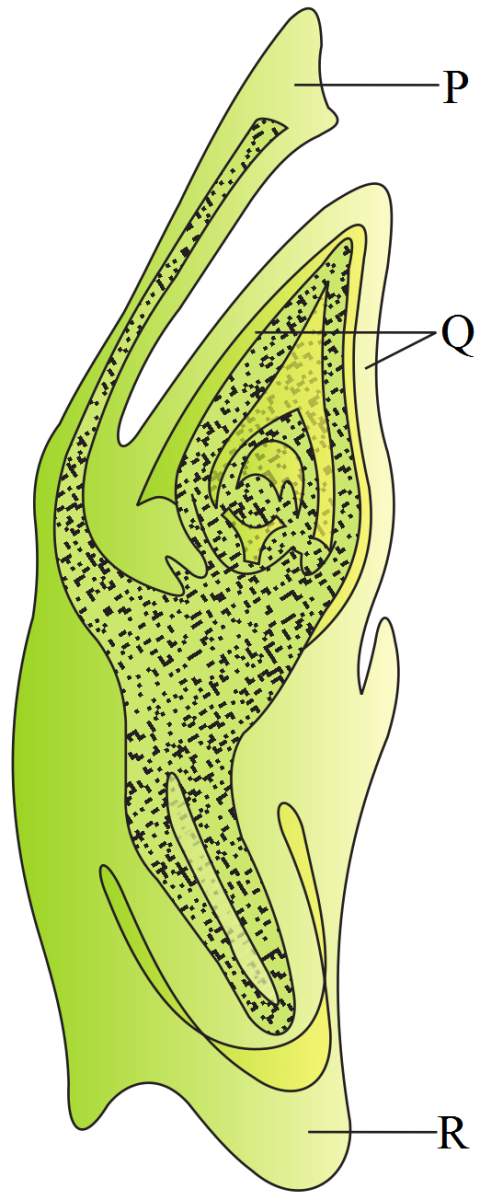
  1. Refer to the given diagram of the embryo of an angiospermous plant with parts labelled P, Q and R. Select the correct statement(s) regarding this.
  1. Part 'P' supplies nutrition to the developing embryo.
  2. Part 'Q' is the protective sheath of radicle and root cap.
  3. Part 'R' is the protective sheath of shoot apex and leaf primordia.
  4. The embryo shown in the diagram is present in members of Family Poaceae.
  1. (IV) only.
  2. (II) and (III) only.
  3. (I) and (IV) only.
  4. (I), (II), (III) and (IV).
  1. Which of the given statements are true?
  1. During the development of a dicot embryo, heart-shaped embryo is followed by globular embryo.
  2. The part of embryonal axis above the level of cotyledons is epicotyl, while the part below the level of cotyledons is hypocotyl.
  3. Monocot seeds possess a single cotyledon, represented by scutellum.
  1. (I) and (II).
  2. (II) and (III).
  3. (I) and (III).
  4. (I), (II) and (III).
  1. Consider the following parts of an embryonal axis of a dicot seed.
  1. Hypocotyl.
  2. Epicotyl.
  3. Radicle.
  4. Plumule.
In which of the following the above parts are correctly arranged from top to base?
  1. (III) → (I) → (II) → (IV).
  2. (II) → (I) → (III) → (IV).
  3. (IV) → (II) → (I) → (III).
  4. (III) → (IV) → (II) → (I).
  1. In grass family, the cotyledon, is called:
  1. Epiblast.
  2. Plumule.
  3. Scutellum.
  4. Perisperm.

Answer

  1. (b) An egg cell and a male gamete.
​​​​​​​​​​​​​​​​​​​​​​​​​​​​​​​​​​​​​​​​​​​​​​​​​​​​​​​​Explanation:

In double fertilisation, out of the two male gametes, one fuses with egg or oosphere to perform generative fertilisation. Generative fertilisation is also called syngamy or true fertilisation. It gives rise to a diploid zygote or oospore.
  1. (c) (I) and (IV) only.
  2. (b) (II) and (III).
​​​​​​​​​​​​​​​​​​​​​​​​​​​​​​​​​​​​​​​​​​​​​​​​​​​​​​​​​​​​​​​​​​​​​​Explanation:

During the development of dicot embryo, initially the dicot embryo is globular and undifferentiated. Early embryo with radial symmetry is called proembryo. It is transformed into embryo with the development of radicle, plumule and cotyledons. Two cotyledons differentiate from the sides with a faint plumule in the center. At this time the embryo becomes heart-shaped.
  1. (c) (IV) → (II) → (I) → (III).
  2. (c) Scutellum.
​​​​​​​​​​​​​​​​​​​​​​​​​​​​​​​​​​​​​​​​​​​​​​​​​​​​​​​​​​​​​​​​​​​​​​​​​​​​​Explanation:

In the grass family, the cotyledon is called scutellum that is situated towards one side (lateral) of the embryonal axis.

Need a full question paper?

Generate a complete, print-ready paper with questions like this in minutes — across 16+ boards, with answer keys.

Start Generating Free

Similar questions

Distinguish between: m-RNA, t-RNA and r-RNA.
Highlight five areas where biotechnology has influenced our lives.
Read the following and answer any four questions from (i) to (v) given below:
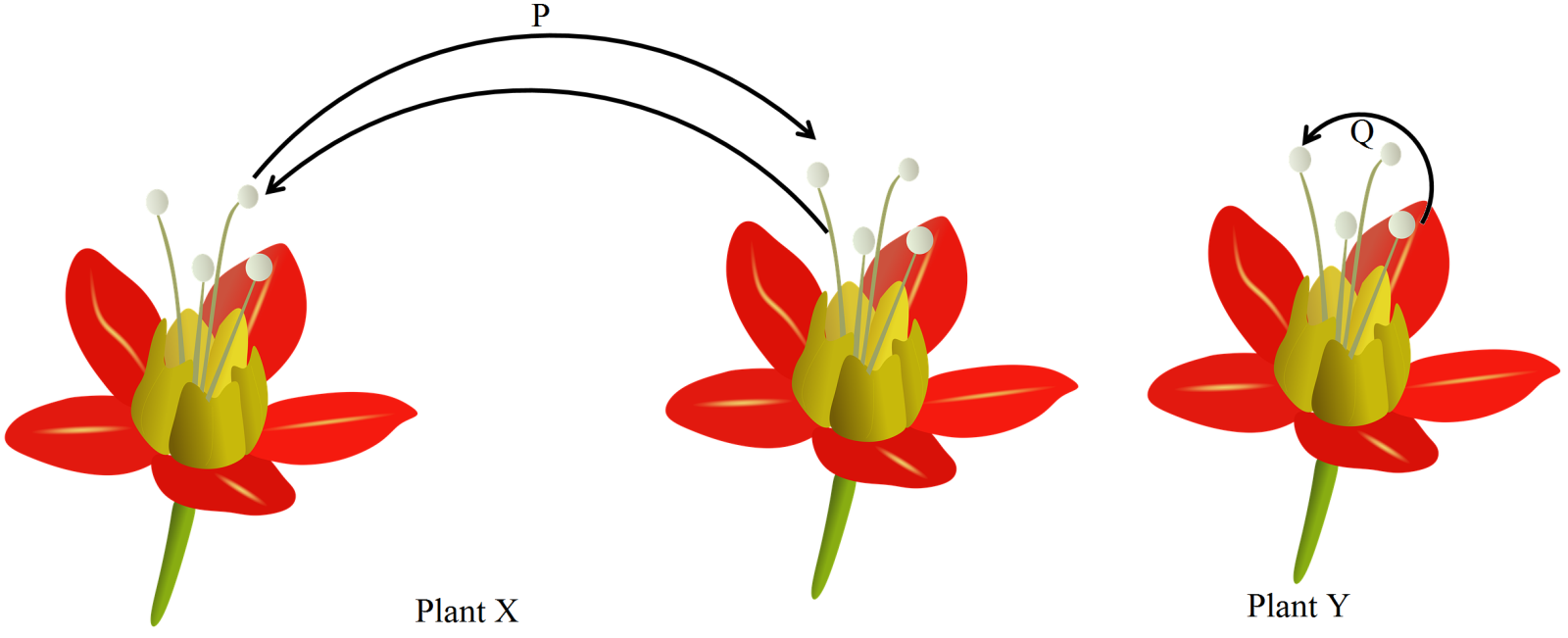
In angiosperms, the pollen grains are being transferred from the anther to the stigma and is termed pollination. This phenomenon was first discovered by Camerarius (1694) in the end of seventeenth century. Pollen grains are immobile. They cannot reach the stigma by themselves. An external agent is required for this. The pollination is mainly of two types-self pollination and cross pollination. The diagram given below shows two plants of the same species showing different types of pollination.
  1. What is transferred between the plants in the process indicated by arrow P?
  1. Ova.
  2. Pollen.
  3. Nutrients.
  4. Seeds.
  1. Which of the following statements is correct regarding processes P, Q and R?
  1. Processes P, Q and R introduce genetic variability in the offspring of sexually reproducing plants X and Y.
  2. Wind serves as agent for process Q if plants X and Y belong to Genus Salvia.
  3. Flowers of plants X and Y need to produce odour and nectar for completion of processes P and Q if they are entomophilous.
  4. If plants X and Y belong to Genus Cannabis, then their flowers need to produce sticky and heavy pollens in very small amount for accomplishment of process Q.
  1. Identify the processes P, Q and R.
S. No
P
Q
R
(a)
Geitonogamy
Xenogamy
Autogamy
(b)
Allogamy
Chasmogamy
Cleistogamy
(c)
Autogamy
Geitonogamy
Xenogamy
(d)
Geitonogamy
Allogamy
Autogamy
  1. In Catliarantl1us, the growth of style brings the stigma in contact of ripe anthers present on the mouth of corolla tube. This is an example of:
  1. Homogamy.
  2. Cleistogamy.
  3. Geitonogamy.
  4. Xenogamy.
  1. Which of the given processes represents a type of pollination that would result in greater adaptability of the particular species to potential environmental changes?
  1. P.
  2. Q.
  3. R.
  4. All of these.
Distinguish between: Homologous organs and Analogous organs.
Inorganic fertilizers and Organic fertilizers / biofertilizers.
A regulatory body working under MoEF for the release of transgenic crop is ____________:
  1. NBPGR
  2. NSC
  3. NIPGR
  4. GEAC
Read the following and answer any four questions from (i) to (v) given below:
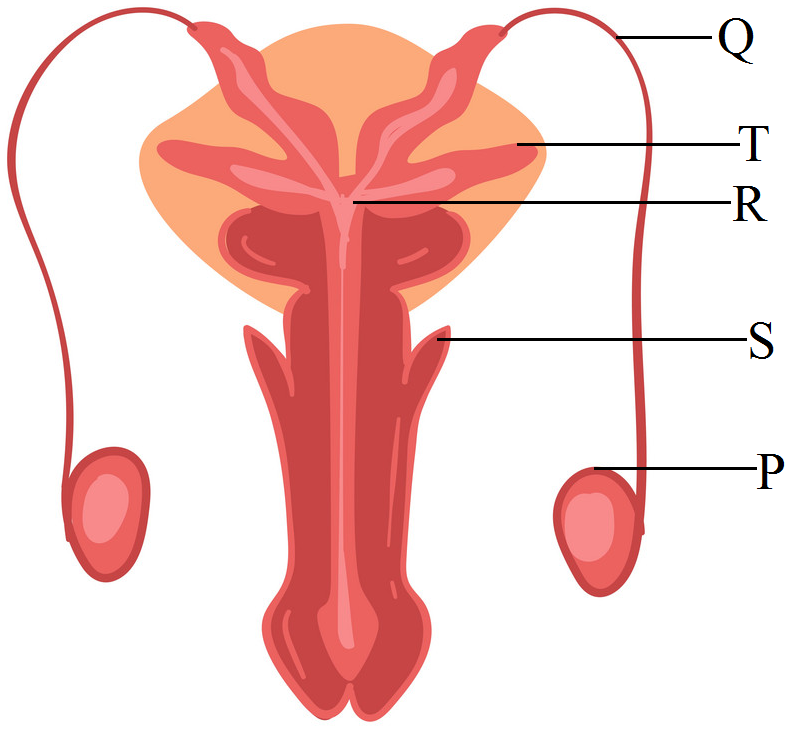
Human male reproductive system comprises of a pair of testes, primary sex organs associated with formation of gametes and production of sex hormone. Study the given figure of human male reproductive system and answer the following questions.
  1. Which of the following is correct for labelled part P?
  1. P is rete testis which transports sperms to outside.
  2. P is epididymis which secretes fluid that nourish the sperms.
  3. P is epididymis that carry sperms and secretion of seminal vesicles.
  4. P is rete testis, which lies along inner side of each testis and stores the sperms.
  1. Identify the correctly matched pair.
  1. Q - Vasa efferentia.
  2. R - Ejaculatory duct.
  3. S - Seminal vesicle.
  4. T - Cowper's gland.
  1. Which statement is incorrect for Q?
  1. It carries spermatozoa from epididymis to ejaculatory duct.
  2. Q are only 2 in number.
  3. It arises from rete testis.
  4. It constitutes male sex accessory duct.
  1. Which structure passes through the prostate gland and carries sperms and secretion of seminal vesicle?
  1. P.
  2. T.
  3. S.
  4. R.
  1. Assertion: Mucus present in secretion of bulbourethral gland decreases the number of sperms damaged during ejaculation.
Reason: Mucus lubricates the end of penis and lining of the urethra.
  1. Both assertion and reason are true, and reason is the correct explanation of assertion.
  2. Both assertion and reason are true, but reason is not the correct explanation of assertion.
  3. Assertion is true, but reason is false.
  4. Both assertion and reason are false.
Distinguish between : Eosinophils and Basophils.
Read the following and answer any four questions from (i) to (v) given below:
According to Mendel, one gene control the expression of one character only. The ability of a gene to have multiple phenotypic effect because it influences a number of characters is an exception. The gene having a multiple phenotypic effect because of its ability to control of two or more characters can be seen in cotton. In cotton, a gene for the lint also influences the height of plant, size of the ball, number of ovules and viability of seeds.
  1. Genes with multiple phenotypic effects are known as?
  1. Hydrostatic genes.
  2. Duplicate genes.
  3. Pleiotropic genes.
  4. Complimentary genes.
  1. Which of the following disorder is an example of genes with multiple phenotypic effects?
  1. Phenylketonuria.
  2. Haemophilia.
  3. Sickle cell anaemia.
  4. Both (a) and (c)
  1. Which of the following is an example of gene with multiple phenotypic effect?
  1. Drosophila white eye mutation.
  2. Kernel colour in wheat.
  3. Height in human beings.
  4. Skin colour in human beings.
  1. Which of the following statements is not correct regarding genes with multiple phenotypic effect?
  1. It is not essential that all the traits are equally influenced.
  2. Occasionally a number of related changes are caused by a gene.
  3. It occurs due to effect of the gene on two or more inter-related metabolic pathways.
  4. None of these.
  1. Assertion: ln garden pea, the gene which controls the flower colour also controls the colour of the seed coat and presence of red spots in the leaf axils.
Reason: A pleiotropic gene influences more than one trait.
  1. Both assertion and reason are true and reason is the correct explanation of assertion.
  2. Both assertion and reason are true but reason is not the correct explanation of assertion.
  3. Assertion is true but reason is false.
  4. Both assertion and reason are false.
Column AColumn B
(1) Walter Rosen(a) Popularisation of term biodiversity
(2) David Tillman(b) Rivet Popper Hypothesis
(3) Paul Ehrlich(c) Productivity Stability Hypothesis
(4) Edward Wilson(d) Coined