Question
Column $I$ describe some situations in which a small object moves. Column $II$ describes some characteristics of these motions. Match the situation in Column $I$ with the characteristics in Column $II$ and indicate your answer by darkening appropriate bubbles in the $4 \times 4$ matrix given in the $ORS$.
Column $I$ Column $II$
$(A)$ The object moves on the $\mathrm{x}$-axis under a conservative force in such a way that its "speed" and "position" satisfy $v=c_1 \sqrt{c_2-x^2}$, where $\mathrm{c}_1$ and $\mathrm{c}_2$ are positive constants. $(p)$ The object executes a simple harmonic motion.
$(B)$ The object moves on the $\mathrm{x}$-axis in such a way that its velocity and its displacement from the origin satisfy $\mathrm{v}=-\mathrm{kx}$, where $\mathrm{k}$ is a positive constant. $(q)$ The object does not change its direction.
$(C)$ The object is attached to one end of a massless spring of a given spring constant. The other end of the spring is attached to the ceiling of an elevator. Initially everything is at rest. The elevator starts going upwards with a constant acceleration a. The motion of the object is observed from the elevator during the period it maintains this acceleration. $(r)$ The kinetic energy of the object keeps on decreasing.
$(D)$ The object is projected from the earth's surface vertically upwards with a speed $2 \sqrt{\mathrm{GM}_e / R_e}$, where, $M_e$ is the mass of the earth and $R_e$ is the radius of the earth. Neglect forces from objects other than the earth. $(s)$ The object can change its direction only once.

Answer

Get the step-by-step solution for this question inside the Vidyadip app.

Get the answer in the app

Need a full question paper?

Generate a complete, print-ready paper with questions like this in minutes — across 16+ boards, with answer keys.

Start Generating Free

Similar questions

The area of a cross-section of steel wire is $0.1\,\,cm^2$ and Young's modulus of steel is $2\,\times \,10^{11}\,\,N\,\,m^{-2}.$  The force required to stretch by $0.1\%$ of its length is ......... $N$.
Amount of light entering into the camera depends upon
A defective eye cannot see close objects clearly because their image is formed
The vernier constant of Vernier callipers is $0.1 \,mm$ and it has zero error of $(-0.05) \,cm$. While measuring diameter of a sphere, the main scale reading is $1.7 \,cm$ and coinciding vernier division is $5$. The corrected diameter will be ........... $\times 10^{-2} \,cm$
An object is projected from ground with speed $u$ at angle $\theta$ with horizontal. the radius of curvature of its trajectory at maximum height from ground is ..........
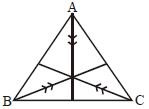
Three particles $A, B$ & $C$ of equal mass move with speed $V$ as shown to strike at  centroid of equilateral triangle after collision. $A$ comes to rest & $B$ retraces its path  with speed $V$. speed of $C$ after collision is :-
A thin oil layer floats on water. A ray of light making an angle of incidence of $40^o $ shines on oil layer. The angle of refraction of light ray in water is......$^o$

(${\mu _{oil}} = 1.45,\,{\mu _{water}} = 1.33$)

A bar magnet of magnetic moment $10^4\,J/T$ is free to rotate in a horizontal plane. The work done in rotating the magnet slowly from a direction parallel to a horizontal magnetic field of $4×10^{-5}\, T$ to a direction $ 60° $ from the field will be.....$ J$
A planar loop made of wire is rotating in a uniform magnetic field. At time $t=0$, the plane of the loop is perpendicular to the magnetic field. If the loop is rotating about an axis passing through its plane with a period of $10$ seconds, at which of the following times will the induced electromotive force (emf) be maximum and minimum, respectively?
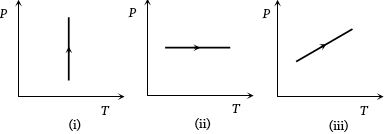
Pressure versus temperature graphs of an ideal gas are as shown in figure. Choose the wrong statement