Question
| Column I | Column II |
| 1. Protoxylem | (a) Xylem with larger vessels |
| 2. Endarch Xylem | (b) Protoxylem arranged towards pith |
| 3. Metaxylem | (c) Metaxylem arranged towards pith |
| 4. Exarch xylem | (d) First formed xylem vessels |
| Column I | Column II |
| 1. Protoxylem | (a) Xylem with larger vessels |
| 2. Endarch Xylem | (b) Protoxylem arranged towards pith |
| 3. Metaxylem | (c) Metaxylem arranged towards pith |
| 4. Exarch xylem | (d) First formed xylem vessels |
| Column I | Column II |
| 1. Protoxylem | (d) First formed xylem vessels |
| 2. Endarch Xylem | (b) Protoxylem arranged towards pith |
| 3. Metaxylem | (a) Xylem with larger vessels |
| 4. Exarch xylem | (c) Metaxylem arranged towards pith |
Generate a complete, print-ready paper with questions like this in minutes — across 16+ boards, with answer keys.
| Column I | Column II |
| 1. Herbarium | (a) It is a place having a collection of preserved plants and animals |
| 2. Key | (b) A list that enumerates methodically all the species found in an area with brief description aiding identification |
| 3. Museum | (c) It is a place where dried and pressed plant specimens mounted on sheets are kept |
| 4. Catalogue | (d) A booklet containing a list of characters and their alternates which are helpful in identification of various taxa. |
| Column I | Column II |
| 1. Cuboidal epithelium | a. Fallopian tube |
| 2. Squamous epithelium | b. Kidney |
| 3. Ciliated epithelium | c. Intestine |
| 4. Columnar epithelium | d. Endothelium |
| Phylum | Characters |
| 1. Annelida | (a) Tube feet |
| 2. Mollusca | (b) Ostia |
| 3. Ctenophora | (c) Radula |
| 4. Porifera | (d) Parapodia |
| 5. Echinodermata | (e) Comb plates |
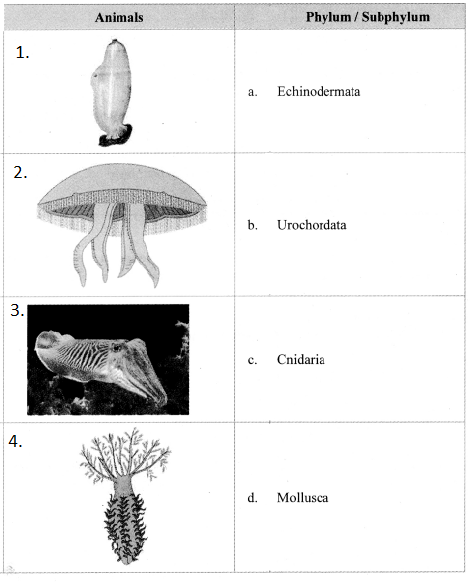
| Column I (Organism) | Column II (Characteristic Feature) |
| 1. Euplectella | (a) Exoskeleton formed of placoid scales |
| 2. Periplaneta | (b) Presence of mantle |
| 3. Sepia | (c) Water canal system |
| 4. Scoliodon | (d) Jointed appendages |
| 5. Clarias | (e) Exoskeleton formed of cycloid scales |
| Column I | Column II |
| 1. Mitochondria | (a) Synthesis of protein |
| 2. Nucleus | (b) Photosynthesis |
| 3. Chloroplast | (c) Respiration |
| 4. Ribosomes | (d) Nucleoplasm |
| Column $I$ | Column $II$ |
| $1. \ G:$ Phase | $(a) \ 1-3$ Hours |
| $2. \ G_i$ Phase | $(b) \ 2-5$ Hours |
| $3. \ M$ Phase | $(c) \ 6-8$ Hours |
| $4. \ S$ Phase | $(d) \ 8$ Hours |
| Column I | Column II |
| 1. Composite fruit | (a) Custard apple |
| 2. Parthenocarpic fruit | (b) Cultivated Banana |
| 3. Aggregate fruit | (c) Mango |
| (d) Pineapple |
| Column I | Column II |
| 1. Psilopsida | (a) Selaginella |
| 2. Lycopsida | (b) Equisetum |
| 3. Sphenopsida | (c) Adiantum |
| (d) Psilotum |