MCQ
Column $II$ gives certain systems undergoing a process. Column $I$ suggests changes in some of the parameters related to the system. Match the statements in Column $I$ to the appropriate process$(es)$ from Column $II$.

Column $I$  Column $II$ 
$(A)$ The energy of the system is increased

$(p)$ $System:$ A capacitor, initially uncharged

$Process:$ It is connected to a battery

$(B)$ Mechanical energy is provided to the system, which is converted into energy of random motion of its parts

$(q)$ $System:$ A gas in an adiabatic container fitted with an adiabatic piston

$Process:$ The gas is compressed by pushing the piston

$(C)$ Internal energy of the system is converted into its mechanical energy

$(r)$ $System:$ A gas in a rigid container

$Process:$ The gas gets cooled due to colder atmosphere surrounding it

$(D)$ Mass of the system is decreased

$(s)$ $System:$ A heavy nucleus, initially at rest

$Process:$ The nucleus fissions into two fragments of nearly equal masses and some neutrons are emitted


$(t)$ $System:$ A resistive wire loop

$Process:$ The loop is placed in a time varying magnetic field perpendicular to its plane

  • $A-p, q, t \ \ B-q \ \ C-s \ \ D-s$
  • B
    $A-r, q, t \ \ B-q \ \ C-p \ \ D-s$
  • C
    $A-p, s, t \ \ B-r \ \ C-s \ \ D-t$
  • D
    $A-p, r, s \ \ B-q \ \ C-q \ \ D-p$

Answer

Correct option: A.
$A-p, q, t \ \ B-q \ \ C-s \ \ D-s$
a
$(P) \rightarrow(A)$ : electric energy stored.

$(Q) \rightarrow(A B)$ energy supplied, increasing internal energy.

$(R) \rightarrow$ (none) energy reduces, heat flows out, internal energy drops.

$(S) \rightarrow(A C D)$ Mass to energy conversion

$( T ) \rightarrow( A )$ Current flows leading to heat generation

Need a full question paper?

Generate a complete, print-ready paper with questions like this in minutes — across 16+ boards, with answer keys.

Start Generating Free

Similar questions

${v_e}$ and ${v_p}$ denotes the escape velocity from the earth and another planet having twice the radius and the same mean density as the earth. Then
If g is the acceleration due to gravity at the earth's surface and $r$ is the radius of the earth, the escape velocity for the body to escape out of earth's gravitational field is
If $R =$ universal gas constant, the amount of heat needed to raise the temperature of $2$ mole of an ideal monoatomic gas from $273K$ to $373K$ when no work is done ...... $R$
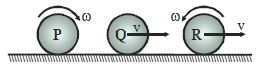
Three solid spheres are made to move on a rough horizontal surface. Sphere $P$ is given a spin and released. Sphere $Q$ is given a forward linear velocity. Sphere $R$ is given linear and rotational motions as shown in the figure. Directions of the friction force on spheres $P, Q, R$ are respectively
The diameter of a sphere is measured using a vernier caliper whose $9$ divisions of main scale are equal to $10$ divisions of vernier scale. The shortest division on the main scale is equal to $1 \mathrm{~mm}$. The main scale reading is $2 \mathrm{~cm}$ and second division of vernier scale coincides with a division on main scale. If mass of the sphere is $8.635 \mathrm{~g}$, thedensity of the sphere $1 \mathrm{~s}$ :
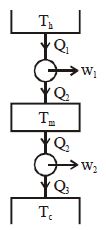
Suppose that two heat engines are connected in series, such that the heat exhaust of the first engine is used as the heat input of the second engine as shown in figure. The efficiencies of the engines are $\eta_1$  and $\eta_2$, respectively. The net efficiency of the combination is given by
Hanging in a spring m the period of oscillation of the mass is T. Oscillations are made by cutting the spring in half and hanging double the mass on it. Now the period of oscillation will be :
The average distance between molecules of an ideal gas at $STP$ is approximately of the order of
A uniform metallic wire is elongated by $0.04\, m$ when subjected to a linear force $F$. The elongation, if its length and diameter is doubled and subjected to the same force will be ..... $cm .$
A particle moves along a straight line as $s = u(t - 2) + a(t - 2)^2$