Column$-II$ is related to Column$-I$. Join them appropriately :
| Column $-I$ | Column $-II$ |
| $(a)$ When temperature raised Young’s modulus of body | $(i)$ Zero |
| $(b)$ Young’s modulus for air | $(ii)$ Infinite |
| $(iii)$ Decreases | |
| $(iv)$Increases |
Medium


Download our appand get started for free
Experience the future of education. Simply download our apps or reach out to us for more information. Let's shape the future of learning together!No signup needed.*
Similar Questions
- 1View SolutionWhy the spring is made up of steel in comparison of copper
- 2One end of a metal wire is fixed to a ceiling and a load of $2 \mathrm{~kg}$ hangs from the other end. A similar wire is attached to the bottom of the load and another load of $1 \mathrm{~kg}$ hangs from this lower wire. Then the ratio of longitudinal strain of upper wire to that of the lower wire will be____________.View Solution
[Area of cross section of wire $=0.005 \mathrm{~cm}^2$, $\mathrm{Y}=2 \times 10^{11}\ \mathrm{Nm}^{-2}$ and $\left.\mathrm{g}=10 \mathrm{~ms}^{-2}\right]$
- 3A string of area of cross-section $4\,mm ^{2}$ and length $0.5$ is connected with a rigid body of mass $2\,kg$. The body is rotated in a vertical circular path of radius $0.5\,m$. The body acquires a speed of $5\,m / s$ at the bottom of the circular path. Strain produced in the string when the body is at the bottom of the circle is $\ldots . . \times 10^{-5}$. (Use Young's modulus $10^{11}\,N / m ^{2}$ and $g =10\,m / s ^{2}$ )View Solution
- 4The area of a cross-section of steel wire is $0.1\,\,cm^2$ and Young's modulus of steel is $2\,\times \,10^{11}\,\,N\,\,m^{-2}.$ The force required to stretch by $0.1\%$ of its length is ......... $N$.View Solution
- 5View SolutionThe following four wires are made of the same material. Which of these will have the largest extension when the same tension is applied ?
- 6The work done in increasing the length of a metre long wire of cross-sectional area ........ $J.$ $1\,mm^2$ through $1\,mm$ will be $(Y = 2 \times 10^{11}\,Nm^{-2})$View Solution
- 7A compressive force, $F$ is applied at the two ends of a long thin steel rod. It is heated, simultaneously, such that its temperature increases by $\Delta T$. The net change in its length is zero. Let $l$ be the length of the rod, $A$ its area of cross- section, $Y$ its Young's modulus, and $\alpha $ its coefficient of linear expansion. Then, $F$ is equal toView Solution
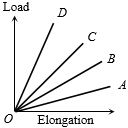
- 8View SolutionThe load versus elongation graph for four wires of the same material is shown in the figure. The thickest wire is represented by the line
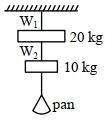
- 9Wires ${W}_{1}$ and ${W}_{2}$ are made of same material having the breaking stress of $1.25 \times 10^{9} \,{N} / {m}^{2}$ ${W}_{1}$ and ${W}_{2}$ have cross-sectional area of $8 \times 10^{-7}\, {m}^{2}$ and $4 \times 10^{-7}\, {m}^{2}$, respectively. Masses of $20 \,{kg}$ and $10\, {kg}$ hang from them as shown in the figure. The maximum mass that can be placed in the pan without breaking the wires is $.....{kg}$ (Use $\left.{g}=10\, {m} / {s}^{2}\right)$View Solution
- 10A solid cube of copper of edge $10 \,cm$ subjected to a hydraulic pressure of $7 \times 10^6\, pascal$. If Bulk modulus of copper is $140 \,GPa$, then contraction in its volume will be ................ $m ^3$View Solution