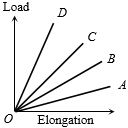
The load versus elongation graph for four wires of the same material is shown in the figure. The thickest wire is represented by the line
Easy


Download our appand get started for free
Experience the future of education. Simply download our apps or reach out to us for more information. Let's shape the future of learning together!No signup needed.*
Similar Questions
- 1View SolutionThe quality of the material which opposes the change in shape, volume or length is called
- 2The Young's modulus of a wire of length $L$ and radius $r$ is $Y$ $N/m^2$. If the length and radius are reduced to $L/2$ and $r/2,$ then its Young's modulus will beView Solution
- 3In $CGS$ system, the Young's modulus of a steel wire is $2 \times {10^{12}}$. To double the length of a wire of unit cross-section area, the force required isView Solution
- 4To double the length of a iron wire having $0.5\,c{m^2}$ area of cross-section, the required force will be $(Y = {10^{12}}\,dyne/c{m^2})$View Solution
- 5The length of an iron wire is $L$ and area of cross-section is $A$. The increase in length is $l$ on applying the force $F$ on its two ends. Which of the statement is correctView Solution
- 6A wire of length $50\, cm$ and cross sectional area of $1$ sq. mm is extended by $1\, mm.$ The required work will be $(Y = 2 \times {10^{10}}\,N{m^{ - 2}})$View Solution
- 7An $8\,m$ long copper wire and $4\,m$ long steel wire, each of cross section $0.5\,cm^2$ are fastened end to end and stretched by $500\,N$ force. The elastic potential energy of the system is (Youngs mod $: Y_{cu}= 1\times 10^{11}\,N/m^2,$ $Y_{steel} = 2\times 10^{11}\,N/m^2$ ) :View Solution
- 8The area of cross section of a steel wire $(Y = 2.0 \times {10^{11}}N/{m^2})$ is $0.1\;c{m^2}$. The force required to double its length will beView Solution
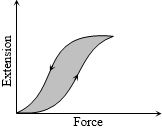
- 9The diagram shows a force-extension graph for a rubber band. Consider the following statementsView Solution
$I.$ It will be easier to compress this rubber than expand it
$II.$ Rubber does not return to its original length after it is stretched
$III.$ The rubber band will get heated if it is stretched and released
Which of these can be deduced from the graph
- 10A wire of length $L$ and radius $r$ is clamped rigidly at one end. When the other end of the wire is pulled by a force $F$, its length increases by $5\,cm$. Another wire of the same material of length $4 L$ and radius $4\,r$ is pulled by a force $4\,F$ under same conditions. The increase in length of this wire is $....cm$.View Solution