Question
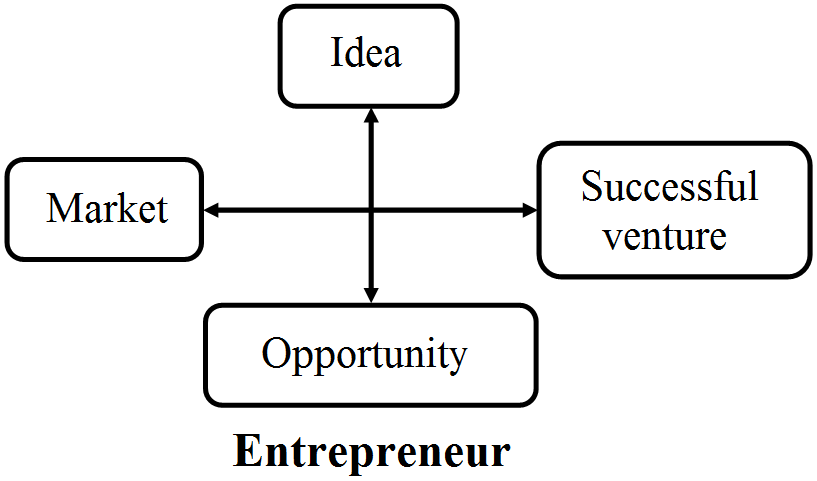
Comment on the following diagram.

Answer

The given diagram depicts that there are innumerable ideas present and spotted by an entrepreneur. The basic ideas may emerge from problems, changes in the environment, inventions, competition and innovations taking place.
An entrepreneur through his vision and creativity, identifies an idea to generate a solution to a problem. This solution is converted into an opportunity.
Here, what is important is that, the ideas have to assessed in terms of its potentiality of the opportunity. Thus, investigation of ideas has to be done for opportunity assessment.
Idea and opportunity assessment Steps are as follows:
  1. Product identification.
  2. Application and use.
  3. Level of operation.
  4. Cost.
  5. Competition.
  6. Technical complexity.
  7. Annual turnover and assessment.
Finally, market assessment in terms of demand of the product, supply and nature of competition, cost and price of the product and prevailing product innovations have to be done to move into a direction of setting up of successful venture.

Need a full question paper?

Generate a complete, print-ready paper with questions like this in minutes — across 16+ boards, with answer keys.

Start Generating Free

Similar questions

What is trade marking? Why is it necessary?
R and S Co. manufacturing plant that produces four different types of machine tools and their cost, price and BE Qty. The fixed costs are allocated - taking into consideration the utilization of common resources for different products.
Here is the basic data-
Products: P, Q, R and S
Selling Price: ₹ 2,00,000; ₹ 1,0,000; ₹ 1,40,000 and ₹ 4,00,000 respectively
Variable Cost: 560,000; 350,000; 360,000 and 200,000 respectively
Allocated Fixed Expenses per month:37,00,000; 35,00,000; 320,00,000 and 530,00,00 respectively.
Compute of Break Even level and explain how it will effect the company if product units fails to move beyond Break even level.
Write the full forms of various SFIs and when they were established.
Describe the characteristics of a company.
Define 'Creativity'. Explain the five stages of the 'creative process'.
In the following cases (statements)
identify the type of budgets related to it:
  1. It always estimates of future sales, DE often broken down into both units and currency.
  2. It estimates the various costs involved with manufacturing those units, including labour and material.
  3. It is used to determine an organization's long term investments.
  4. It also estimates the investment for BATERIAS research and development.
  5. It estimates the funds for promotion and advertising.
  6. It shows a cost estimated/associated and is used to establish a particular company project.
  7. An estimate of the number of units that must be manufactured to meet the sales goals.
  8. A budget which details the amount of cash you collect and pay out.
  9. This is generally tallied on a monthly basis, but some businesses tabulate this weekly.
  10. It helps you figure out how much money you need to put in place new equipment or procedures to launch new products or increase production or ervices.
  11. It estimates the value of capitalpurchases you need for your business to grow and increase revenues.
Explain the investment decision under the financial plan. In which areas should the investment be made on the basis of priority?
Explain in detail, the various formalities required to start a business.
Samiksha is running her boutique for past 3 years. Recently, she has observed that her customer base is diminishing because of increased competition as well as peoples growing inclination towards readymade garments. Is this a cause of concern? Give any two ways to diversify customer base.
'Environmental factors exert influence upon each other and do not operate in isolation? Discuss.