Question
Communicable and non-communicable diseases.
| Communicable diseases | Non-communicable diseases |
| 1. Diseases transmitted from infected person to healthy person are called communicable or infectious diseases. | 1. Diseases that are not passed from one person to other are non-communicable or non-infectious diseases. |
| 2. Communicable diseases spread through pathogens. | 2. Non-communicable diseases do not spread through pathogens. |
| 3. Communicable diseases are not inherited from parental generation to offspring. | 3. Non-communicable diseases like cancer can be from parental generation to offspring. |
| 4. Vectors play the major role in spreading disease from one person to another. | 4. Caused due to allergy, illness, malnutrition or abnormalities in cell proliferation, changes in lifestyle, environment play a significant role. |
| 5. Treated by conventional methods using antibiotics and other drugs. | 5. Treated conservatively for a long time or surgically. |
| 6. Diseases are acute which develop suddenly due to infections.
E.g. Pneumonia, Tuberculosis, AIDS, Typhoid, Cholera, Malaria. | 6. Diseases are chronic which develop and persist for a long time. E.g. Cancer, Rickets, Allergies, Kwashiorkor, Diabetes, Heart disease, etc. |
Generate a complete, print-ready paper with questions like this in minutes — across 16+ boards, with answer keys.
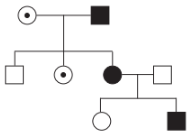
(a) Identify whether the trait is sex-linked or autosomal.
(b) Give an example of a trait in human beings which shows such a pattern of inheritance.