MCQ
Communication on ground is through electromagnetic waves of wavelength
  • A
    larger than $600\, m$
  • B
    between $200$ and $600\, m$
  • C
    between $1$ and $5\, m$
  • between $10^{-3}$ and $0.1$

Answer

Correct option: D.
between $10^{-3}$ and $0.1$
d
The required wavelength should be from $10^{-3}\, \mathrm{m}$ to $0.1\, \mathrm{m}$

$\Rightarrow I_{e}=\frac{100}{90} \times 10 \,\mathrm{mA}=11.1\, \mathrm{mA}$

Need a full question paper?

Generate a complete, print-ready paper with questions like this in minutes — across 16+ boards, with answer keys.
Start Generating Free

Similar questions

A bar magnet is demagnetized by inserting it inside a solenoid of length $0.2\, m$, $100\, turns$, and carrying a current of $5.2\, A$. The coercivity of the bar magnet is.....$A/m$
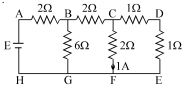
The figure shows a network of resistors and $a$ battery. If $1\,A$ current flowsthrough the branch $CF$, then answer the following questions The $\mathrm{emf}$ $E$ of the battery is If a zero resistance wire is connected in parallel to branch $CF$ ............... $V$
Ratio of thermal energy released in two resistor $R$ and $3 R$ connected in parallel in an electric circuit is :
Which of the following is the correct statement regarding electrochemical cell?
Two streams of protons move parallel to each other in the same direction. They will:
Given below in the left column are different modes of communication using the kinds of waves given in the right column

$A.$ Optical Fiber Communication $P.$ Ultrasound
$B.$ Radar $Q.$ Infrared Light
$C.$ Sonar $R.$ Microwaves
$D.$ Mobile Phones $S.$ Radio Waves

From the options given below, find the most appropriate match between entries in the left and the right column

The oscillating frequency of acyclotron is $10\, MHz$. If the radius of its dee is $0.5\, m$, the kinetic energy of a proton, which is accelerated by the cyclotron is......$MeV$
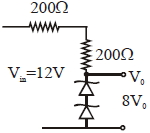
The circuit shown below is working as a $8\; \mathrm{V}\;dc$ regulated voltage source. When $12 \;\mathrm{V}$ is used as input, the power dissipated (in $\mathrm{mW}$ ) in each diode is

(considering both zener diodes are identical)
A hot liquid is kept in a big room. The logarithm of the numerical value of the temperature difference between the liquid and the room is plotted against time. The plot will be very nearly:
If $\hat i$ denotes a unit vector along incident light ray, $\hat r$ a unit vector along refracted ray into a medium of refractive index $\mu $ and $\hat n$ unit vector normal to boundary of medium directed towards incident medium, then law of refraction is