MCQ
Two streams of protons move parallel to each other in the same direction. They will:
  • Attract each other
  • B
    Repel each other
  • C
    Neither attract nor repel
  • D
    Rotate

Answer

Correct option: A.
Attract each other

Two streams of protons move parallel to each other in the same direction.
So, we can assume that they are two wires carrying current in same direction.
We know that two parallel wires having same direction of current attract each other.

Need a full question paper?

Generate a complete, print-ready paper with questions like this in minutes — across 16+ boards, with answer keys.
Start Generating Free

Similar questions

The resistance of a galvanometer is $90\, ohms$. If only $10$ percent of the main current may flow through the galvanometer, in which way and of what value, a resistor is to be used
An electric current i enters and leaves a uniform circular wire of radius a through diametrically opposite points. A charged particle q moving along the axis of the circular wire passes through its centre at speed v. The magnetic force acting on the particle when it passes through the centre has a magnitude:
The average acceleration in one time period in a simple harmonic motion is:
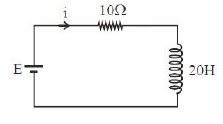
A $20\, Henry$ inductor coil is connected to a $10\, ohm$ resistance in series as shown in figure. The time at which rate of dissipation of energy (Joule’s heat) across resistance is equal to the rate at which magnetic energy is stored in the inductor, is
Find the direction of vibration of Electric field if vibration of magnetic field is in positive $x-$ axis and propagation of em wave is along positive $y-$ axis.
What is used as a moderator in a nuclear reactor
A conducting sphere of radius $10\, cm$ is charged $10\,\mu \,C$. Another uncharged sphere of radius $20\, cm$ is allowed to touch it for some time. After that if the sphere are separated, then surface density of charges, on the spheres will be in the ratio of
There are two charges $+1$ microcoulombs and $+5$ microcoulombs. The ratio of the forces acting on them will be
The half life period of radium is 1600 years. The fraction of a sample of radium that would remain after 6400 years is
A uniform electric field having a magnitude $E_0$ and direction along the positive X - axis exists. If the potential V is zero at x = 0, then its value at X = +x will be