MCQ
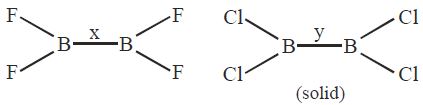
Compare $B—B$ bond length in following molecules :
- A$x > y$
- ✓$y > x$
- C$x = y$
- DNone of these
Fluorine is more electronegative than chlorine. Hence, the electrons of $\mathrm{F}-\mathrm{B}$ bond are more towards $\mathrm{F}$ than the electrons of $\mathrm{Cl}-\mathrm{B}$ bond. Thus, the partial positive charge on $\mathrm{B}$ atom is more in fluoro derivative than in chloro derivative.
Hence, the attraction for the bond pair of electrons of $\mathrm{B}-\mathrm{B}$ bond is greater for the fluoro
compound than for chloro compound.
Hence, $\mathrm{y}>\mathrm{x}$
Generate a complete, print-ready paper with questions like this in minutes — across 16+ boards, with answer keys.
$\begin{matrix}
C{{H}_{3}}\,\,\,\,\,\,\, \\
|\,\,\,\,\,\,\,\,\,\,\,\,\,\,\,\, \\
{{H}_{3}}C-C-CH=C{{H}_{2}} \\
|\,\,\,\,\,\,\,\,\,\,\,\,\,\,\,\,\, \\
C{{H}_{3}}\,\,\,\,\,\,\,\,\, \\
\end{matrix}$