Question
Compare the process of calcination and roasting.

Answer

Comparison of calcination and roasting :
CalcinationRoasting
  • It is the process of heating the ore
    to a high temperature in the
    absence of air, or where air does not take part in the reaction.
  • The process of heating the concentrated ore in the presence of air to a high temperature so as not to melt it is called roasting.
  • Usually carbonate ores or ores containing water are calcined.
  • Usually sulphide ores are roasted.
  • Organic matter, if present in the ore, gets expelled and the ore becomes porous.
  • The impirirties of P, As and S are removed as their oxides which being volatile, escape as gases.
  • It is done in reverbratory furnace The holes of the furnace are kept closed.
  • It is also done in reverbratory furnace but the holes of the furnace are kept open to allow the entry of air in to the furnace.

Need a full question paper?

Generate a complete, print-ready paper with questions like this in minutes — across 16+ boards, with answer keys.

Start Generating Free

Similar questions

Making use only of substances chosen from those given below:
Dilute sulphuric acid
Sodium carbonate
Zinc
Sodium sulphite
Lead
Salcium carbonate
Give the equation for the reaction by which you could obtain:
(i) Hydrogen
(ii) Sulphur dioxide
(iii) Carbon dioxide
(iv) Zinc Carbonate (two steps required).
How would you prepare :
zinc sulphate crystals from zinc dust (powdered zinc and zinc oxide).
The percentage composition of sodium phosphate, as determined by analysis is $: 42.1\% \ Na, 18.9\%\  P, 39\%$ of $O$. Find the empirical formula of the compound.
$[H =1, N =14, Na = 23, P = 31, Cl = 35.5, Pt = 195]$
The following table represents the first period of the modern periodic table. Study the table and answer the questions that follow:
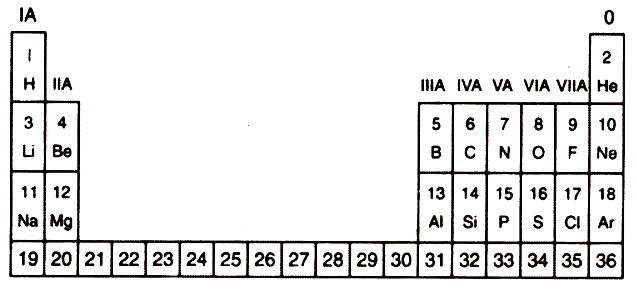
(i) Write the formula of the sulphate of the element with atomic number 13.
(ii) What type of bonding will be present in the oxide of the element with atomic number 1?
(iii) Which feature of the atomic structure accounts for the similarities in the chemical properties of the elements in group VIIA of the periodic table?
(iv) Name the element which has the highest ionization potential.
(v) How many electrons are present in the valence shell of the element with atomic number 18?
(vi) What is the name given to the energy released, when an atom in its isolated gaseous state accepts an electron to form an anion?
(vii) What is the electronic configuration of the element in the third period which gains one electron to become an anion?
(viii) Fill in the blanks:
The atomic size ______ as we move from left to right across the period, because the ______ increases, but the ______ remains the same.
Two oxides of a metal $(M)$ have $20.12\%$ and $11.19\%$ oxygen. The formula of the first oxide is $MO$. Determine the formula of the second oxide.
Find the molecular formula of a hydrocarbon having vapour density $15,$ which contains $20\%$ of Hydrogen.
Name the common refrigerant. How does it deplete the ozone layer?
Give the trivial names and $IUPAC$ names of the following:
(a) $C_3H_6$
(b) $C_2H_4$
(c) $C_2H_2$
(d) $CH_30H$
(e) $CH_3COOH$
The reaction of potassium permanganate $(VII)$ with acidified iron $(II)$ sulphate is given below :
$2KMno_4 + 10FeSO_4 + 8H_2O \rightarrow K_2SO_4 + 2MnSO_4 + 5Fe2(SO_4)_3 + 8H_2O$
If $15.8g$ of potassium permanganate $(VII)$ was used in the reaction, calculate the mass of iron $(II)$ sulphate used in the above reaction.