Questions

[5 Mark Question Answer]

🎯

Test yourself on this topic

10 questions · timed · auto-graded

Question 15 Marks
XY
Normal Electronic Configuration 2,8,72,8,2
Nature of OxideDissolves in water  and truns blue litmus red.Very low solublity in water. Dissolves in hydrochloric acid
Tendency for Oxidising and reducing reactionsTends to oxidise elements and compoundTends to act as a reducing agent
Electrical and Thermal ConductivityVery poor electrical conductor Poor thermal conductivityGood electrical conductor Good thermal conductor
Tendency to form Alloys and AmalgamsNo tendency to form alloysForms alloys
Using the information above, complete the following :
(i) _________ is the metallic element.
(ii) Metal atoms tend to have a maximum of ________ electrons in the outermost energy level.
(iii) Non-metallic elements tend to form _________ oxides while metals tend to form _______oxides.
(iv) Non-metallic elements tend to be ______ conductors of heat and electricity.
(v) Metals tend to _______ electrons and act as ________ agents in their reactions with elements and compounds.
Answer
(i) Y is the metallic element.
(ii) Metal atoms tend to have a maximum of 3 electrons in the outermost energy level.
(iii) Non-metallic elements tend to form acidic oxides, while metals tend to form basic oxides.
(iv) Non-metallic elements tend to be poor conductors of heat and electricity.
(v) Metals tend to lose electrons and act as reducing agents in their reactions with elements and compounds.
View full question & answer
Question 25 Marks
Answer the following question :
Write the chemical formulae of main ore iron and aluminum.
Answer
Ore of iron :
Name Chemical name Formula
Red haematite Anhydrous ferric
oxide
$Fe^2O_3$
Brown
haematite
Hydrated ferric
oxide
$2Fe_2O_3.3H_2O$
Ores of aluminium :
Name Chemical name Formula
Bauxite Hydrated
aluminium oxide
$Al_3O_32H_2O$
Cryolite Sodium
aluminium oxide
$Na_3AlF_6​​​​​​​$​​​​​​​
View full question & answer
Question 35 Marks
The following is an extract from Metals in the service of Man, Alexander and street /Pelican 1976:
Alumina (aluminium oxide) has a very high melting point of over $2000^oC $so that it cannot readily be liquefied. However, conversion of alumina to aluminium and oxygen, by electrolysis, can occur when it is dissolved in some other substance.
(a) Which solution is used to react with bauxite as a first step in obtaining pure aluminium oxide?
(b) The aluminium oxide for the electrolytic extraction of aluminium is obtained by heating aluminium hydroxide. Write the balanced chemical equation for this reaction.
(c) Name the element which serves both as the anode and the cathode in the extraction of aluminium.
(d) Write the balanced chemical equation for the reaction that occurs at the cathode during the extraction of aluminium by electrolysis.
(e) Give the balanced chemical equation for the reaction which occurs at the anode when aluminium is purified by electrolysis.
Answer
(a) Sodium hydroxide.
(b) $2 Al ( OH )_3 \xrightarrow[1000^{\circ} C ]{\text { Heat }} Al _2 O _3+3 H _2 O$
(c) Graphite
(d) Reaction at cathode: $Al ^{3+}+3 e^{-} \rightarrow Al$
(e) Reaction at anode: $Al -3 e ^{-} \rightarrow Al ^{3+}$
View full question & answer
Question 45 Marks
Compare the properties of a typical metal and a non- metal on the basis of the following:
(a) electronic configuration
(b) nature of oxides
(c) oxidizing or reducing action
(d) conductivity of heat and electricity
Answer
Property Metal Non-metal
Electronic Configuration Usually have $1, 2$ or $3$ electrons in valence shell . Usually have $5, 6$ or $7$ electrons in the valence shell.
Nature of oxides They generally form basic oxides some of which are amphoteric as $Al_2O_3$ Generally form acidic oxides $(CO_2, SO_2)$. Some oxides are neutral as $NO$ $N_2O$.
Oxidizing or reducing action Reducing agents Oxidizing agents
Conductivity of heat and electricity Generally they are Good conductors of both heat and electricity. Generally they are Poor conductors of heat and non conductors of electricity.
View full question & answer
Question 55 Marks
In order to obtain one tone of aluminium, the following inputs are required:
4 tones of bauxite, $150 Kg $ of sodium hydroxide and $600 \ Kg$ of graphite.
The aluminium compound in bauxite is aluminium oxide and the main impurity is iron (II) oxide. Aluminium is obtained by the electrolysis of aluminium oxide dissolved in cryolite.
(i) Write the formula of cryolite.
(ii) Write down the word which correctly completes the following sentence.
"By dissolving aluminium oxide in cryolite, a ______ (conducting / non- conducting) solution is produced.
(iii) Why so much graphite required for this electrolytic process.
(iv) Write the equation for the reaction which takes place at cathode.
Answer
(i) $Na_3AIF_6$​​​​​​​. It is also known as Sodium aluminium fluoride.
(ii ) Conducting solution is produced.
(iii ) Because it reacts with $O_2$​​​​​​​, produced at anode and gets consumed to form $CO_2.$
$O^{2-} - 2e^- → [O]$
$C + 2[O] → CO_2​​​​​​​$​​​​​​​
So carbon rods are replaced from time to time.
(iv) $2Al^{3+} + 6e^- → 2AI$
View full question & answer
Question 65 Marks
X is an element in the form of a powder. X burns in oxygen and the product is soluble in water. The solution is tested with litmus. Write down only the word which will correctly complete each of the following sentences:
(a) If X is a metal, then the litmus will turn ______.
(b) If X is a non-metal, then the litmus will turn ______.
(c) If X is a reactive metal, then ______ will be evolved, when X reacts with dilute sulphuric acid.
(d) If X is a non -metal, it will form _ oxide, which will form ______ solution with water.
(e) If X is a non -metal, it will not conduct electricity unless it is carbon in the form of ______.
Answer
(a) If X is a metal, then the litmus will turn blue.
(b) If X is a non-metal, then the litmus will turn Red.
(c) If X is a reactive metal, then Hydrogen will be evolved, when X reacts with dilute sulphuric acid.
(d) If X is a non -metal, it will form acidic oxide, which will form acidic solution with water.
(e) If X is a non -metal, it will not conduct electricity unless it is carbon in the form of graphite.
View full question & answer
Question 75 Marks
How is aluminium obtained from pure ore?
Answer
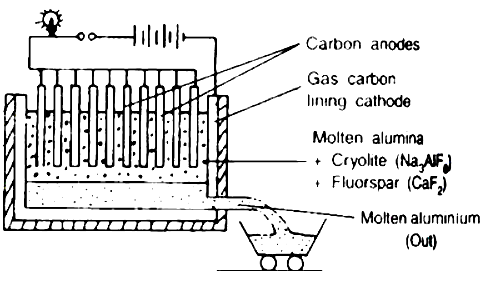
Aluminium is obtained from pure ore by Hall - Heroults process as follows:
i. Electrolyte used :
a. Pure alumina
b. Cryolite
c. Aluminium fluoride
d. Calcium fluoride or Fluorspar
ii . Electrolytic cell : It is a rectangular steel tank with a thick inner lining of carbon .
iii . Electrodes used :
a. Cathode: inner lining of carbon
b. Anode: Thick carbon rods dipping into the fused electrolytes.
Reactions: On passage of electricity through electrolyte aluminium and oxide ions are formed.
At cathode: Aluminium ions get reduced as:
$Al^{3+} + 3e^- → Al$​​​​​​​
At anode: oxygen gas is liberated as:
$O^{2-} - 2e^- → [ O ]$
$[ O ] + [ O ] → O_2$​​​​​​​
The oxygen formed at anode oxidizes the carbon of the anode to carbon dioxide.
$C + O_2 → CO_2​​​​​​​$​​​​​​​
As a result the anode gets oxidized and it has to be replaced periodically.

Figure: Extraction of aluminium from pure ore.
View full question & answer
Question 85 Marks
How is ore purified (give equations also)
Answer
Purification of aluminium ore is done by the Baeyers process.
Baeyers process involves the following steps:
1. Bauxite is crushed to a fine powder.
2. The powdered bauxite is then treated with a strong solution of sodium hydroxide.
3. The mixture is then heated under pressure to $150^{\circ} C$ to $250^{\circ} C$ for about 30 minutes. The heat and the pressure cause the alumina to dissolve in the sodium hydroxide to form sodium aluminate.
$
Al _2 O _3 \cdot 2 H _2 O +2 NaOH \longrightarrow 2 NaAlO _2+3 H _2 O
$
Alumina being amphoteric dissolves in sodium hydroxide.
4. The sodium aluminate solution is then filtered to separate the impurities.
5. The solution of sodium aluminate is then cooled lightly and sent into tanks called precipitators.
6. Crystals of aluminium hydroxide are then added when most of the sodium aluminate undergoes hydrolysis to precipitate insoluble aluminium hydroxide.
$
NaAIO _2+2 H _2 O \longrightarrow NaOH + Al ( OH )_3
$
7. The solid aluminium hydroxide is separated by filtration.
8. The solid aluminium hydroxide is then washed and again filtered and dried, and then heated to about $1100^{\circ} C$ to $1200^{\circ} C$, when aluminium hydroxide decomposes to form aluminium oxide.
$
2 Al ( OH )_3 \longrightarrow Al _2 O _3+3 H _2 O
$
View full question & answer
Question 95 Marks
Compare the process of calcination and roasting.
Answer
Comparison of calcination and roasting :
CalcinationRoasting
  • It is the process of heating the ore
    to a high temperature in the
    absence of air, or where air does not take part in the reaction.
  • The process of heating the concentrated ore in the presence of air to a high temperature so as not to melt it is called roasting.
  • Usually carbonate ores or ores containing water are calcined.
  • Usually sulphide ores are roasted.
  • Organic matter, if present in the ore, gets expelled and the ore becomes porous.
  • The impirirties of P, As and S are removed as their oxides which being volatile, escape as gases.
  • It is done in reverbratory furnace The holes of the furnace are kept closed.
  • It is also done in reverbratory furnace but the holes of the furnace are kept open to allow the entry of air in to the furnace.
View full question & answer
Question 105 Marks
How an ore is concentrated by froth floatation process?
Answer
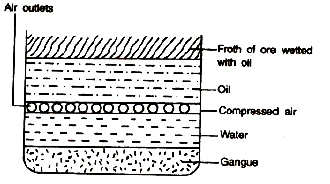
Concentrated of an ore by froth floatation process : This process depends on preferential wettability of the ore and the gangue particles. Crushed ore is taken in
a large tank containing water and certain oils. The ore particles get wetted by the oil and the gangue particles get wetted by water. The mixture is then agitated with
the help of compressed air. The ore particles that get wetted with the oil form a froth on the top, and can be scooped out. This method is used for the concentration
of sulphide ores.

Figure : Froth floatation process
View full question & answer
[5 Mark Question Answer] - Chemistry STD 10 Questions - Vidyadip