Question
Compare the properties of ionic compounds and covalent compounds.

Answer

Ionic compounds
  1. Ionic compounds are usually crystalline solids.
  2. Ionic compounds have high melting and boiling points.
  3. Ionic compounds are usually soluble in water.
Covalent compounds
  1. Covalent compounds are usually liquids or gases.
  2. Covalent compounds have low melting and boiling points.
  3. Covalent compounds are usually insoluble in water.

Need a full question paper?

Generate a complete, print-ready paper with questions like this in minutes — across 16+ boards, with answer keys.

Start Generating Free

Similar questions

Write all the capital letters of the alphabet which look the same in a plane mirror.
The process of ultra-filtration is essential in urine formation, where does this step occur in nephron?
A forest ecosystem having a lot of green plants has some foxes, lions and rabbits in it.
  1. Write a food chain comprising all the four organisms mentioned above.
  2. Name (i) one herbivore, and (ii) two carnivores, in this food chain.
  3. Name the link which is a predator as well as a prey.
  4. Name (i) second trophic level, and (ii) third trophic level.
  5. Which link of this food chain can feed on second trophic level as well as third trophic level, independently?
  6. If the sun provides 1000 J of energy to the plants, then how much energy will be transferred to fox through the food chain.
An element X of group 15 exists as diatomic molecule and combines with hydrogen at 773K in presence of the catalyst to form a compound, ammonia which has a characteristic pungent smell.
  1. Identify the element X. How many valence electrons does it have?
  2. Draw the electron dot structure of the diatomic molecule of X. What type of bond is formed in it?
  3. Draw the electron dot structure for ammonia and what type of bond is formed in it?
A compound $X$ is formed by the reaction of a carboxylic acid $C _2 H _4 O _2$ and an alcohol in presence of a few drops of $H _2 SO _4$. The alcohol on oxidation with alkaline $KMnO _4$ followed by acidification gives the same carboxylic acid as used in this reaction. Give the names and structures of:
a. Carboxylic acid.
b. Alcohol.
c. The compound X . Also, write the reaction.
How are evolutionary relations between organisms traced?
A carbon compound ‘P' on heating with excess cont. $H2SO_4$ forms another carbon compound ‘Q' which on addition of hydrogen in the presence of nickel catalyst forms a saturated carbon compound ‘R'. One molecule of ‘R' on combustion forms two molecules of carbon dioxide and three molecules of water. Identify P, Q and R and write chemical equations for the reactions involved.
You are provided with two containers made up of copper and aluminium. You are also provided with solutions of dilute HCl , dilute $HNO _3, ZnCl _2$ and $H _2 O$. In which of the above containers these solutions can be kept?
  1. If the image formed by a lens is diminished in size and erect, for all positions of the object, what type of lens is it?
  2. Name the point on the lens through which a ray of light passes undeviated.
  3. An object is placed perpendicular to the principal axis of a convex lens of focal length 20cm. The distance of the object from the lens is 30cm. Find,
  1. The position.
  2. The magnification.
  3. The nature of the image formed.
The image below shows a banana plant which is growing with the help of suckers. These suckers are small plant stem outgrowths which can be separated from the main plant and planted separately and they will grow into a new plant subsequently.
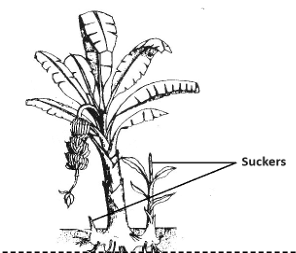
Image
(i) Give the name and type of reproduction that is shown in the image above. (1)
(ii) List two advantages the farmer will have on using the type of reproduction mentioned above. (2)
(iii) The above plant produces male flowers. Explain how this plant will be involved in the process of pollination. (1)
(iv) Why is the offspring of this banana plant not absolutely identical to its parent plant? (1)