Question
  1. Complete the equations for:
  1. $\text{BF}_3+\text{LiH}\rightarrow$
  2. $\text{B}_2\text{H}_6+\text{H}_2\text{O}\rightarrow$
  1. Give reasons:
  1. Conc $HNO_3$ is transported in aluminium container.
  2. Graphite is used as lubricant.
  3. Lead (IV) chloride is highly unstable towards heat.
Answer

  1.  
  1. $2\text{BF}_3+6\text{LiH}\xrightarrow{\ \ \ \ \ \ }\text{B}_2\text{H}_6+6\text{LiF}\\ \ \ \ \ \ \ \ \ \ \ \ \ \ \ \ \ \ \ \ \ \ \ \ \ \ \ \ \ \ \ ^\text{Diborane}$
  2. $\text{B}_2\text{H}_6+6\text{H}_2\text{O}\xrightarrow{\ \ \ \ \ \ }2\text{H}_3\text{BO}_3+6\text{H}_2\\ \ \ \ \ \ \ \ \ \ \ \ \ \ \ \ \ \ \ \ \ \ \ \ \ \ \ \ \ \ \ \ \ \ \ \ \ \ \ \ \ \ \ ^\text{Boric acid}$
  1.  
  1. Aluminium metal reacts with concentrated $HNO_3$ to form protective layer of aluminium oxide on its surface that prevents the lower layers to react with $HNO_3$​​​​​​​, i.e., rendering (making) lower layers passive for further reaction. Hence $HNO_3$​​​​​​​ can be stored and transported in Al vessels.
$2\text{Al}+6\text{HNO}_3(\text{conc.})\xrightarrow{\ \ \ \ \ \ \ }\text{Al}_2\text{O}_3\\+6\text{NO}_2+3\text{H}_2\text{O}$
  1. Graphite has hexagonal layer structure where layers can slide over one another due to weak van der Waals' forces between them ($\text{p}\pi-\text{p}\pi$ bonds). Therefore graphite can be used as lubricant.
  2. Lead can exit in +2 and +4 oxidation states. Down the group stability of lower oxidation state increases and that of higher oxidation state decreases due to inert pair effect. Hence lead (IV) chloride is unstable towards heat and readily decomposes to lead (II) chloride.
$\text{PbCl}_4\xrightarrow{\ \ \ \Delta\ \ \ }\text{PbCl}_2+\text{Cl}_2$

Need a full question paper?

Generate a complete, print-ready paper with questions like this in minutes — across 16+ boards, with answer keys.

Start Generating Free

Similar questions

A sparingly soluble salt gets precipitated only when the product of the concentration of its ions in the solution $\left( Q _{ sp }\right)$ becomes greater than its solubility product. If the solubility of $BaSO _4$ in water is $8 \times 10^{-4} mol dm ^{-3}$, calculate its solubility in $0.01 mol dm ^{-3}$ of $H _2 SO _4$.
Apart from tetrahedral geometry, another possible geometry for $\mathrm{CH}_4$ is square planar with the four H atoms at the corners of the square and the C atom at its centre. Explain why $\mathrm{CH}_4$ is not square planar?
Explain the structure of triple bond with diagram.
The drain cleaner, Drainex contains small bits of aluminum which react with caustic soda to produce dihydrogen. What volume of dihydrogen at $20^\circ C$ and one bar will be released when $0.15g$ of aluminum reacts?
What is the pH of 0.001 M aniline solution? The ionisation constant of aniline is $4.27 \times 10^{-10}$. Calculate the degree of ionisation of aniline in the solution. Also calculate the ionisation constant of the conjugate acid of aniline.
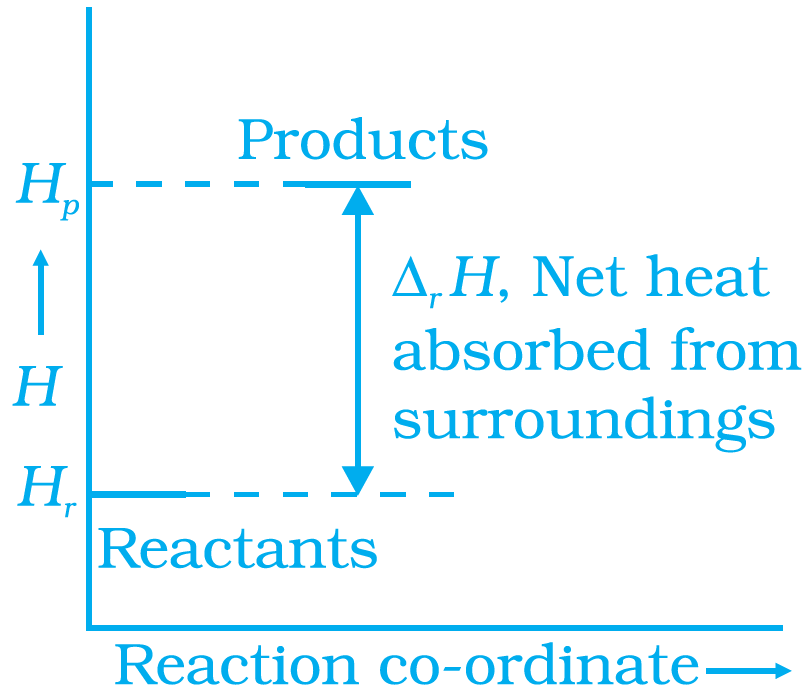
Enthalpy diagram for a particular reaction is given in Fig. Is it possible to decide spontaneity of a reaction from given diagram. Explain.
  1. Show that the circumference of Bohr's orbit for the H-atom is an integral multiple of the de-Broglie wavelength of electron revolving around the orbit.
  2. Explain that the effect of the Heisenberg uncertainty principle is significant only for motion of microscopic objects and is negligible for that of macroscopic objects. $[h = 6.626 \times 10^{-34}Js$, Mass of electron $= 9.1 \times 10^{-31}kg]$.
  3. State Hund's Rule of maximum multiplicity.
How many neutrons and protons are there in the following nuclei?
$\text{ }^{13}_{06}\text{C},\text{ }^{16}_{08}\text{O},\text{ }^{24}_{12}\text{Mg},\text{ }^{56}_{26}\text{Fe},\text{ }^{88}_{38}\text{Sr}$
The lattice enthalpy of an ionic compound is the enthalpy when one mole of an ionic compound present in its gaseous state, dissociates into its ions. It is impossible to determine it directly by experiment. Suggest and explain an indirect method to measure lattice enthalpy of NaCl(s).
What is Homologous series? Give its salient features.