Question
A sparingly soluble salt gets precipitated only when the product of the concentration of its ions in the solution $\left( Q _{ sp }\right)$ becomes greater than its solubility product. If the solubility of $BaSO _4$ in water is $8 \times 10^{-4} mol dm ^{-3}$, calculate its solubility in $0.01 mol dm ^{-3}$ of $H _2 SO _4$.
Answer


Image
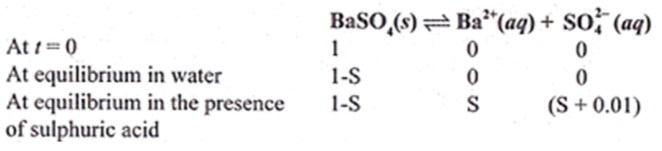
Given solubility of $BaSO _4$ is $8 \times 10^{-4} mol dm ^{-3}$.
Therefore, for $BaSO _4$ in water, $K _{ sp }=\left[ Ba ^{2+}\right]\left[ SO _4^{2-}\right]=(S)(S)=S^2$
$
\therefore K_{s p}=\left(8 \times 10^{-4}\right)^2=64 \times 10^{-8} \ldots(1)
$
The expression for solubility product ( $K _{ sp }$ ) in the presence of sulphuric acid will be as follows:
$
K^{\prime} sp=(S)(S+0.01)\ldots(2)
$
Since the value of $K _{ sp }$ will not change in the presence of sulphuric acid.
Therefore, from (1) and (2), we have,
$
\begin{aligned}
& (S)(S+0.01)=64 \times 10^{-8} \\
& S^2+0.01 S=64 \times 10^{-8} \\
& S^2+0.01 S-64 \times 10^{-8}=0
\end{aligned}
$
$\begin{aligned} & \Rightarrow S=\frac{-0.01 \pm \sqrt{(0.01)^2+\left(4 \times 64 \times 10^{-8}\right)}}{2} \\ & \Rightarrow \frac{-0.01 \pm \sqrt{10^{-4}+\left(256 \times 10^{-8}\right)}}{2} \\ & \Rightarrow \frac{-0.01 \pm \sqrt{1.0256 \times 10^{-4}}}{2} \\ & \Rightarrow \frac{-0.01 \pm 1.0127 \times 10^{-2}}{2} \\ & \Rightarrow \frac{-0.01-1.0127 \times 10^{-2}}{2}, \frac{-0.01+1.0127 \times 10^{-2}}{2} \\ & \Rightarrow-1.006 \times 10^{-2}, 6.35 \times 10^{-5}\end{aligned}$
Concentration can never be negative. Hence required concentration is $6.35 \times 10^{-5} mol dm ^{-3}$

Need a full question paper?

Generate a complete, print-ready paper with questions like this in minutes — across 16+ boards, with answer keys.

Start Generating Free

Similar questions

  1. Define solubility product. Write solubility product expression in terms of molar solubility for $FeCl_3$
  2. What is the effect of temperature on solubility of gases in liquids?
  3. Equilibrium constant for the reaction is $4.0$. What will be the equilibrium constant for the reverse reaction.
  4. Calculate the pH of $10^{-8}M$ HCl solution.
Classify the following substances into oxidising and reducing agents:
  1. Carbon.
  2. Ozone.
  3. Nascent hydrogen.
  4. Nitric acid.
  5. Chlorine.
What will be the work done on an ideal gas enclosed in a cylinder, when it is compressed by a constant external pressure, $p_{ext}$​​​​​​​ in a single step as shown in Fig. Explain graphically.
i. A vessel of $1.00 dm ^3$ capacity contains $16.00$ g of oxygen and $8.00$ g of hydrogen at $17^{\circ} C$. Calculate the partial
ii. According to kinetic molecular theory, explain why gases exert pressure?
iii. How is isotherm at critical temperature of a gas different from those at lower temperatures?
Four moles of $\mathrm{PCl}_5$ are heated in a closed $4 \mathrm{dm}^3(\mathrm{~L})$ container to reach equilibrium at 400 K . At equilibrium $50 \%$ of $\mathrm{PCl}_5$ is dissociated. What is the value of $\mathrm{K}_{\mathrm{c}}$ for the dissociation of $\mathrm{PCl}_5$ into $\mathrm{PCl}_3$ and $\mathrm{Cl}_2$ at 400 K .
What is buffer solution? How many types of buffer solution are there? Explain with examples.
Explain with reasons the increasing order of energy of different orbitals in multielectron atoms.
  1. Calculate the kinetic energy of an electron in second Bohr orbit of hydrogen atom. [$a_0$ is Bohr radius].
  2. Out of the d-orbials which does not have four lobes?
  3. What is physical significance of $\Psi^2?$
Discuss the trend of the following:
The solubility and the nature of oxides, of Group 2 elements.
What is distillation? Explain different types of distillation.