Question
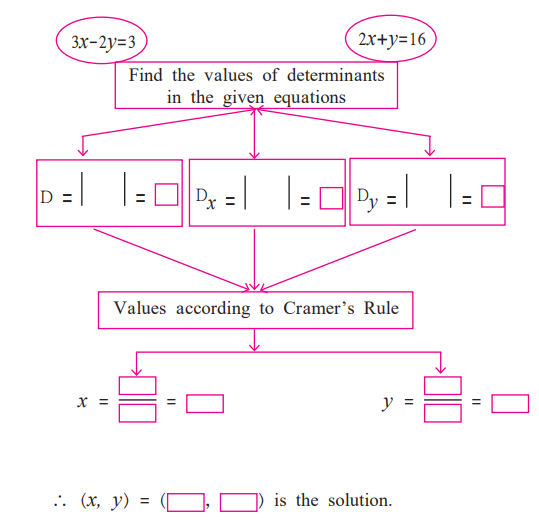
Complete the following activity - 

Image

Answer

Write the coefficient matrix and find D.
$D=\left|\begin{array}{cc}3 & -2 \\ 2 & 1\end{array}\right|=(3 \times 1)-(-2 \times 2)$
$D=3+4=7$
Find $D_x$.
Replace the first column by constants:
$D_x=\left|\begin{array}{cc}3 & -2 \\ 16 & 1\end{array}\right|=(3 \times 1)-(-2 \times 16)$
$D_x=3+32=35$
Find $D_y$.
Replace the second column by constants:
$D_y=\left|\begin{array}{cc}3 & 3 \\ 2 & 16\end{array}\right|=(3 \times 16)-(3 \times 2)$
$D_y=48-6=42$
Find the values of x and y using Cramer’s Rule.
$x=\frac{D_x}{D}=\frac{35}{7}=5$
$y=\frac{D_y}{D}=\frac{42}{7}=6$
$(x, y)=(5,6)$

Need a full question paper?

Generate a complete, print-ready paper with questions like this in minutes — across 16+ boards, with answer keys.
Start Generating Free

Similar questions

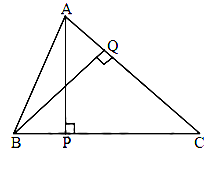
In $\triangle ABC, AP \perp BC$ and $BQ \perp AC, B−P−C, A−Q−C,$ then show that $\triangle CPA \sim \triangle CQB.$ If $AP = 7, BQ = 8, BC = 12,$ then $AC = ?$

In $\triangle C P A$ and $\triangle C Q B$
$\angle C P A \cong[\angle \ldots] \quad \ldots\left[\right.$ each $\left.90^{\circ}\right]$
$\angle A C P \cong[\angle \ldots] \quad \ldots[$ common angle $]$
$\triangle CPA \sim \triangle CQB \quad \ldots . . .[\ldots[\quad$ similarity test $]$
$\frac{ AP }{ BQ }=\frac{[}{\square BC } \quad \ldots . . . .[$ corresponding sides of similar triangles]
$\frac{7}{8}=\frac{[-[]}{12}$
$AC \times[\quad]=7 \times 12$
$A C=10.5$
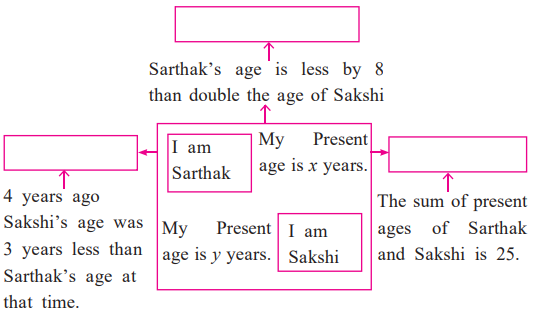
There are some instructions given below. Frame the equations from the information and write them in the blank boxes shown by arrows.

Image
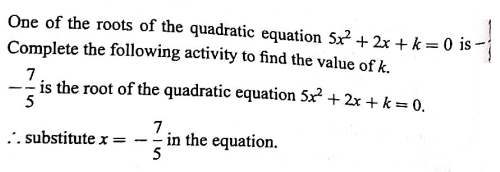
If $x=5$ is a root of equation $\mathrm{kx}^2-14 \mathrm{x}-5=0$, then find the value of $\mathrm{k}$ by completing the following activity.
One of the roots of equation $k x^2-14 x-5=0$ is $\square$.
$\therefore$ Now Let $x=\square$ in the equation.
$ k \square^2-14 \square-5=0$
$\therefore \quad 25 k-70-5=0$
$25 k-\square=0$
$25 k=\square$
$\therefore k=\frac{\square}{\square}=3 $
The prices of different articles and demand for them is shown in the following frequency distribution table. Find the median of the prices.
Solve the following word problems.
A two digit number and the number with digits interchanged add up to 143. In the given number the digit in unit’s place is 3 more than the digit in the ten’s place. Find the original number.
Find the correct answer from the alternatives given.
The persons of O- blood group are 40%. The classification of persons based on blood groups is to be shown by a pie diagram. What should be the measures of angle for the persons of O- blood group?
 
Image
Image
If the point $P (6,7)$ divides the segment joining $A (8,9)$ and $B (1,2)$ in some ratio, find that ratio
Solution:
Point $P$ divides segment $A B$ in the ratio $m$ : $n$.
$A(8,9)=\left(x_1, y_1\right), B(1,2)=\left(x_2, y_2\right) \text { and } P(6,7)=(x, y)$
Using Section formula of internal division,
$ \therefore 7=\frac{m(\square)-n(9)}{m+n}$
$\therefore 7 m+7 n=\square+9 n$
$\therefore 7 m-\square=9 n-\square$
$\therefore \square=2 n$
$\therefore \frac{m}{n}=\square $
In the following table, the toll paid by drivers and the number of vehicles is shown. Find the mean of the toll by 'assumed mean' method.
$\tan ^2 \theta-\sin ^2 \theta=\tan ^2 \theta \times \sin ^2 \theta$. For proof of this complete the activity given below.
Activity:
L.H.S = $\square$
$ =\square\left(1-\frac{\sin ^2 \theta}{\tan ^2 \theta}\right)$
$=\tan ^2 \theta\left(1-\frac{\square}{\frac{\sin ^2 \theta}{\cos ^2 \theta}}\right)$
$=\tan ^2 \theta\left(1-\frac{\sin ^2 \theta}{1} \times \frac{\cos ^2 \theta}{\square}\right)$
$=\tan ^2 \theta(1-\square)$
$=\tan ^2 \theta \times \square \quad \ldots . .\left[1-\cos ^2 \theta=\sin ^2 \theta\right]$
$=\text { R.H.S } $